Urashima Taro saved a turtle, was taken to the Dragon Palace under the sea, and came back home to find everyone he knew was dead. Then he opened the box.
Mythwink
Urashima Taro
He was gone for three days. Three hundred years had passed.
Urashima Taro saved a turtle, was taken to the Dragon Palace under the sea, and came back home to find everyone he knew was dead. Then he opened the box.
Mythwink
He was gone for three days. Three hundred years had passed.
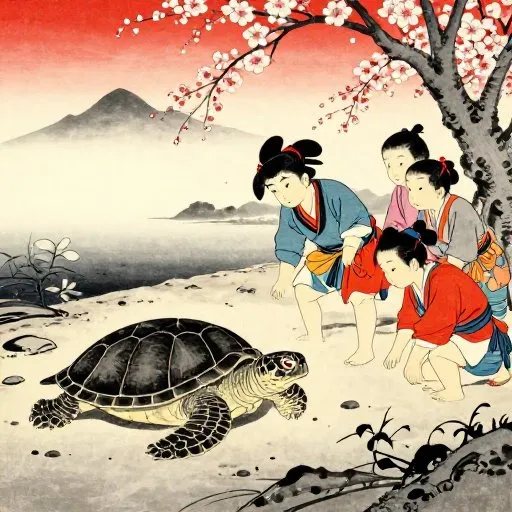
The other children were hurting the turtle.
Urashima Taro saw it on the beach, a small sea turtle surrounded by a group of boys who had decided this was a reasonable way to spend an afternoon. He told them to stop. They did not stop. He paid them from his own pocket. They took the money and went elsewhere, and Urashima Taro stayed with the turtle until it recovered and then helped it back to the sea.
He was a young fisherman. He worked on the coast of Tango Province, the region in what is now northern Kyoto Prefecture on the Sea of Japan side. He lived with his elderly parents. His life was ordinary and decent and he had done a kind thing for a creature that could not defend itself.
The next day, the turtle came back.
It came to the surface of the sea near his boat while he was fishing and it spoke to him. It said he had saved its life and it would like to show him something in return. It told him to climb on its back. It would take him somewhere that could not be found any other way.
He climbed onto the turtle's back.
They dove.
The sea closed over them and they went down, the light changing from the bright green shallows to the deep cold blue and then further, into the dark and through it, until ahead of them lights appeared. A gate. Then walls. Then a palace more beautiful than anything on the surface of the earth, with towers of coral and floors of mother-of-pearl and fish moving through the rooms like citizens. This was Ryugu-jo. The Dragon Palace. The undersea castle of Ryujin, the Dragon King, ruler of the sea.
The turtle who had been a turtle became a young woman. She told him her name was Otohime, the sea princess, and that she had been the turtle on the beach, and that she was glad he had saved her life.
She brought him inside.
The Dragon Palace was not a brief visit.
Otohime showed him everything. The rooms where each direction's seasons were kept, the east room always in spring and the north always in winter, all four seasons accessible simultaneously in a palace that had no single weather. She showed him the deep chambers where the ocean managed itself, the current rooms, the tide rooms, the places where the sea's own administration happened. She fed him food he had never tasted. She introduced him to the fish who were the palace's courtiers, and they were gracious and welcoming.
They talked. They walked the coral gardens. The days passed.
After three days, Urashima Taro felt something shift in him. A pull. He thought of his parents, waiting at home, wondering where he had gone. He thought of the boat pulled up on the beach at Tango. He told Otohime he needed to go back.
She did not argue. She said she understood. She said she wished he would stay, and the way she said it suggested she meant it, but she was not going to keep him against his will.
She gave him a box.
The box was called the tamate-bako. The treasure chest, or the jewel-box, or the box of many treasures: the name can be translated different ways. She held it out to him and told him it was a gift and that it was very important. She told him the condition. Under no circumstances, in no situation, for no reason whatsoever, was he ever to open it.
He took the box. He promised.
The turtle, who was Otohime again, or perhaps Otohime who was also the turtle, took him back to the surface and to the shore.
He stepped onto the beach at Tango and the turtle disappeared into the sea.
Nothing was the same.
The beach was familiar. The shape of the coastline, the particular way the land met the sea, these had not changed. But the village was different. The houses were not the houses he knew. The people walking the paths were not the people he knew. He looked for his parents' home. He found a house on the same plot of ground but it was the wrong house, or an old house rebuilt, or a different house entirely on the same land.
He asked an old man who he was and where the family of Urashima Taro had gone.
The old man thought about it and said he had heard the name. He said it was the name of a fisherman who had gone out on the sea and never come back, three hundred years ago. There was a story about it. He had simply vanished. His parents had waited for him and died waiting, a long time ago.
Three hundred years.
He had been in the Dragon Palace for three days. He had come home and three hundred years had passed. Everyone he had ever known was dead. His parents, his neighbors, the children who had been hurting the turtle on the beach and who had taken his money and run away. All of them had been born and grown old and died while he was eating sea-palace food and walking through a room where all four seasons existed simultaneously.
He walked back to the beach.
He did not know what to do. There was nothing to do. He stood at the edge of the water with the tamate-bako in his hands and three hundred years of loss around him and the sea in front of him, and he held the box.
He had promised not to open it.
Think about the weight of that promise. Otohime had been very clear. He had agreed. He was holding the last thing anyone who had known him had given him. The last connection. Every other connection had been severed by three hundred years.
He opened the box.
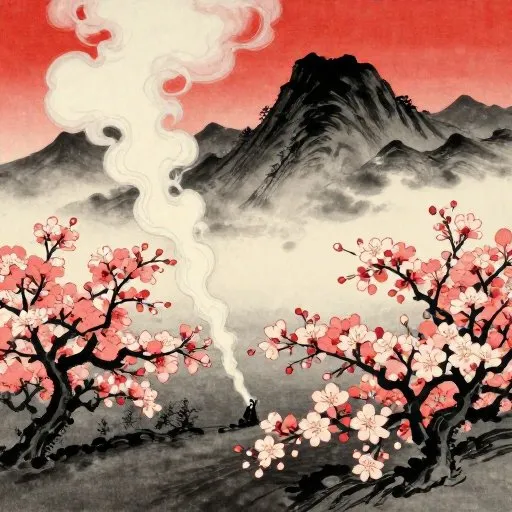
White smoke came out.
That's it. That is what was in the box. White smoke, which drifted up and away from the tamate-bako and was gone on the sea wind.
And as the smoke dissipated, Urashima Taro aged. Three hundred years of age, all at once, the years he had not lived catching up to him in a single breath. His hair turned white. His face became ancient. His back bent. His hands became the hands of an old man.
He fell and he died on the beach.
The Japanese versions of this story vary. Some end here. Some have him transformed into a crane, which in Japanese iconography represents longevity and good luck, which is either ironic or merciful depending on how you read it. Some have him turning to dust entirely. The core of the story does not change: he opened the box, and the box contained what it always contained, and he could not survive it.
The tamate-bako has been interpreted many ways by scholars and storytellers. The smoke as his years, preserved by Otohime so that he could stay young in the Dragon Palace, released when he broke the promise. The box as the vessel of his mortality, which could only be kept intact as long as he followed the one rule. The smoke as the past itself, uncontainable once you try to hold it.
What it feels like, reading it, is simpler than any of those interpretations. He was given a gift with one condition. He broke the condition. Not out of malice, not out of stupidity, but out of grief and confusion and the need to do something with his hands while he stood on a beach where everyone was dead. The punishment is completely disproportionate to the failure. That is also true. That is the thing about this story that has stayed with people for over a thousand years.
Urashima Taro is recorded in the Man'yoshu, Japan's oldest anthology of poetry, compiled around 759 CE. The entry is brief but the story is clearly already an established tale by the time it is mentioned. The fuller narrative version appears in the Nihon Shoki (720 CE) and later in the Tango no Kuni Fudoki, a regional geography and legend collection from the Tango Province, which is where the story is set.
The Tango Province records are specific. They name the village. They describe the coastline. Urashima Jinja, a shrine dedicated to Urashima Taro, exists today in Kyoto Prefecture and claims a connection to the historical figure or tradition behind the myth. The tamate-bako is said to be enshrined there. The box is still there.
The turtle rescue framing is important. This is a story about cause and effect. He did a good thing. The good thing led to a wonderful experience. And the wonderful experience led to the worst possible ending. The story does not say he was wrong to save the turtle. It does not say he was foolish to go to the Dragon Palace. It holds all of it. You can do the right thing and the right thing can take you somewhere remarkable and you can still come back to find that everyone is dead and that the last gift you were given was the thing that finished you.
Japanese folklore is full of these structures. The reward that costs more than you knew. The gift with the condition that cannot be met. The story does not resolve into a lesson, exactly. It resolves into an experience. You are supposed to feel the weight of it.
He was a good fisherman who saved a turtle. He was taken somewhere extraordinary. He came back.
The three days were not three days.
He opened the box because he was standing alone on a beach where everyone he had ever known was dead, and the box was the last thing he had, and he opened it.
The smoke went out over the sea.
Get on the list before the myths do.
New retellings from world mythology, gods behaving badly included. This list is just starting, so nothing has gone out yet, only a place in line.
Nothing has been sent from this list yet. You'll be among the first to hear once new myths start going out, and you can leave anytime.