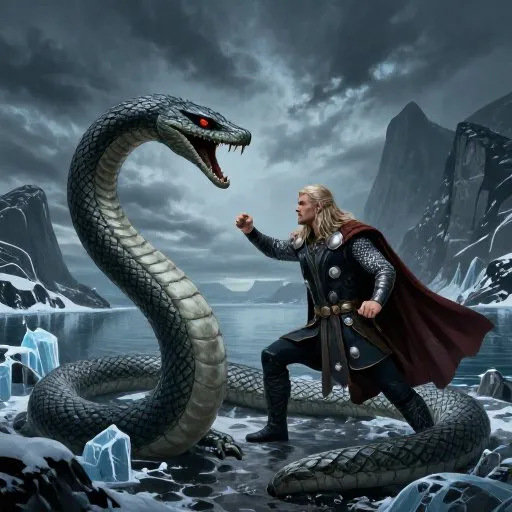
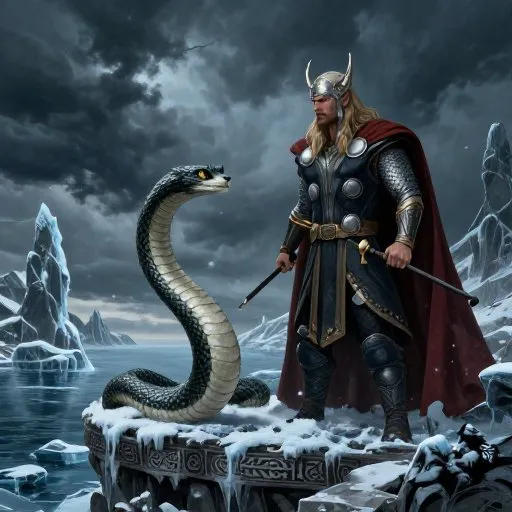
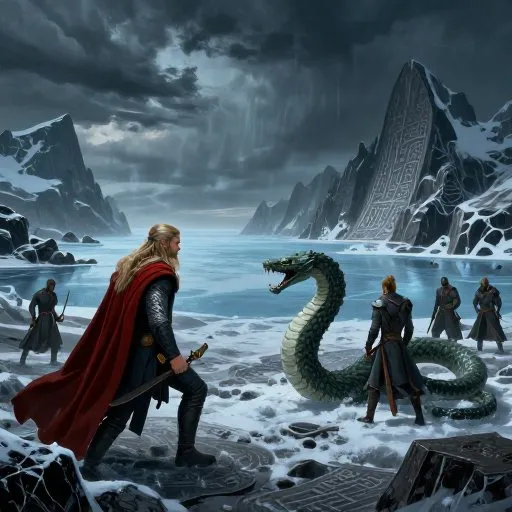
The Norse myth of Thor vs. Jormungandr: the fishing trip that nearly ended the world, a cat that wasn't a cat, and why their final meeting was always going to end the same way.
Mythwink
Thor spent half his life trying to kill a snake. The snake disagreed.
The giant Hymir did not want to go fishing with Thor. This is understandable. Thor had come to him uninvited, eaten two of his oxen for dinner, and now needed a rowing partner and bait and the use of a boat and, by the way, could Hymir provide the bait? The giant said fine, go cut your own bait. Thor walked into the pasture and came back with the head of Hymir's largest ox, Himinhrjot. The best ox. The prized one. The head, specifically, because Thor had already decided what he was going to use it for and he didn't need the rest.
Hymir was not pleased. But there is something about Thor that makes refusal feel like additional effort, so they got in the boat.
The Hymiskvida, the poem in the Poetic Edda that tells this story, describes Hymir as one of the strongest and most ancient giants in existence. He had three hundred heads once, in an earlier episode, though the poem doesn't dwell on this. He was also, by this point in the story, deeply tired of his guest. They rowed out to where Hymir usually fished. Hymir caught two whales, which is a solid day's work by any measure. Thor wanted to go further.
Hymir said it was far enough. They were in good water. They had fish. Reasonable men would go home.
Thor was not interested in reasonable. He started rowing again. Hymir sat in the bow in the private agony of a man who knows this is going to become a story someone tells about him for a thousand years, none of it flattering.
They rowed out past the edge of the safe world, past the places where the fish are normal-sized and the water does what water is supposed to do, into the region where Jormungandr lived.
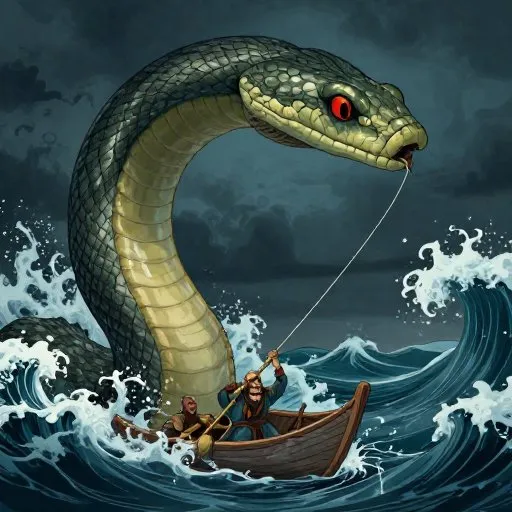
Thor baited his hook with the ox head and dropped it into the sea.
Jormungandr, the Midgard Serpent. Child of Loki, sibling of Fenrir, sibling of Hel. The Prose Edda describes how Odin, wary of Loki's offspring from the very beginning, had each one dealt with: Hel he sent to rule the realm of the dead, Fenrir he had bound with the ribbon no force could break, and Jormungandr he threw into the ocean that surrounds Midgard, the world of humans.
That was the solution. Throw it in the ocean.
It grew. It grew until it encircled the entire world. It grew until it could bite its own tail, holding the whole of Midgard in a ring. Odin had thrown a problem into the sea and the problem had become the border of reality. This is how Norse mythology handles most containment strategies.
The ox head sank. The serpent was at the bottom, as it always was, coiled under the ocean floor, the weight of all that water above it. The bait reached it. It took the hook.
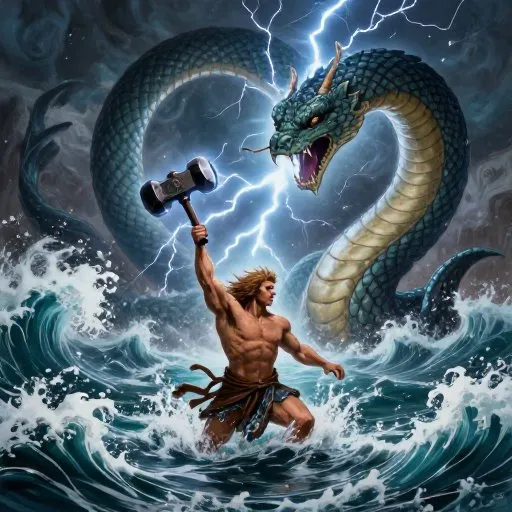
What Thor felt in his hands when Jormungandr bit down was the pull of something that was not a fish. Was not an animal in the ordinary sense. Was the weight of the world, specifically, attached to a line he was holding. He braced himself against the boat. The Hymiskvida describes his feet going through the hull of the boat and to the seabed. He was standing on the ocean floor, thigh-deep in water, pulling with both hands against a thing that had the entire circumference of Midgard behind it.
He pulled. It came up. Slowly. Then faster.
The serpent's head broke the surface. They looked at each other.
The Poetic Edda does not waste words on this moment. It does not describe Jormungandr's appearance in decorative detail. It reports the fact: Thor raised his hammer. He was going to end this, right now, on this boat, with this hammer. Every time they met was always going to come to this. He raised Mjolnir.
Hymir cut the line.
There is a version of this story where Hymir's action is cowardice. There is another version where it is the only sane response to being in a small boat on the open ocean while two beings of enormous destructive power face each other six feet away.
The Hymiskvida does not specify Hymir's internal state. It only says he cut the line. The serpent sank back into the sea. Thor threw his hammer at it, and it went into the deep, and nobody knows if it struck or missed. Then Thor hit Hymir hard enough to knock him into the water.
That's the end of the fishing trip.
Thor went home. The World Serpent went back to the bottom, where it had been since Odin threw it there, and it went back to holding its tail in its mouth, and the world stayed where it was, and Ragnarok was postponed. Because one giant, in one moment of practical terror, cut a line.
Think about what that means. The final battle between Thor and Jormungandr was scheduled for Ragnarok. It was prophesied. Both of them knew it was coming. They had looked at each other across six feet of open ocean and they both knew. But the moment wasn't right yet. The moment wasn't Vigrid, wasn't the end of everything, wasn't after Fimbulwinter and the wolves catching the sun and the dead sailing in from the sea. It was a fishing boat and a giant with a knife and an imperfect moment.
And so the serpent went back to the bottom, and Thor went home to Asgard, and they both waited for the right time.
This is what the Norse believed about fate: not that it happened automatically, but that it happened at the right time, and that the world between now and then had to fill out properly. Hymir's panic was part of the design. The near-miss was part of the design. The hammer thrown into the deep where nobody could confirm it landed was part of the design. The story was not over. It was on hold.
There is a second story about Jormungandr and Thor, and it is somehow stranger than the first.
Thor traveled to Utgard, the stronghold of the giant king Utgard-Loki. This is a different Loki. The name means roughly "Loki of the Outer Enclosure." He was the king of the giants who existed past the borders of the known world, and he entertained Thor's visit with a series of challenges.
The challenges, all of them, turned out to be tricks. Utgard-Loki's stronghold ran on illusion. What appeared to be one thing was another. What appeared to be a reasonable contest was something else entirely.
One of the challenges was to lift a cat. A large grey cat that lived in the hall. Thor grabbed it and pulled. He got one paw off the ground. He pulled harder. Two paws. He strained with everything he had, with the full strength of Thor, the god who killed giants before breakfast, and he got the cat's body curved in an arch with all four paws dangling and the spine bowed outward, and then he could not lift it further.
One paw off the ground. That is all he managed.
The giants in the hall laughed.
After Thor left, Utgard-Loki told him the truth. The cat was Jormungandr. The World Serpent, coiled around the entire world, disguised as a cat. When Thor lifted its body, he bent the serpent that encircled all of Midgard. He moved the border of reality. That one paw off the ground had terrified the watching giants because they understood what they were looking at: a being strong enough to partly lift the thing that holds the world in its shape.
One paw. The giants laughed, and later went pale when they understood.
And Thor, who had nearly killed the serpent on a fishing boat and had lifted it in disguise in a great hall, went home having still not finished the job. The job would wait until Ragnarok. It always waited until Ragnarok.
At Ragnarok, on the field of Vigrid, they met for the last time.
Everything that had been building since the beginning of the Norse world, Jormungandr's birth, the fishing trip, the cat in the hall, the bond broken and the serpent rising from the ocean with the flood behind it, came to this. Thor with his hammer. Jormungandr with its venom. All the rehearsals, the boat, the hall, the near-kill and the tricks and the postponements, were over.
Thor killed it. That much is certain. He struck it with Mjolnir and the serpent died. The Prose Edda is plain about this.
Then he took nine steps and fell.
The venom had been in the air around them, and no amount of strength addresses venom. Thor, who could not be defeated in any contest of force, who had held the line against the weight of the world on a boat in the deep sea, who had bent the border of Midgard with his bare hands, died of poison. Nine steps. He counted out nine steps from the serpent's body and then he was gone.
There are fights you win and die from anyway. The Norse understood this as well as anyone.
What stays with you about Thor and Jormungandr is not the ending. It's the catalogue before it. The fishing trip where Hymir cut the line. The cat in the hall with its one paw off the floor. Every time they almost finished it and didn't. Every time the moment was wrong or someone panicked or the serpent sank back into the dark. The Norse built a mythology of preparation for the inevitable, and Thor and Jormungandr are the clearest example. They were always going to kill each other. The stories told between their first meeting and their last are what makes the last meeting matter.
When he stood on the ocean floor with the line in his hands and the serpent's head breaking the surface and Mjolnir raised, that moment was real. He was ready. The serpent was ready. And then a frightened giant with a knife made them wait a little longer.
Fate in Norse mythology does not mean the future is easy. It means the future is coming and what you do before it arrives is what you are. Thor went fishing again and again. He lifted the cat. He went to Vigrid knowing the venom was part of the deal.
He took nine steps. He made sure they could count them.