← All Stories

The Greek myth of Theseus, the Minotaur, and the Labyrinth. He slew the beast and sailed home. Then his father jumped off a cliff. The full story, told properly.

Theseus and the Minotaur

Mythwink

Theseus and the Minotaur

He killed the monster, saved the city, and forgot to change his sails. Fourteen people died for this man.

1The Invoice

Chapter 1: The Invoice

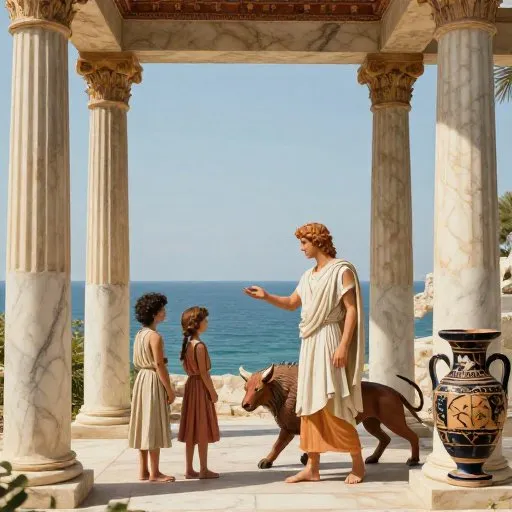
Every year, Athens paid Crete in children.

Not metaphorically. Not as a concept. Fourteen Athenian young people, seven boys and seven girls, were loaded onto a ship with black sails, sailed to the island of Crete, and handed over to King Minos. Then the ship came back empty. This had been happening for either nine years in one cycle or multiple cycles depending on your source. Diodorus Siculus says this. Plutarch, writing in his Life of Theseus, says this. The Athenians had lost a war to Minos, and this was the debt.

Minos had a problem. His problem was specifically located in a maze underneath his palace.

Here is how the problem started: Poseidon had given Minos a white bull, sacred and magnificent, specifically so that Minos could sacrifice it to him. This was a transaction. The bull was not a gift. It was an instrument of worship and Minos was supposed to use it for that. Minos saw the bull, thought it was too beautiful to kill, and substituted a lesser animal for the sacrifice. He kept the white bull. He thought Poseidon wouldn't notice.

Poseidon noticed.

The punishment was this: Minos's wife Pasiphae, queen of Crete, became consumed with an unnatural desire for the white bull. You can read the word "unnatural" and supply the rest. Minos, in desperation, called in Daedalus. The inventor. The greatest craftsman in the known world. He asked Daedalus to solve the problem. Daedalus built a wooden cow, hollow, covered in genuine hide, anatomically functional. Pasiphae got inside it. The white bull did not notice the difference.

Nine months later, Pasiphae gave birth to a child. The child had the body of a man and the head of a bull. His name was Asterion, but everyone called him the Minotaur. The Bull of Minos.

Minos could not kill it. It was his wife's child, which made it complicated in ways that law and custom had not prepared anyone for. He also could not let it wander around Crete eating people, which it would do because it ate people. That was a thing it did. So he called Daedalus again.

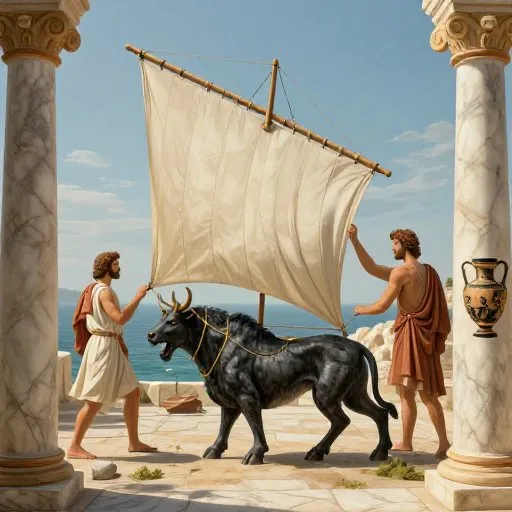
Daedalus built the Labyrinth. A structure so complex that Daedalus himself, its architect, could only barely find his way out. They put the Minotaur inside. They put the Athenian tribute inside. That's what the fourteen young people were for. They were the food supply. Every nine years, Crete sent an invoice, and Athens paid in people, and the Minotaur ate them in the dark.

This had been the arrangement for long enough that it was simply the arrangement. The way things were. The thing nobody did anything about.

Until Theseus decided to do something about it.
2The Volunteer

Chapter 2: The Volunteer

Theseus was the son of Aegeus, king of Athens, though the mythology can't quite decide if that's the full story. Poseidon also claimed paternity. His mother Aethra had encounters with both Aegeus and Poseidon in some versions, and Theseus ended up with semi-divine strength that a purely mortal king of Athens might not pass on. The Greeks told these stories about their heroes the way some families tell stories about an ancestor who was probably not as remarkable as the legend, but nobody's going to be the one to say it.

His father Aegeus had left a sword and a pair of sandals under a great rock when Theseus was a baby, with instructions: when the boy can lift the rock, give him the sword and sandals and send him to Athens. Theseus found the rock when he was sixteen. He lifted it, took the items, and walked to Athens the hard way, clearing the road of bandits and monsters. Not because it was safer than sailing. It wasn't. He did it because he wanted to prove something.

This is character information. Theseus was not someone who took the easy path when a harder path was available to demonstrate something. Keep this in mind.

When the third tribute was being gathered, Theseus was in Athens and he watched the fourteen young people chosen by lot, watched their families, watched his father's face, and volunteered. He would go. He would go to Crete with the tribute and he would kill the Minotaur and he would come back.

His father did not want him to go. Aegeus was old and Theseus was his heir, possibly his only real claim on a future. He argued. But you cannot tell a person who walked to Athens fighting monsters specifically to demonstrate his capability that he should not go fight a monster. The math doesn't work.

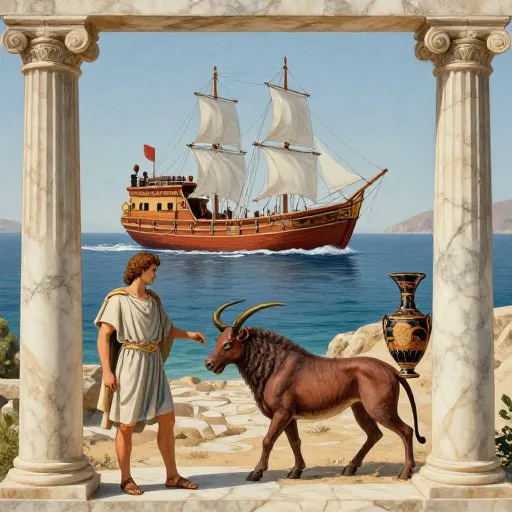
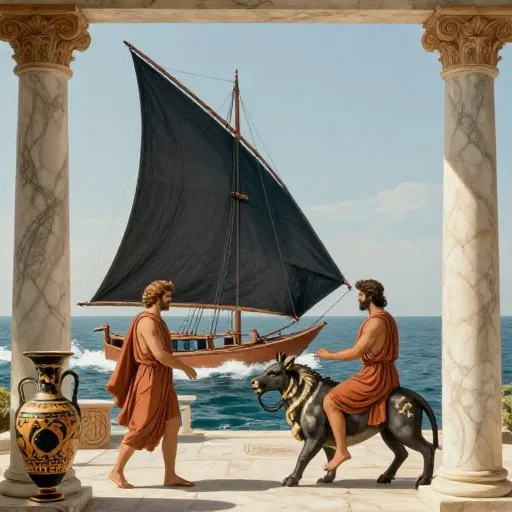
They made an agreement. The tribute ships sailed with black sails, the color of mourning. If Theseus succeeded, he would change the sails to white before the ship came in sight of land. Aegeus would watch from the cliffs. White sails meant his son was alive. Black sails meant he was not.

The ship sailed. The sails were black.

3Ariadne's Thread

Chapter 3: Ariadne's Thread

Theseus arrived at Crete with thirteen other Athenians and nothing resembling a plan beyond "kill the Minotaur." Which is not a plan. That is a goal. Plans have steps.

The steps came from Ariadne.

Ariadne was the daughter of Minos and Pasiphae, which made her the Minotaur's half-sister, which was one of several uncomfortable family dynamics in this particular household. She saw Theseus at the harbor. She was, the sources say, immediately and completely taken with him. Ovid renders her account of it in the Heroides, which is a collection of letters written in the voices of mythological women to the men who wronged them. We'll come back to that. The short version is: she decided to help him.

She went to Daedalus. He had built the Labyrinth and he knew how to get out of it. He told her about the thread. If Theseus tied one end to the entrance and kept hold of it as he walked in, he could follow it back out. He wouldn't need a map. He wouldn't need to understand the structure. He just needed to not let go.

Ariadne brought Theseus the ball of thread that night. She told him what Daedalus had said. She also, in several versions, gave him a sword, though he had his own. She helped him because she loved him, or thought she did, or had decided to, which is not exactly the same thing.

In exchange, Theseus promised to take her with him when he left. To marry her. He promised, the sources are clear on this. It was not ambiguous. She helped him knowing she could not go back to life in Minos's palace after this, and he told her she would not have to.

He went in the next day with the thread tied to the door.

The Labyrinth was built to confuse. Not just to complicate the route but to disorient, to make the mind lose track of itself. High walls, repeating patterns, dead ends that looked like the same dead ends from before. The Minotaur in some accounts roamed constantly; in others it slept at the center. Either way, you couldn't hear it clearly until you were close, and by then the question was who moved first.

Theseus moved first. The fight is not described in detail in the oldest sources, which is true of a surprising number of the most significant moments in Greek mythology. What matters is the end of it. The Minotaur died. Theseus followed the thread back to the entrance. Ariadne was waiting.

The fourteen Athenians were alive. They left that night, taking Ariadne with them, before Minos understood what had happened.

4Naxos

Chapter 4: Naxos

The ship stopped at the island of Naxos.

Why Naxos? The sources offer three explanations, and none of them are particularly good. Plutarch mentions that some accounts say Theseus left Ariadne because he loved someone else. Others say the goddess Athena or Dionysus appeared and told him to leave her there, that Ariadne belonged to Dionysus and Theseus had to let her go. Others say she was simply abandoned because Theseus had the character of a man who made promises and then found them inconvenient.

Ariadne woke up alone on a beach. The ship was gone.

Ovid's Heroides Letter 10 is Ariadne's letter to Theseus, and it is one of the most quietly devastating pieces of ancient writing about betrayal. She describes waking up. Looking for him. Going to the cliff to watch the ship disappear. She is not dramatic. She does not curse him. She lists, methodically, what she did for him and what he did in return. I showed you the Labyrinth. I gave you the thread. I left my family, my home, everything. And you left me on a beach while I slept.

Dionysus found her. He married her. She became a goddess, or immortal, or at least well cared for, depending on which source you read. Whether this counts as a happy ending for Ariadne is a question the ancient world debated and never fully settled. She survived. She was fine. Theseus had promised her something and given her something else. The difference between those two things is the whole story.

Meanwhile, Theseus was sailing home. Toward Athens. Toward his father, who was sitting on the cliffs above Cape Sounion watching the horizon for sails. Who had been watching the horizon since the ship left.

The arrangement was clear. White sails if the hero lived. Black sails if he didn't.

Theseus forgot to change the sails.

You can offer explanations. Grief over what he'd done to Ariadne. Distraction. The ordinary human failure of carrying a terrible responsibility and then dropping it just before the finish line. The ancient sources don't offer a reason. Plutarch just says he forgot. The sails stayed black.

5The Sea of His Father

Chapter 5: The Sea of His Father

Aegeus saw the black sails.

He had been watching the cliffs at Sounion since the ship disappeared, or some version of that vigil, and now the ship was coming in and the sails were black and his son was dead. That is what the black sails meant. That was the entire agreement. White if he lived. Black if he didn't. The sails were black.

He jumped from the cliff into the sea.

It is a short scene in every version. There is no speech. There is no long goodbye. The sea received him and the sea was afterward named for him, the Aegean, and Theseus's ship came into port with its living hero and its black sails and without a king to welcome it.

Theseus had killed the Minotaur. He had ended the tribute. Athens would never send its young people to Crete again. That is not small. That is, by any measure, the main thing. The fourteen people who came home alive would not have come home without him. The future people who would never have to be loaded onto a black-sailed ship would never have to be loaded onto a black-sailed ship.

And his father was dead because he forgot.

Greek mythology does this thing constantly. The hero succeeds. The thing he set out to do gets done. The world is measurably better because of what he accomplished. And then something small, something entirely preventable, something that required nothing but the most ordinary kind of care, goes wrong. And the cost is specific and real and falls on someone who had no part in any of it.

Theseus became king of Athens. He became one of the greatest heroes in the Greek tradition. He founded institutions. He unified Attica. He was celebrated for centuries.

He also forgot to change the sails.

Both of those things are true. And the Greeks kept both of them in the story, which says something about how they understood heroes. You don't have to be careless in large ways to destroy something. The large things, the brave things, those Theseus could do. It was the small obvious thing that broke. It is always the small obvious thing.

The Aegean Sea still has his father's name. Every ship that sails it sails across the grief of a man on a cliff who saw black sails and believed what they told him.

Mythology Notes