← All Stories

The Egyptian afterlife judgment: your heart weighed against a feather, 42 confessions to make, and a creature that's part crocodile, part lion, part hippo waiting for the result.

The Weighing of the Heart

Mythwink

The Weighing of the Heart

You spent your whole life earning this moment. Try not to think about the crocodile.

1The Feather

Chapter 1: The Feather

You die.

This is not the end of the story. For an ancient Egyptian, death was not a door slamming shut. It was a door opening onto something very specific, very procedural, and very well-documented. The Egyptians were the most bureaucratic civilization in the ancient world. Of course they had paperwork for the afterlife.

Here is what happens. Your soul, the part of you the Egyptians called the ba, detaches from your body. You are now in the Duat, the Egyptian underworld. It is not nothing. It is not void. It is a landscape with rivers and gates and guardians and a very long hall at the end of it, and you need to navigate all of it before anyone makes a decision about where you go next.

At the end of the hall, you will find a scale.

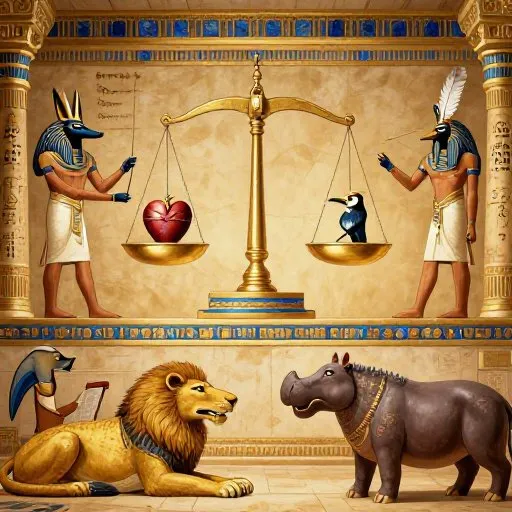
On one side of the scale sits Ma'at's feather. Ma'at is the principle of truth, justice, and right order. She is both a goddess and an abstract force. The Egyptians did not always separate those things. She is depicted as a woman with an ostrich feather in her hair, and that feather is the measure of everything. It is exactly as light as a human life ought to be if you lived it well.

Your heart goes on the other side.

Your heart. Not a symbol of your heart, not a representation of your heart. Your actual heart, which is why the embalmers who prepared your body for burial were very careful with it, and why the heart was the one organ that stayed inside the mummy while everything else got removed and put in jars. It needed to be there for this. It was the record. Every feeling you had, every choice you made, every lie you told, every cruelty you committed, every kindness too. The Egyptians believed all of it was written inside you. The scale would read it.

If your heart balanced the feather, if your life had the weight of a life lived in accordance with Ma'at, you went to the Field of Reeds. The Egyptians called it Aaru. It looked like Egypt, but better. The crops were always full. The river always flowed. You were with your family. You had work to do, because the Egyptians genuinely enjoyed productive work and could not imagine paradise without it.

If your heart was heavier than the feather, Ammit was waiting.
2The Monster at the Scale

Chapter 2: The Monster at the Scale

Nobody designed Ammit by accident.

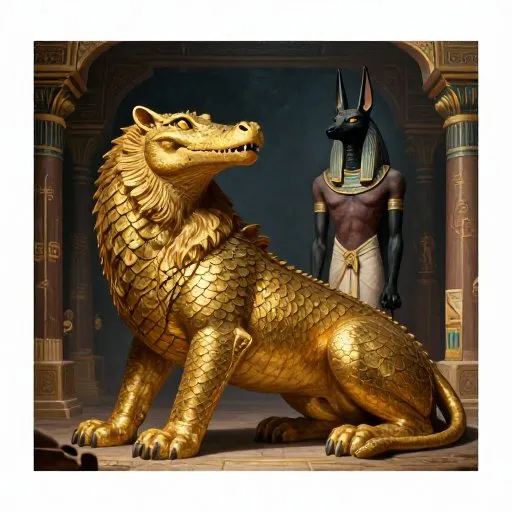
She is part crocodile from the head to the shoulders. Her forequarters are lion. Her hindquarters are hippopotamus. She sits beside the scale, always, waiting. She has one job and she does it with complete commitment. If your heart fails the weighing, she eats it.

Think about what the Egyptians were afraid of. Crocodiles killed people in the Nile. Lions killed people in the desert. Hippos killed more people than both of them combined. The ancient Egyptians lost more lives to hippopotamus attacks than to any other large animal. They knew exactly how terrifying a hippo was. They had watched them. They had lost people to them.

Ammit was built out of the three things most likely to kill you.

And if she ate your heart, you ceased to exist. Completely. This is important: it was not punishment in the sense of pain or suffering. It was annihilation. The Egyptians called this the second death, and it was the thing they feared most, more than ordinary dying. To die was to transition. To be eaten by Ammit was to stop. No afterlife. No Field of Reeds. No reunion with your family. Just nothing, permanently, and even the nothing wouldn't be there to experience.

She sat and she waited and she was very patient, because the dead came continuously.

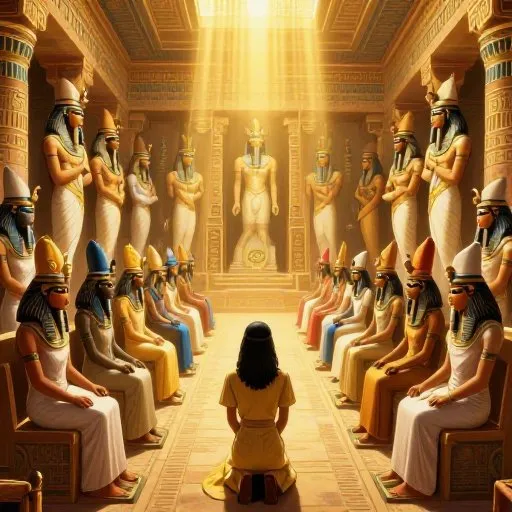
The gods staffed the Hall of Two Truths. Anubis, the jackal-headed god, conducted the weighing itself. He placed your heart on the scale and balanced it against the feather with the care of a craftsman who understood the weight of what he was doing. Thoth, the god of writing and knowledge and wisdom, stood to one side with a reed pen and a papyrus scroll and wrote down the result. The outcome was recorded. Heaven was also a bureaucracy. Of course it was. These were Egyptians.

Forty-two assessor gods sat in the hall to witness. One for each of the forty-two nomes, the administrative districts of Egypt. Everyone had a representative present. This was not informal. This was the most important legal proceeding in the universe and it was conducted with corresponding rigor.

3The Forty-Two Confessions

Chapter 3: The Forty-Two Confessions

Before the heart touched the scale, you had to speak.

The Egyptians called these the Negative Confessions. Forty-two statements, addressed to each assessor god in turn, each one beginning with "I have not." I have not stolen. I have not killed. I have not told lies. I have not cheated in trade. I have not caused pain. I have not been violent. I have not been greedy.

They go on. Forty-two of them. You recited each to the appropriate god by name. There were gods in charge of specific moral failures. Neha-hau, who presided over anger. Uatch-rekhit, who presided over arrogance. Qerrti, who presided over speaking against the king. Each one listening for the confession that applied to them.

There was also a practical dimension to this. The confession was partly a legal declaration and partly a magical act. The Egyptians believed that speaking something correctly and in the right place and time had real power. You were not just saying you had not sinned. You were, in the speaking of it, presenting yourself as someone who had not. The words were doing work.

You want to know what was on the list? There is a translation of the complete Negative Confessions in the Book of the Dead. You can read it today. Some of the confessions are exactly what you would expect. Murder. Theft. Adultery. Lying. But some of them are specific in a way that tells you about the society that created them. I have not cut off the water supply. I have not snared birds in the sanctuary of the gods. I have not fouled the water. I have not been overly loud. I have not increased the size of the grain measure for my own advantage.

Someone had to have done those things badly enough that the priests decided they needed to be on the list.

The Egyptians, it turns out, had the same problems every civilization has. The theology was elaborate and the afterlife was cosmic in scale, but underneath it all they were worried about the same things people have always been worried about. The man cheating with the grain scale. The man stealing water. The man who talked too loud. It turns out the checklist of human failings is fairly consistent across five thousand years and the gods change but the problems don't.

4The Book of the Dead

Chapter 4: The Book of the Dead

The whole system had a guidebook.

The Egyptians called it the Book of Coming Forth by Day. Scholars call it the Book of the Dead, and the name stuck because it is, admittedly, more memorable. It is not one text. It is a collection of spells, prayers, and instructions that developed over more than fifteen hundred years. Different versions for different periods. Different versions for different budgets.

Yes. Budgets.

A complete Book of the Dead, personalized with your name and illustrated with full-color vignettes of your soul navigating the Duat, was expensive. Very expensive. It was the province of pharaohs and high priests and wealthy officials who could afford to have scribes spend months on their personalized afterlife manual. Everybody else got what they could afford. A few spells written on papyrus scraps. Passages inscribed on coffin walls. The critical minimum. Spell 125, the declaration before Osiris and the weighing, was essential. You needed that one. Everything else was negotiable depending on your means.

Think about what that meant. The priests and scribes of ancient Egypt were, in a very real sense, selling insurance for the afterlife. You paid for the words that would protect your soul. The more you paid, the more comprehensive your protection. The poorest Egyptians went into death with whatever their family could afford to inscribe for them.

The Book of the Dead also contained practical guidance for the weighing itself. There were spells specifically designed to address your heart. Spell 30, the heart scarab spell, was placed directly on the mummy's chest over the heart. It addressed the heart directly and instructed it not to speak against the deceased. Not to contradict the Negative Confessions. To behave itself.

The Egyptians were thorough. They left nothing to chance if they could help it. You don't build a spell to tell your own heart to stay quiet unless you know very well that the heart has things it might say.

5The Field of Reeds

Chapter 5: The Field of Reeds

If you passed, you went to Aaru.

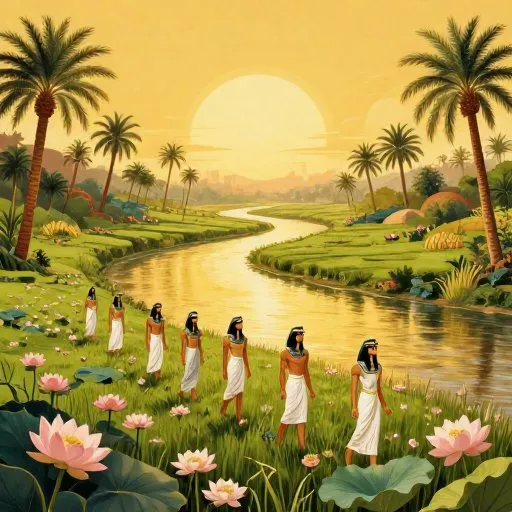
The Field of Reeds was not vague. The Egyptians were not vague about anything they considered important. Aaru was specific. It looked like the Nile valley during the inundation season, when the flood receded and left behind the black fertile silt and everything grew. It looked like home, but better. The crops never failed. The river never ran dry. You were with your family. You were yourself, with your memories and your personality and your body restored. There was work to do, because an eternal leisure that required nothing of you was not, to an Egyptian, an attractive idea. The afterlife should be productive.

There were also shabti figurines. Hundreds of them, buried with the dead. Small figurines that would come to life in the Field of Reeds and do the agricultural labor you were assigned, so that you could rest. This is genuinely one of the most humanly relatable things in all of Egyptian theology: the rich buried hundreds of shabtis so their soul could get out of doing the weeding. The pharaoh Tutankhamun was buried with 413 of them.

Think about the scale of belief required to build all of this. This was not a fringe idea in ancient Egypt. This was not the theology of one priest or one sect. The weighing of the heart was central to Egyptian religious practice for roughly three thousand years. Temples were built around it. Entire professional classes existed to prepare the dead for it. Millions of people paid real money to equip themselves for this moment. They built their lives around it.

The feather on the scale was not a metaphor to them. It was a physical object in a real hall at the end of a real journey they expected to take. Anubis was not a symbol. He was there, waiting, with his steady jackal hands and his perfect scale.

And Ammit was there too. Patient. Just off to one side. Not hoping for anything. Just present.

She's still there, as far as millions of ancient Egyptians were concerned. Waiting for hearts that are heavier than a feather. Which is to say, waiting for the truth to weigh more than the life that created it.

That's a thing a civilization believed, in complete seriousness, for three thousand years. The question they were asking about themselves and each other, in every transaction and every relationship and every choice they made, was whether they were living a life light enough to pass.

It is not the worst question a civilization has ever organized itself around.

Mythology Notes