← All Stories

The Igbo myth of Tortoise and the sky feast: how Tortoise borrowed feathers to fly, named himself "All of You," ate the entire banquet, and fell back to earth in pieces.

The Tortoise and the Birds

Mythwink

The Tortoise and the Birds

He talked his way into the sky feast. He ate everything. Getting down was the problem.

1The Invitation That Wasn't His

Chapter 1: The Invitation That Wasn't His

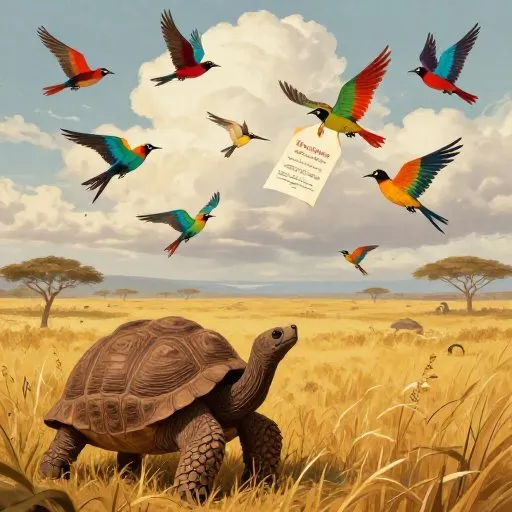
There was a feast in the sky.

The birds received the invitation. Not the tortoise. The birds. They had wings and the sky had a feast and it followed logically that the invitation went to the ones who could get there. The tortoise, who had no wings and lived on the ground and moved slowly enough that arriving somewhere on time was already a project, had not been invited.

He heard about it.

Here's the thing about the tortoise in Igbo tradition, and in most West African storytelling traditions where he appears: he is not innocent. He is not the underdog hero. He is not the quiet small creature who deserves to win. He is intelligent, hungry, and almost entirely without shame about what he will do to get what he wants. He heard about the feast in the sky and he decided to go to it. The fact that he hadn't been invited was a logistical problem, not a moral one.

He went to the birds and explained that he had changed. He was not the tortoise they knew. He was different now. Wiser, more thoughtful, more committed to the common good. He would be a credit to them on this journey. He argued it with such confidence and such detail and such apparent sincerity that the birds looked at each other and then looked back at the tortoise and thought: well, he sounds very certain about this.

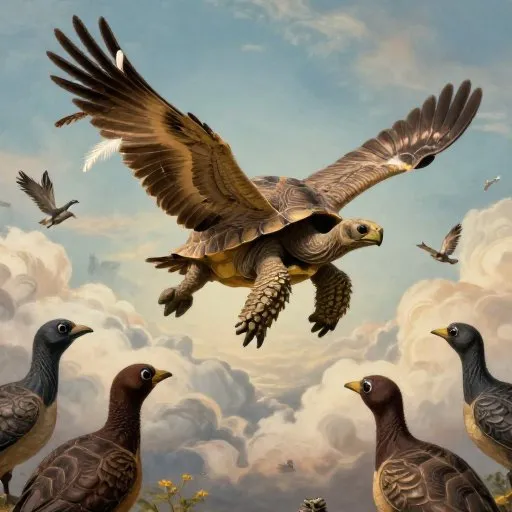
Each bird gave him a feather. One feather each, enough for the tortoise to assemble a set of wings. Whether these wings worked through engineering or magic, the story doesn't bother to specify. What matters is they worked. The tortoise had wings. He could fly.

He had one more request before departure. He explained, with the tone of someone raising a perfectly reasonable practical concern, that they needed new names for the journey. All of them. New names. The sky people would expect it.

The birds, who had given him feathers and were now committed to the project, agreed.

The tortoise named himself: All of You.
2The Name

Chapter 2: The Name

You want to understand the name before we continue.

The sky people had prepared the feast. They had cooked it and arranged it and set it out with the understanding that it was for the birds. When the birds arrived, the sky people welcomed them and asked who the feast was for.

The tortoise, who was wearing borrowed feathers and a borrowed name, said: it is for all of you.

The sky people nodded. The feast was for All of You. They called out: "The feast is for All of You." The tortoise, whose name was All of You, stepped forward and ate.

He ate everything. Every dish. The tortoise who had not been invited to this feast, who had borrowed his wings and invented his name and arranged this situation with deliberate precision over several days of social engineering, sat down at a feast prepared for all the birds and ate every last piece of it.

The birds stood at the edge of the feast and watched.

The texts on this story, including the version Chinua Achebe tells in Things Fall Apart through the elder Uchendu, dwell on this part. Achebe's version is precise: the tortoise told the birds that in preparing for a feast, a wise guest goes home first and puts out all the good things for visitors. He sent the birds home with a message for his wife. He would explain the logic of the name after he ate. The birds left.

Then he sat down and ate the entire feast.

Whether you admire this or not probably depends on whether you're the tortoise or the birds. The tortoise had done nothing illegal. He had asked for feathers. They gave them. He had proposed new names. They agreed. He had named himself All of You. Nobody stopped him. The feast was for All of You. He was All of You.

The logic is airtight. The ethics are something else.

3The Message

Chapter 3: The Message

The birds came back. The birds always come back in these stories, and when they do, they are no longer charmed by the tortoise's certainty. They had gone home as he asked. They had done nothing because there was nothing to do. They came back to the sky and found the feast empty and the tortoise sitting in the middle of it looking entirely comfortable with everything that had happened.

They took back their feathers.

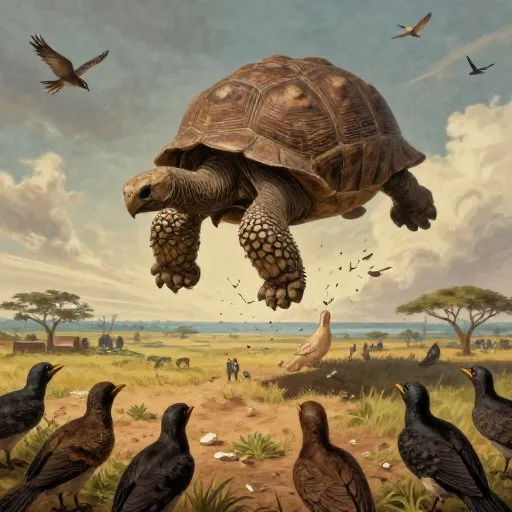
All of them. Each bird took back the feather it had given, and the tortoise stood in the sky with no wings, full of a feast he had eaten alone, looking at a very long way down.

He needed to get a message to his wife. He needed her to put soft things outside their house before he landed. Blankets, leaves, grass, anything that would cushion a tortoise falling from the sky. He asked the parrot to carry the message.

The parrot agreed. Or appeared to agree, which in the context of the tortoise's recent behavior is a distinction worth noting. The parrot flew down. He found the tortoise's wife. And he told her: your husband says to put out all the hard things. The pots. The tools. Everything hard that you have. Put them outside.

She put them outside.

The tortoise fell.

He hit the hard things. His shell cracked into pieces. Many pieces. And here is where the Igbo telling differs from a clean cautionary tale: he didn't die. He was brought inside. A medicine man was called. The pieces were glued back together.

4The Shell

Chapter 4: The Shell

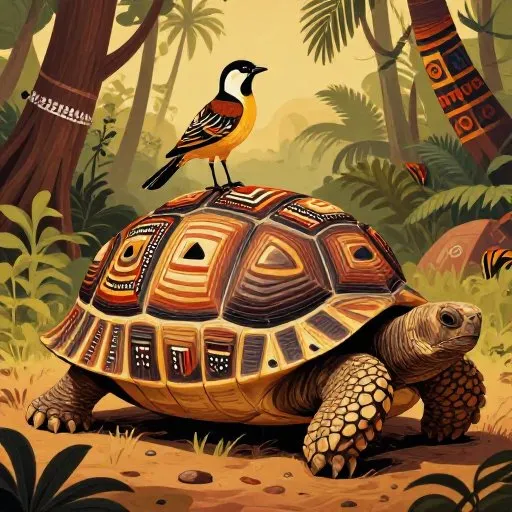
Look at a tortoise shell. Any tortoise. The shell is not smooth. It is a pattern of plates fitted together, divided by visible seams, as if someone had assembled it from separate pieces and the joins hadn't quite disappeared.

That's the myth's explanation. That pattern is what you're looking at when you see a tortoise shell. The evidence of the fall. The record of a feast eaten alone in the sky, wings returned, message corrupted, pieces gathered from the ground and reassembled.

The tortoise survived. He always survives in these stories. That is part of the point. He is not destroyed by his own appetite and cleverness. He is damaged and reassembled and here, still present, still the tortoise he was before except for the pattern on his back.

Chinua Achebe tells this story in Things Fall Apart through an elder speaking to Okonkwo. The context matters. Okonkwo is a man in crisis, exiled, uncertain of his place. The elder tells the story not as a moral lesson about greed but as a lesson about the consequences of how you treat people: the birds gave the tortoise feathers. He ate their feast. When you treat the people who trusted you that way, they take back what they gave you, and the fall is your own doing.

The shell tells you the rest. You can learn the whole thing just from looking at a tortoise. Here is where it cracked. Here is where it was put back together. Here is what it looks like when someone survives the consequences of being entirely themselves.

5What the Story Is Actually About

Chapter 5: What the Story Is Actually About

This story travels well because it is not really about a tortoise.

It is about a particular problem: the person in the group who is smarter than everyone and knows it and is not above using that fact. The tortoise got into the feast because he was cleverer than the birds. The birds were not stupid. They were just trusting, and they were trusting because the tortoise sounded very confident and very reasonable. The tortoise had studied the birds the way you study a system you intend to work.

It works until it doesn't. That's the shape of the story. The cleverness that got him into the sky is the same cleverness that set up the fall: the message he sent through the parrot, trusting that the parrot would honor a social obligation, is him running the same play that the birds ran when they gave him feathers. He trusted. It cost him.

Achebe wrote Things Fall Apart in 1958. It is one of the most widely read African novels in the world, one of the most widely read novels of the twentieth century in any tradition. And inside it, an elder sits down with a man who is suffering and tells him the story of the tortoise and the sky feast. Not to mock him. To help him see something about himself and about what happens when you do not acknowledge the people who make your position possible.

The shells of tortoises in southeastern Nigeria look like this because of what the tortoise did. The story and the visible evidence corroborate each other. Every tortoise you see is carrying the record of the feast on its back.

That is a specific kind of storytelling. It looks at the actual world and says: here is the myth that explains what you can see right now. Look. The story is right there on its back.

Mythology Notes