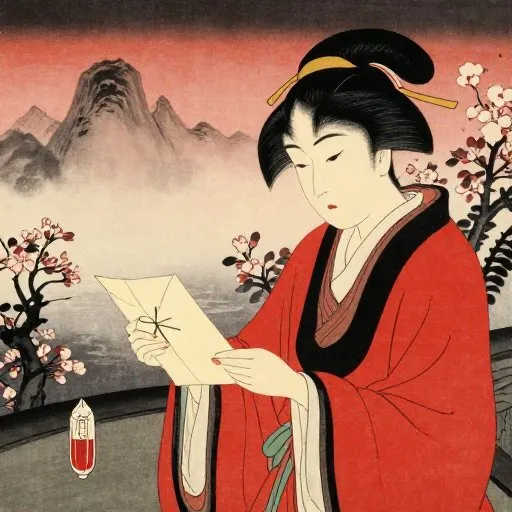
An old bamboo cutter finds a tiny girl inside a glowing stalk. She grows up to be the most beautiful woman in Japan. Five nobles fail her impossible tasks. Then she tells everyone she's from the Moon.
Mythwink
They found her in a piece of bamboo. They should have asked more questions.
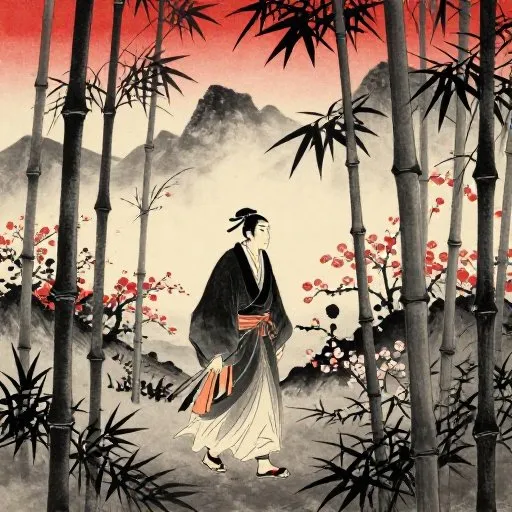
The old man's name was Taketori no Okina. The Bamboo Cutter. He walked through the bamboo groves every day, cutting stalks, bringing them home, and the work was humble and steady and had been his whole life.
One morning he found a stalk that was glowing.
Not reflecting light. Generating it. A soft radiance from within, as if something bright were inside the bamboo rather than outside of it. He cut it open.
Inside was a tiny girl. The size of a thumb. Perfectly formed, perfectly calm, sitting inside the bamboo stalk as if she had been placed there, which she had, though by whom and for what purpose he would not understand for a very long time.
He brought her home. He and his wife had no children, and here, inside a piece of bamboo, was a child. They named her Kaguya-hime. The name means, roughly, "radiant princess" or "shining princess." She was already named by what she was.
From that day forward, every time the old man went into the bamboo grove, he found a piece of gold inside a glowing stalk. Not every stalk. The right one, the shining one, every time. It happened consistently and the old man accepted it with the pragmatism of someone whose life had changed completely and who was going to work with that rather than question it. He became wealthy. The family that had nothing had enough.
And Kaguya grew. Not slowly, the way children grow. Quickly. Within three months she was the size of a woman, and her beauty was, according to the Taketori Monogatari, the text that preserves this story and which dates to the 10th century CE, without comparison in the world. Not in Japan. In the world.
People came from considerable distances simply to look at her. The old man built fences. He employed guards. He tried to create a reasonable boundary between his daughter and the men who had heard about her and arrived without invitation.
It did not work. Nothing he could build was sufficient to contain what Kaguya was.
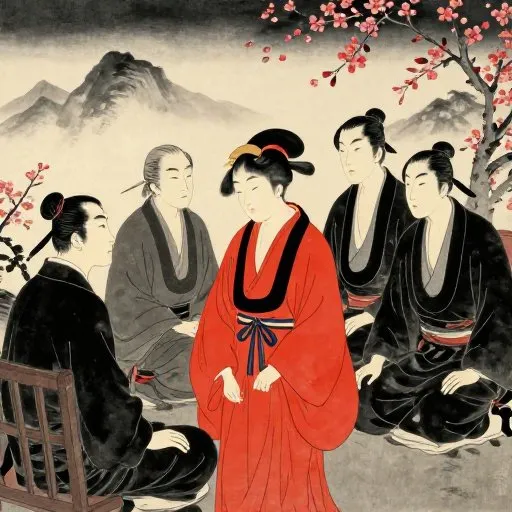
Five men decided they would marry her.
They were not ordinary men. They were the highest-ranking nobles in Japan, and their names in the Taketori Monogatari are given alongside impossible tasks designed specifically for each of them. Kaguya did not want to marry anyone. She was clear about this. But she was also aware that refusing five powerful nobles outright was its own kind of problem, so she offered a compromise: she would marry whoever brought her the specific thing she asked for.
The tasks were impossible. This was the point.
She told the first noble, Prince Ishitsukuri, to bring her the stone bowl of the Buddha, which was kept in India. He left, convinced himself that the journey to India was impractical, found an attractive bowl in a local mountain temple, and brought it back claiming it was the genuine article. Kaguya looked at it. It was not glowing. The real bowl, she said, would glow with a divine radiance. This one did not. She handed it back.
The second noble, Prince Kuramochi, was asked to bring a branch from the jeweled tree on the island of Horai, a legendary island where golden roots bear silver trunks and jeweled fruit. He vanished for a long time, returned with a spectacular jeweled branch that he claimed to have obtained at great personal hardship and cost, and presented it along with a detailed account of his voyage. The craftsmen he had secretly hired to make the branch then arrived at the house demanding payment, and the deception ended.
The third suitor was asked for the legendary fire-rat's robe, a Chinese artifact that could not be burned by flame. He ordered one through Chinese merchants. They sent something that cost an enormous amount and was described as authentic. Kaguya tested it in a fire. It burned. The merchants had sold him a regular robe.
The fourth was asked for a jewel from a dragon's neck. He commissioned ships and set out for the open sea, encountered a terrible storm he interpreted as divine discouragement, decided this was a sign he should not continue, and came home. He told Kaguya the difficulty of the task was itself proof of his devotion. She told him it was proof of nothing and she was not interested.
The fifth suitor was asked for the shell of the easy-birth swallow, a legendary nesting item found on the highest point of a swallow's nest. He climbed, fell, broke several ribs, nearly died, and the shell he thought he had found turned out to be unrelated debris. He presented it anyway. It was not the shell.
All five failed. Completely. Some failed comically. Some almost got there through sheer determination and then failed anyway. The Emperor of Japan himself heard about Kaguya and came to see her and proposed, and she thanked him respectfully and declined. He was gracious about it, more gracious than the five nobles, and they maintained a correspondence. But she would not leave the bamboo cutter's house for the palace. She would not marry anyone.
The old man, who had watched all of this from a distance, suspected that something was happening that was larger than him.
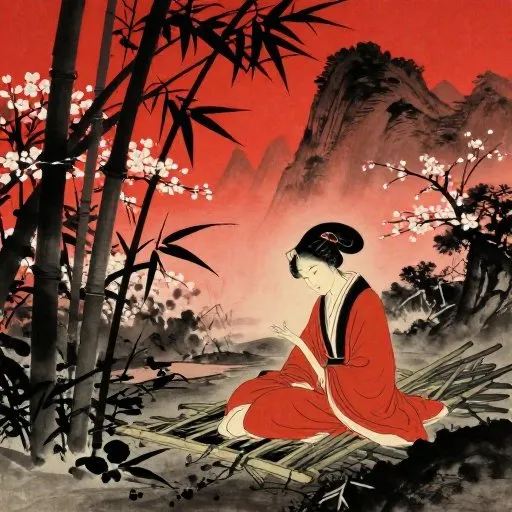
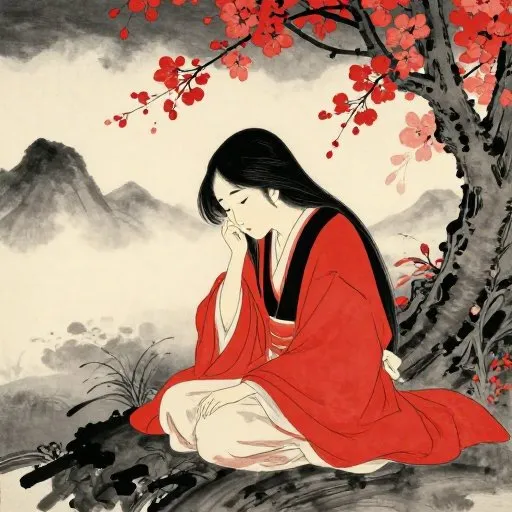
Each year when autumn came, Kaguya wept.
Not unhappily, exactly. Or not only unhappily. She would look at the moon, which was full and bright, and she would cry. Her adoptive parents asked what was wrong and she would say that nothing was wrong and that she was fine, which was not convincing given that she was crying at the moon.
This continued. As the years passed, it got worse. The lunar month would come and the full moon would rise and Kaguya would look at it and be undone. The old man and his wife grew increasingly worried. They watched her watch the moon and they could not understand it, but they could see that she was in pain about something that she would not explain, and that there was nothing they could do about it.
Finally she told them.
She was from the Moon. She had been placed in the bamboo grove as a child to be kept safe during some celestial difficulty, and the time of her safety was ending. The people of the Moon were coming to take her back. She did not know exactly when. She knew it would be soon.
She did not want to go.
This is the part of the Taketori Monogatari that earns its reputation. The comedy of the five failed suitors is real and satisfying. The image of the tiny girl in the bamboo stalk is memorable and beautiful. But the story has a genuine weight at its center, and the weight is here. She had grown up with an old man and his wife in a bamboo cutter's house. She had a life. She had people who loved her. And she was going to be taken back against her will to a place of origin she had not chosen and could not refuse.
She told her father what was coming. He told the Emperor, who sent troops. Two thousand soldiers. They surrounded the house with torches and bows.
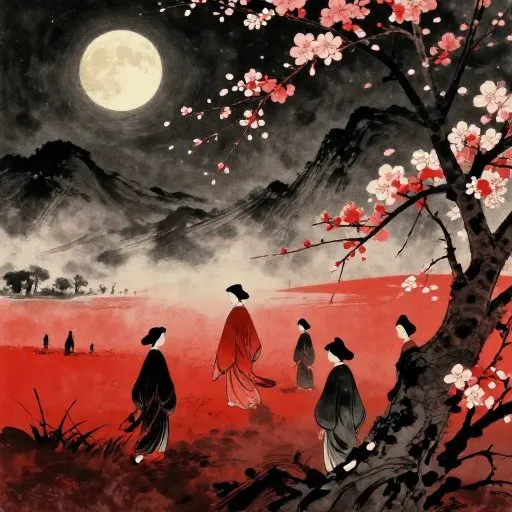
The Moon people arrived at midnight.
The Taketori Monogatari describes their approach. Flying carriages. Celestial attendants. An otherworldly brightness that outshone the torches of two thousand soldiers. The guards who had been stationed to protect Kaguya found that they could not move. They were not harmed. They simply could not lift their arms or draw their bows or do anything except stand still while the Moon people landed.
The leader of the delegation told Kaguya it was time.
She wrote two letters. One to her adoptive parents, thanking them for raising her, apologizing that she could not stay, telling them she had loved the life they gave her. The letter is in the text. It is brief and it is real and the old man who received it could not read it without weeping. She had been his daughter. She had been found in bamboo and she had been his daughter and she was leaving and there was nothing he could do.
She wrote a second letter to the Emperor. With the letter she left the elixir of immortality, which the Moon people had brought for her. She had no use for it. She was celestial and therefore did not age. But she had been given it as a parting gift, and she sent it to the Emperor with a note that said, in effect: I am sorry I could not stay. This is what I have for you.
Then she put on the celestial robe the Moon people had brought, and the moment it touched her shoulders, she stopped caring.
The Taketori Monogatari says this directly. The robe removed earthly feeling. She had been grieving this departure for years. She had wept at the moon for years. The moment the robe was on her, all of it was gone. The old man and his wife and their bamboo house, the letters she had just written, the Emperor who had courted her with patience: none of it mattered. She was celestial again. She got into the carriage.
The Moon people left. The brightness faded. Two thousand soldiers stood in the dark with their useless bows, and an old man held a letter.
The Emperor received the letter and the elixir.
He read the letter. He had known, in some way that powerful people often know things they do not say, that she was never going to stay. He had written to her. She had written back. The correspondence had been genuine on both sides. He had not been one of the five who degraded themselves with tricks and forgeries and expeditions they abandoned. He had simply kept writing.
He did not want to live forever without her. He asked his advisors which mountain was closest to heaven.
They told him Mount Fuji.
He sent soldiers to the summit with the elixir and ordered them to burn it.
The text of the Taketori Monogatari gives the etymology directly. The name "Fuji" derives from "fushi," immortality. The mountain is named for what was burned on it. The smoke that was said to rise from Fuji's peak in ancient times was the smoke of an emperor burning eternal life because the person he would have spent it with had gone somewhere he could not follow.
This is almost certainly not the actual etymology of the word Fuji. Linguists have other theories, none of them settled. But the myth kept the story anyway, because the story was better than the truth, or because the story was a kind of truth that the etymology was not.
The Taketori Monogatari is considered the oldest surviving Japanese prose narrative. Its full title is sometimes translated as "The Tale of the Bamboo Cutter." It was written down around the late 9th or early 10th century CE, but references to it appear in the 11th century work The Tale of Genji as "the ancestor of all tales," implying it was already old by then.
Kaguya-hime is up there somewhere. In the Moon. Not crying at the Moon from down here anymore, because the robe took all of that when she put it on. Not remembering the old man's house or the bamboo grove or the autumn evenings when the full moon rose and she knew what was coming.
The old man lived. He kept cutting bamboo. The grove that had once glowed for him stayed quiet.
Some stories are about the people who get to leave. Some are about the people who stay.