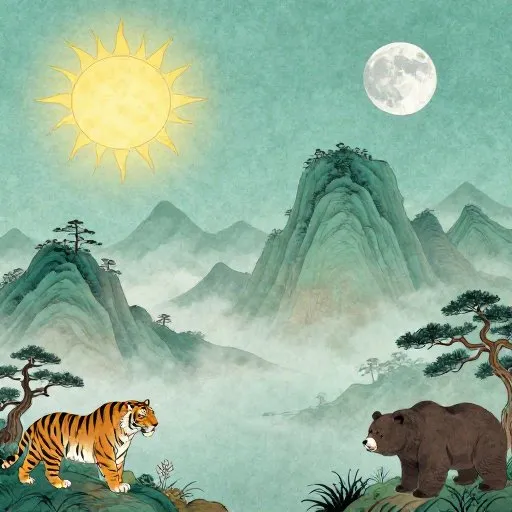
The Korean folktale of a tiger who ate a mother on a mountain path, dressed in her clothes, and came for her children. Why the sun and moon chase each other across the sky.
Mythwink
The tiger ate their mother. The children got out of reach. The rest is astronomy.
There was a woman who worked hard.
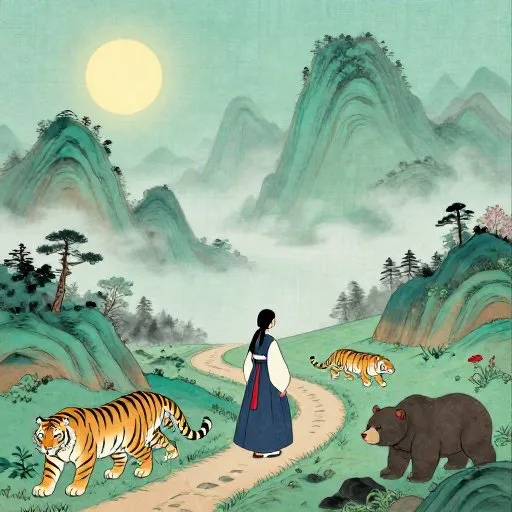
Every day she went out to earn what her family needed, and every day she came back over the mountain to her children. This is where the story begins, with the ordinary business of keeping a family alive. A mother. A mountain. Two children at home who were waiting.
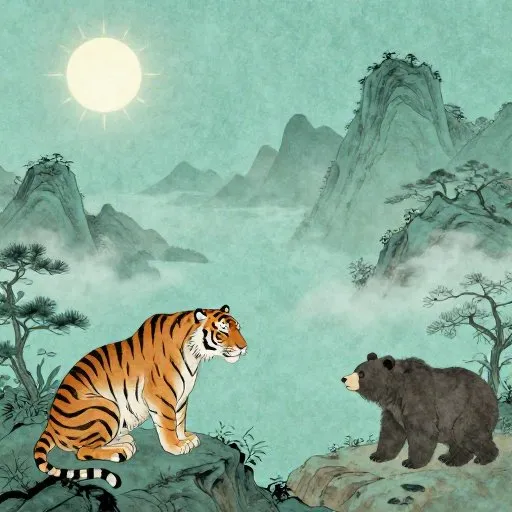
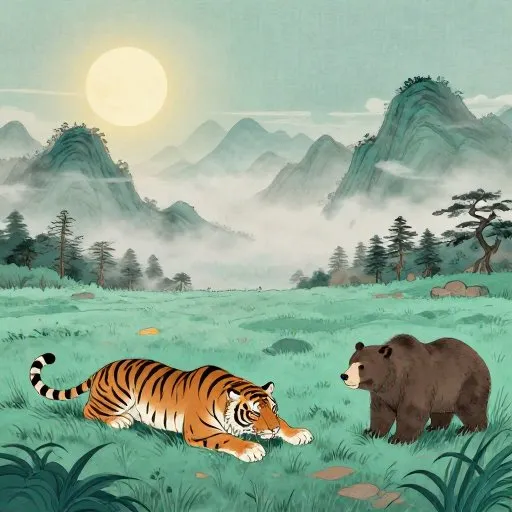
This is a Korean folktale, not a creation myth in the Dangun sense, not a founding story with a national holiday attached. It is the kind of story told to children at night, the kind that explains things while doing something else entirely. It explains why the sun and the moon are what they are. But first it tells you something about tigers, which in Korean folk tradition are not always symbolic. They are neighbors. They have been on those mountains for a long time and they have opinions about people walking alone on paths at night.
The woman was coming home over the mountain. She had rice cakes. The exact type varies by telling: some say she was carrying them for a local celebration, some say they were payment for her work. What the rice cakes are is not important. What they represent is: something a tiger would want.
The tiger appeared on the path.
He asked for a rice cake.
She gave him one. Because the alternative to giving a tiger on a mountain path what it asks for is not an option that improves your situation.
He asked for another.
She gave him another.
He asked again.
One by one, she gave him the rice cakes she had worked all day to earn, there on the mountain in the dark, hoping each one would be the last one he asked for. And when the rice cakes were gone, when every single one was gone, the tiger was still hungry.
He ate her.
The tiger was clever about what came next. Or maybe clever is too generous. The tiger understood one thing: those children were behind a door, and if they knew what had happened on the mountain, the door would stay closed. So the tiger put on the woman's clothes.
This is the image that sticks with children who hear this story: a tiger in a dress and a headscarf, shuffling up to a house in the dark, trying to sound like someone's mother. It is frightening and also, if you're honest about it, slightly ridiculous. But it works. For a while.
The tiger knocked on the door and said: "Children. It's your mother. Open the door."
The children called back from inside. They asked for proof. They asked questions. One child noticed something wrong with the voice. The tiger disguised the voice. The children asked to see a hand through the door.
The tiger put a hand through the gap. The children looked at it. Hairy. The hand was hairy.
"Mother," one child said, "why is your hand so hairy?"
The tiger said: "I've been working all day in the fields. My hands have gotten rough."
That is not an answer to the question. But children in the dark with a voice that mostly sounds like their mother sometimes take the answer that lets them open the door. The younger one might have believed it. The older one knew.
The older child, the brother in most versions, knew something was wrong. He grabbed his sister and they ran. Out of the house, into the dark, and up the nearest tree as fast as they could climb.
The tiger came inside and found no one there. The tiger came outside and found them in the tree.
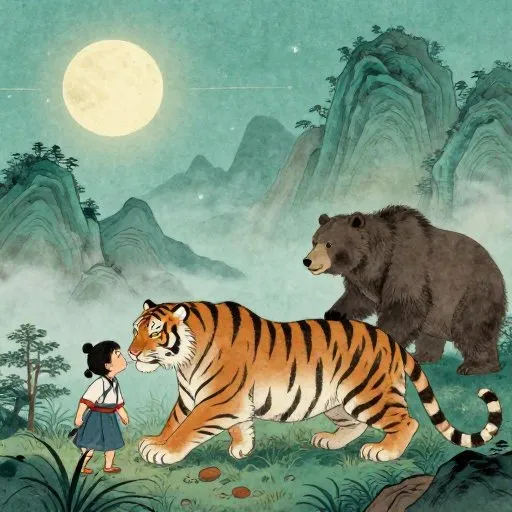
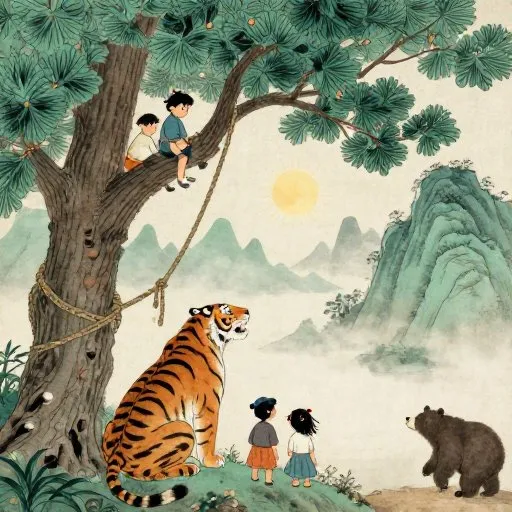
The tiger looked up at the children in the tree. The children looked down at the tiger. This is, in the geography of the folktale, the moment of total helplessness. They've gotten above it. But a tiger is more than capable of climbing a tree, and the children knew that, and the tiger knew they knew.
"How did you get up there?" the tiger called up.
This is the detail that children listening to this story remember for their entire lives. The brother called down: "We put sesame oil on our hands and climbed."
Sesame oil. On the hands. To grip a tree. That is obviously wrong. Sesame oil is slippery. A tiger might not know that. Or might not stop to think about it. The tiger put sesame oil on its paws and tried to climb. Slid back down. Tried again. Slid back down.
Eventually the tiger found the real method, which the brother had hoped to avoid revealing, and began to climb.
The children had no more tricks. They had nothing left. They had outrun a tiger and outsmarted it twice and now it was coming up the tree and there was nothing above them but sky. They did what people do when they have nothing left.
They prayed. They called out to heaven and asked for help. Let us live, they said. If we are meant to live, send us a rope. Send us a way up.
A rope descended from heaven.
The children climbed. The tiger watched them go and then it prayed too, in its desperation or its hunger or whatever a tiger feels when its meal climbs into the sky. Send me a rope, the tiger said.
A rope descended.
The tiger climbed.
But the rope the tiger received was rotten. It broke.
The tiger fell.
In some tellings the tiger falls into a millet field. In some it falls into a sorghum field. In all of them it falls and it dies, and where it landed, the blood stained the stalks. This is why millet, in some versions of the story, has red-tinged roots or stem markings. The story reaches into the field and leaves a mark on the plant that grows there.
This is what folktales do, all the ones that were worth keeping. They land somewhere real. They attach the story to an observable thing. You look at a stalk of millet and you know what happened. You know the tiger came after the children and fell. You know the children got out.
The children were in the sky now. The rope had taken them all the way up. They were in heaven.
And in heaven they were given roles.
This is where the story opens into its explanation. The brother became the sun. The sister became the moon. Or in some versions the sister became the sun first but found it uncomfortable to be looked at all day, and asked to trade, and became the moon instead, because no one stares at the moon. There is something in that version, something worth sitting with: a girl who did not want to be watched, who chose the quieter light, the one that people glance at rather than stare at. The version where she makes that choice for herself is the more interesting one.
Either way: one sibling became the sun and one became the moon. They were placed in the sky to light the world. The world that had, until then, been dark enough for tigers to walk mountain paths in women's clothing.
The sun crosses the sky every day. The moon follows at night.
They never stop. They never rest in the same part of the sky at the same time. They chase each other, or run from each other, or simply move the way people move when they have something to do and they know exactly what it is.
The Korean folktale says they're siblings. The same two children who hid in a tree on a dark night while something wearing their mother's clothes tried to figure out how to get them down. They made it up. They made it all the way up, and they're still there.
This story is told to children in Korea. It has been told for a very long time. Like most folktales, its exact age is not recoverable. It exists in many regional variants, collected formally by Korean folklorists in the twentieth century. The story in its various forms appears across Korea and in the Korean diaspora communities in China, Japan, and beyond. It is not a national myth in the Dangun sense. It belongs to a different register: bedtime, not holiday. Firelight, not ceremony.
But notice what it contains. A mother who worked hard and still didn't make it home. Children who had to be smart and then brave and then lucky, in that order. A prayer that was answered. And then a different life entirely, in the sky, doing the work that needs doing every day without end.
The tiger prayed too. The difference was the rope.
The two lights are still up there. The sun goes first. The moon follows. One is looking back and one is looking forward, or they're both looking forward, or they've stopped keeping track of that and they're just moving, the way you move when you've been doing something long enough that the motion is no longer separate from who you are.
Look up on a clear night.
The children got out.