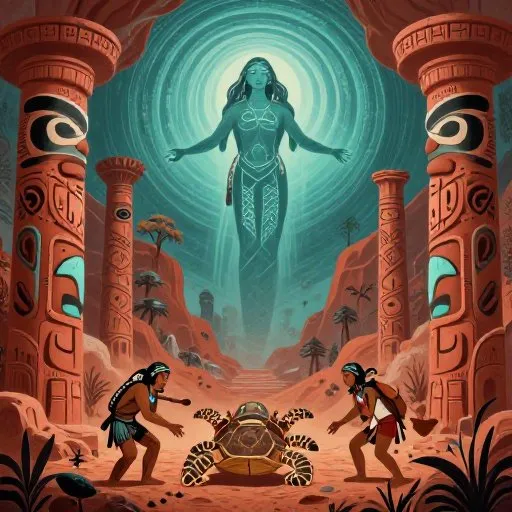
The Iroquois creation story: Sky Woman falls, a turtle offers its back, a muskrat dives for mud, and Turtle Island grows into a continent.
Mythwink
She fell through the floor of the sky. Everything you're standing on is what happened next.
The Sky Woman story is the central creation account of the Iroquois, also called the Haudenosaunee: the Six Nations whose homelands run across what is now upstate New York and into southeastern Canada. In it, a woman falls out of a world above the sky. Water birds catch her before she hits the sea, a great turtle offers its back for her to land on, and a muskrat dives to the bottom of the ocean and comes up with a single handful of mud. That mud spreads across the turtle's shell and becomes the land. The Haudenosaunee call it Turtle Island, and in this telling Turtle Island is North America itself. Here is the whole story, from the world before this one to the world you are standing in now.
Before this world, there was another one.
It existed above, somewhere past where the sky ends. Not clouds. Not space as we understand it. A different place entirely, a sky world with its own ground and its own trees and its own rules about what was possible. The Haudenosaunee have carried this story for a very long time, and it begins not with nothingness but with a different kind of existence, already full and already inhabited.
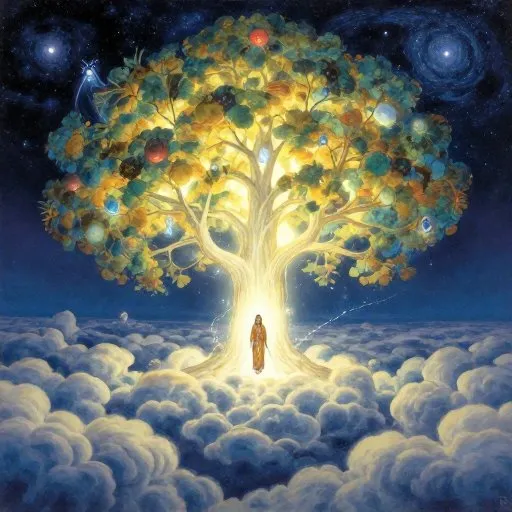
At the center of the sky world stood a Great Tree. Its roots ran deep enough to hold everything together, and light came up out of those roots, so the tree was the source of light for the whole sky world. It mattered in the way things matter when everything depends on them.
And then someone decided to uproot it.
Who, exactly, and why, depends on the telling. In the versions recorded by Seneca anthropologist Arthur C. Parker and by Tuscarora scholar J.N.B. Hewitt, a man of the sky world falls ill, or has a dream, and becomes convinced the Great Tree has to come down. In the sky world a dream is not just a dream. A dream tells you what must happen. So the tree is dug out by the roots, and where it stood there is now a hole in the floor of the sky world, with darkness below it and a way through to something else.
In some tellings Sky Woman leans over the edge to look. In some she is pushed by her husband. In some she reaches for the roots of the falling tree and goes down with it. Every version agrees on the part that matters: she goes through the hole.
Sky Woman fell out of the sky world. Below her, there was only water.
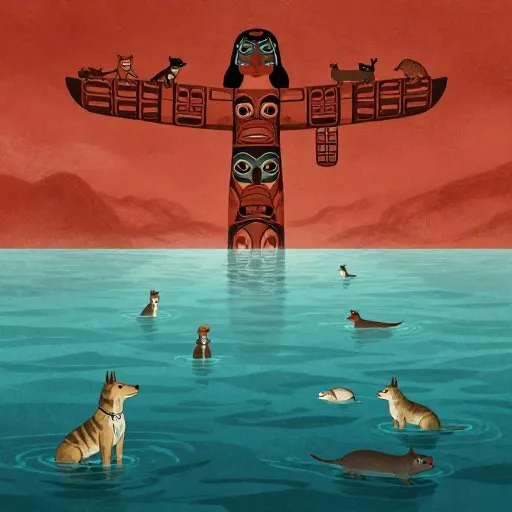
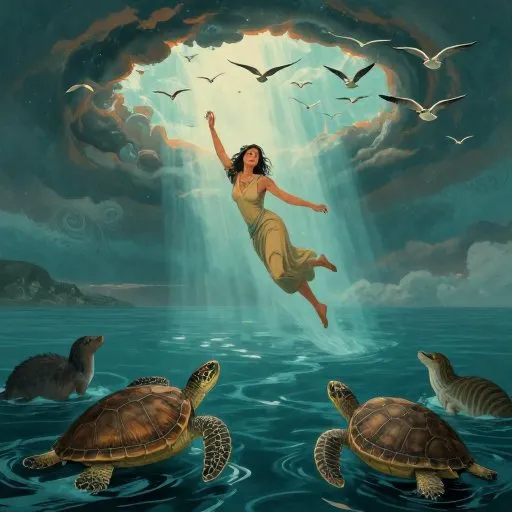
Below the sky world there was no land at all, only water: an ocean without edges and without a shore. Animals lived on it and in it, and birds flew above it, and all at once they saw the same impossible thing. A woman was falling out of the sky, and there was nothing beneath her to land on.
The birds moved first. Geese, or swans, depending on who is telling it, flew up together and caught her on their backs. They broke her fall and held her up. But birds cannot hold a woman of the sky world forever, and there was nowhere to set her down. You cannot put a land being down on open water.
Turtle said: put her on my back.
Consider what that means. Turtle offered its own body as an island, its shell as the foundation of a world. The Haudenosaunee do not treat that offer as a small thing. The name many Indigenous nations use for North America is Turtle Island, and it is not decoration. The land exists, in this account, because of what Turtle did in this moment: said yes when there was nothing, and has been carrying the result ever since.
But a turtle's back, even a great turtle's back, is not soil. Sky Woman needed earth to build on, and the earth was at the bottom of the sea.
So the animals dove. This is the part folklorists call the earth-diver: one after another, the animals try to reach the bottom and bring up mud. Otter dove and came back with nothing. Beaver dove and came back with nothing. Duck tried. Loon tried. The water was too deep and the bottom too far, and in many versions a long line of strong, capable animals fails before the one who does not.
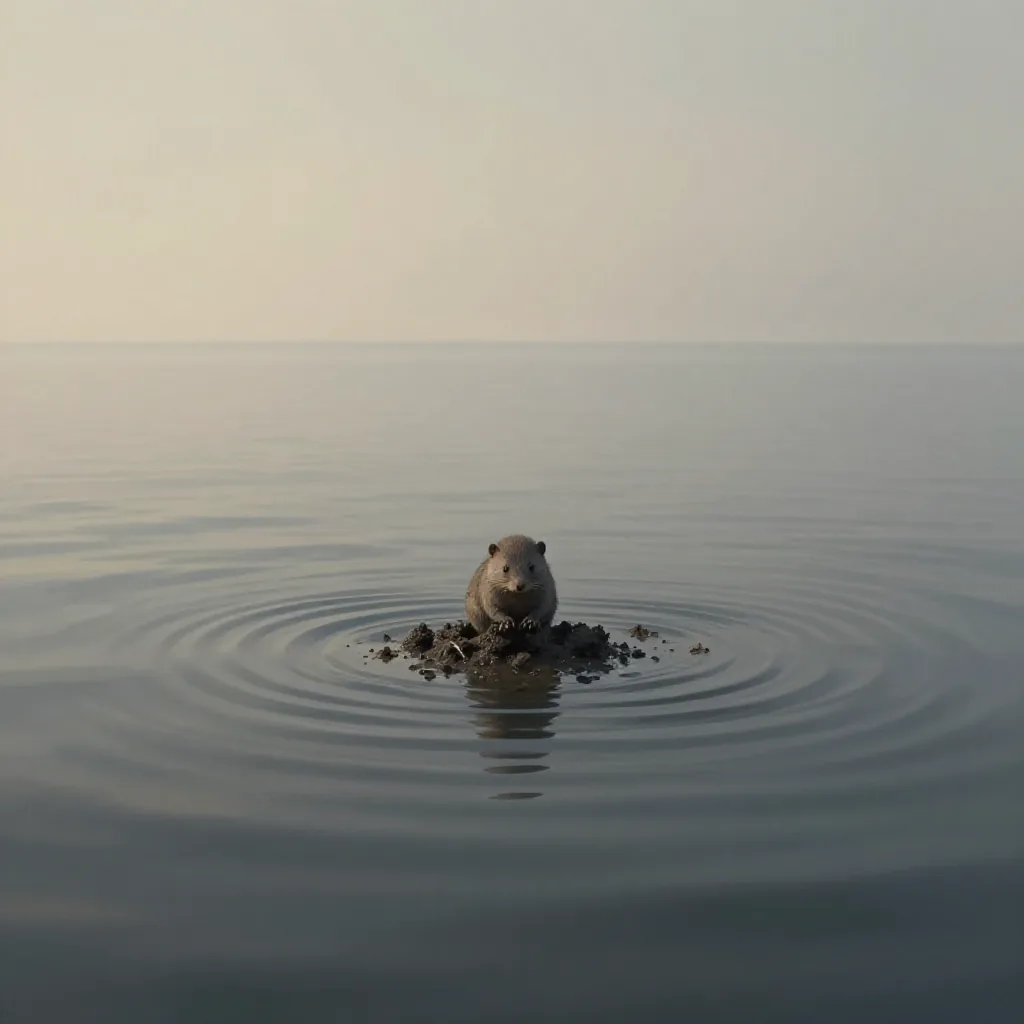
Muskrat is usually the one. Small, unremarkable Muskrat dove and stayed down far past when the others had given up, far past when anything should have been able to hold its breath. When Muskrat finally broke the surface it was barely alive and barely moving, and clutched in its paw, or its mouth, or its claws, was a tiny smear of mud.
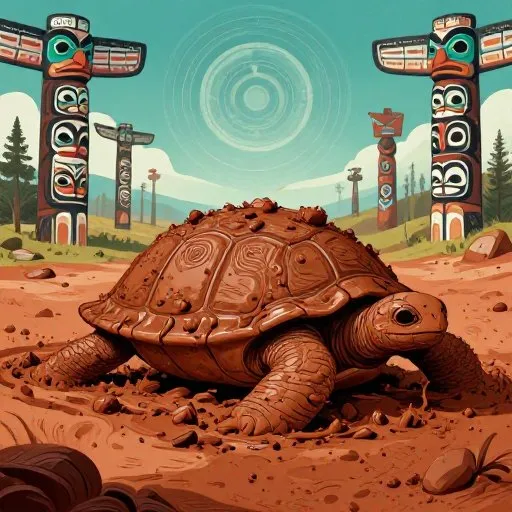
That was enough. Sky Woman took it and placed it on Turtle's back. And it grew.
The mud spread. Slowly at first, then faster, then in every direction across Turtle's back. It thickened into soil and hardened into rock and took on the shape of a continent. This is where the land came from, and it is why Turtle Island is not a figure of speech: Turtle is underneath it, carrying it, still.
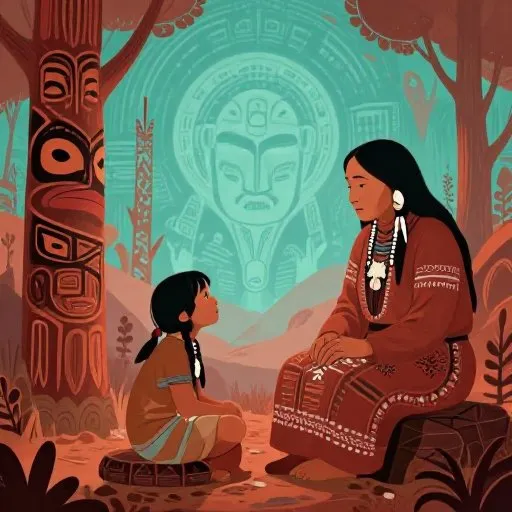
Sky Woman came down onto the new earth and walked on it. She was pregnant when she fell, and the child came soon: a daughter, who grew up on a world that was itself still growing around her.
The daughter's story is short and hard. She became pregnant in turn, and in the Haudenosaunee accounts she was carrying twins who were already at odds before they were born. The Onondaga and Seneca versions describe the two of them arguing inside her about how they would enter the world.
One twin chose the ordinary way out. The other refused it. The left-handed twin, the one who would become the source of the world's difficulty and danger, decided he would not wait and would not take the normal path. He forced his way out through his mother's side, and it killed her.
The accounts name her. Her name is usually translated as Mature Flowers, or simply Flowers. Sky Woman buried her daughter in the ground the two of them had helped make, and out of the grave grew the three plants the Haudenosaunee live on: corn, beans, and squash. The Three Sisters. Flowers died, and what came up out of her fed the world. In this story the plants that keep the people alive grow from the first grave in the earth.
The twins grew up, and Sky Woman, their grandmother, raised them.
The right-handed twin and the left-handed twin made the world between them: together, against each other, often in open competition, they shaped everything in it. The Haudenosaunee name the right-handed one Sapling, Teharonhiawako, and the left-handed one Flint, Tawiskaron.
The right-handed twin made rivers that ran both ways at once, so a canoe could go upstream as easily as down. The left-handed twin came along behind him and put bends and rapids in them and set the current running one direction only. Harder to paddle. More interesting water. The right-handed twin made plants grow straight and easy to gather. The left-handed twin gave them thorns and tangles. The right-handed twin made soft winds. The left-handed twin made the storms.
You can see the shape of it. The world is not built to be comfortable. It was made by two forces pulling in opposite directions, and what they left behind is the actual world: beautiful and dangerous and difficult, full of things that will hurt you standing right beside the things that keep you alive.
This is a different account of hardship than many Western readers grow up with. There is no fall from grace here, no original sin, no ruined paradise. The difficulty was built in from the start, not as punishment but as structure. The left-handed twin is not the devil. Haudenosaunee scholars are careful on this point: the twins are two halves of a balance, not good against evil. Without the left-handed twin the world would be smooth and calm and almost certainly dead.
Sky Woman's own part in it varies. In some versions she favors the left-handed twin, which brings its own trouble; in some she stays out of it entirely. Every version ends the same way: the twins come to a final contest, the right-handed twin wins, and the left-handed twin goes down below the earth. He did not disappear. He is still down there. Which is part of why things are still hard.
Sky Woman stays in the story long after the twins finish their work. In some Haudenosaunee accounts she becomes associated with the moon and the night sky she fell from. Her grandsons, for all their fighting, finished what she began: a world that could actually be lived in.
Here is the thing about creation stories. They are not really about the past. A creation story explains why the world is the way it is right now, while you are living in it. The Haudenosaunee account does not describe a lost golden age or a perfect world gone wrong. It describes exactly the world we have: one that rests on something that chose to carry it, that grew from a handful of mud brought up by the smallest animal that tried, that holds both corn and thorns and both calm rivers and rapids, because two forces made it in opposition and neither one won completely.
Turtle is still under the land, still carrying it. If you live on the North American continent you are on Turtle Island, and for the Haudenosaunee, the Anishinaabe, the Lenape, and many other nations who hold versions of this understanding, that is not a metaphor. The name carries the whole story with it every time someone says it out loud.
Muskrat dove deeper than anything else and barely came back. That one handful of mud became everything. The world was not handed to anyone. It was held up, and carried, and grown from almost nothing, by the ones who were willing to try.
Strip the Sky Woman story down to its mechanics and you get a specific pattern: the world begins as endless water, someone dives to the bottom, and land is built up from a scrap of mud carried to the surface. Folklorists have a name for that pattern. They call it the earth-diver, and Stith Thompson catalogued it as motif A812 in his 'Motif-Index of Folk-Literature.'
It is one of the most widely recorded creation patterns on the planet. Versions of the earth-diver turn up across Native North America and run west through Siberia and into parts of Central and Eastern Europe. The folklorist Alan Dundes surveyed dozens of them in a 1962 essay and found the same small detail again and again: not the strongest animal but the most persistent one, often the smallest, is the one who reaches the bottom. Muskrat succeeding where Otter and Beaver fail is not a quirk of the Haudenosaunee telling. It is close to a rule of these stories.
That is worth sitting with, because it tells you what the story is actually arguing. The earth-diver is not a story about power. It is a story about endurance, and about a world that gets built by the willingness to go down one more time. The land is not conquered into being. It is fetched, by someone who almost drowns doing it.
It also connects this myth to others told a world away. A creation account built out of water, sacrifice, and the raw making of land is not unique to the Haudenosaunee. In Chinese mythology the goddess [Nüwa shapes the first humans out of river mud](https://mythwink.com/stories/nuwa-creates-humanity). In the Aztec account of [the Five Suns](https://mythwink.com/stories/the-five-suns), the world is made and destroyed and remade more than once before the one we live in finally holds. The particulars differ everywhere. The underlying question, how did solid ground and living people come out of nothing, is one almost every tradition has tried to answer. You can read the Sky Woman story on its own terms and also as one answer among many, sitting alongside the other [Native American creation stories](https://mythwink.com/categories/native-american) that shaped this continent long before it carried that name.
Get on the list before the myths do.
New retellings from world mythology, gods behaving badly included. This list is just starting, so nothing has gone out yet, only a place in line.
Nothing has been sent from this list yet. You'll be among the first to hear once new myths start going out, and you can leave anytime.