← All Stories

The Chinese myth of Sun Wukong, the Monkey King who fought heaven itself. Born from stone, master of 72 transformations, and absolutely nobody's problem but everyone's problem.

The Monkey King

Mythwink

The Monkey King

He was born from a rock, became king of the monkeys, and then decided that wasn't enough.

1The Stone

Chapter 1: The Stone

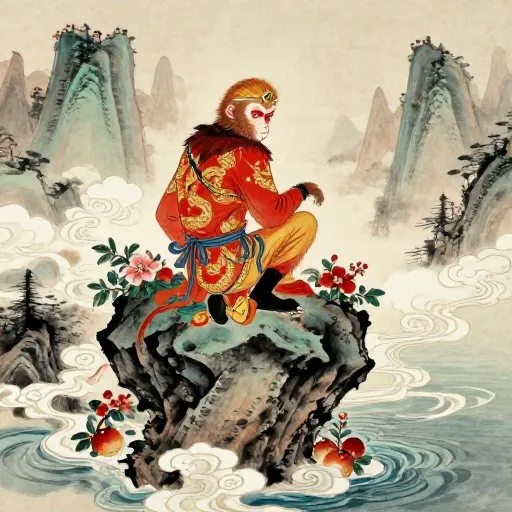
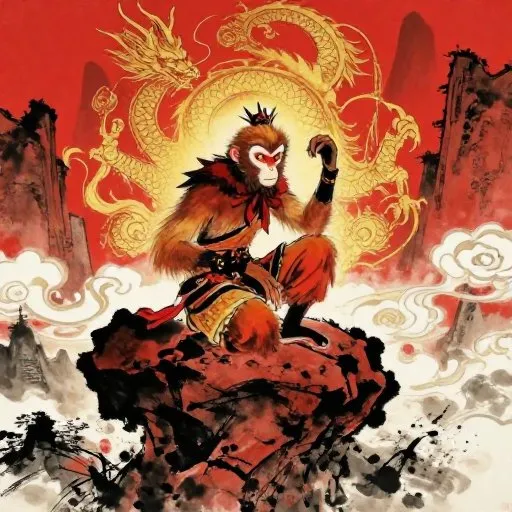
There is a rock on the Mountain of Flowers and Fruit, on an island in the middle of the Eastern Sea, and for a very long time it just sat there. Absorbing sunlight. Drinking in the spiritual energy of heaven and earth. The way rocks do.

And then it cracked open, and out came a monkey.

This is how Journey to the West, the sixteenth century novel by Wu Cheng'en, begins. Not with a prophecy. Not with a chosen one. With a rock that had been sitting in the sun long enough that it produced a monkey. The Taoists had a concept for this: the ten thousand things arise from the Tao, and if something sits in the right place and absorbs enough of the right energy for long enough, things happen. The rock was very patient. The energy was very abundant. The monkey was very inevitable.

He landed on the ground, bowed to each of the four cardinal directions, and his eyes shot golden light into the sky. Heaven and Earth took note. This was, it turned out, an understatement.

The monkey found the other monkeys. There was a waterfall. Behind the waterfall was a cave with a stone house, stone furniture, and stone food bowls, and nobody knew it was there. The monkey jumped through first. He discovered it was beautiful inside, declared it home, and the other monkeys elected him king on the spot. He had been alive for roughly one afternoon.

His name, the one he would eventually be given, was Sun Wukong. "Sun" meaning monkey. "Wu" meaning awareness, or awakening, or the absence of something. "Kong" meaning emptiness, or space, the Buddhist concept of sunyata. The Monkey King. The one who is aware of emptiness. Depending on which interpretation of the name you prefer, he was either a king who understood the nature of reality or a monkey with nothing inside him. Both readings, honestly, work.

He was king of the monkeys for three hundred years. In the Mountain of Flowers and Fruit, among the stone furniture and the waterfall, he ruled happily enough. Then one of his subjects said something that changed everything.

The old monkey said: you are a king, yes, but you are mortal. You will die someday, and then what?

Sun Wukong was not prepared for this information. He sat down and cried. He had been king for three hundred years and it had not occurred to him that it would end. And once it occurred to him, he could not stop thinking about it. Which is, if you've ever been a person, a feeling you might recognize.

He decided to go find immortality. He built a raft and sailed off.
2The Master and the Transformations

Chapter 2: The Master and the Transformations

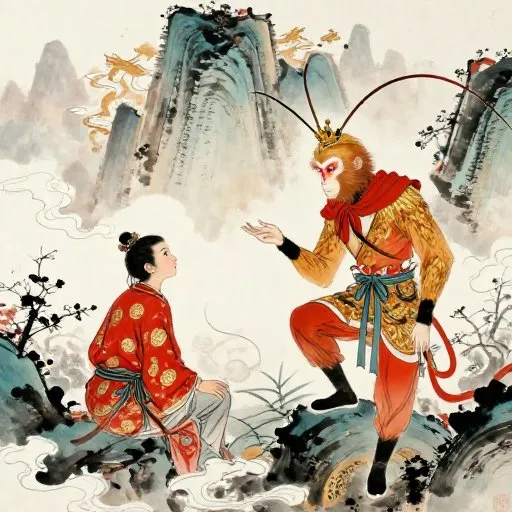
He wandered for ten years looking for a Taoist immortal who would teach him how to live forever. Ten years on foot and by raft, going from place to place, getting directions from humans, learning to wear clothes and speak properly. By the time he found the cave of the Patriarch Subodhi, he looked and talked like a person. More or less.

Subodhi almost turned him away. The monkey had no teacher, no lineage, no proper introduction, no reason to be standing at the door of one of the greatest masters in the world except that he had walked and sailed and asked strangers for directions until he arrived. Subodhi let him in. Probably because anyone willing to do that for ten years deserves a hearing.

The training took years. Sun Wukong was not a natural student. He was impulsive, show-offy, easily distracted, and constitutionally incapable of sitting still when something interesting was happening. But he was also brilliant in the specific way that some people are brilliant: he learned everything faster than anyone expected, and then used it in ways nobody anticipated.

Subodhi taught him the 72 Transformations. This requires a moment.

Seventy-two. Distinct. Complete transformations. Into any animal, any object, any person, any natural phenomenon. The wind. A tree. A bird. A specific human being whose face he had seen once. Not illusions. Actual transformations. The texts are specific about this. Sun Wukong did not appear to be these things. He became them.

He also learned cloud-somersaulting: one leap covered 108,000 li, roughly 54,000 kilometers. To put that in perspective, the circumference of the earth is about 40,000 kilometers. He could travel farther than the circumference of the Earth in a single bound.

And then he went and showed off in front of the other students, doing transformations for applause, which was explicitly the one thing Subodhi told him not to do.

Subodhi expelled him immediately. Not angrily. He had always known this was coming. He told Sun Wukong to go, but never to say who had taught him, because the trouble that was coming was going to be the kind of trouble a teacher doesn't want traced back.

Subodhi saw what was coming. He taught Sun Wukong anyway. That detail keeps turning up in this story: the people who know what they're dealing with, who do the thing anyway.

3The Pillar of the Sea

Chapter 3: The Pillar of the Sea

Sun Wukong went home and found his monkeys being harassed by a demon king. He dealt with that efficiently. But now he had a problem: he had power, and no weapon worthy of it. He needed something that wouldn't break or bend when he swung it at full strength, which ruled out every weapon humans had ever made.

Someone suggested the Dragon King of the Eastern Sea. He had a storeroom of divine weapons. He would surely have something suitable.

Sun Wukong walked to the bottom of the ocean. The Dragon King, who was not expecting a monkey, was deeply reluctant. He offered various weapons. A massive sword. A two-pronged halberd. A divine battle axe. Sun Wukong picked each one up, swung it once, declared it too light, and put it down. The Dragon King was running out of weapons.

Then a deep, low hum came from the back of the storeroom.

The pillar. The iron pillar. It had been there since the mythical King Yu used it to measure the depth of the primordial flood. Twenty feet long, as thick as a barrel. It had been glowing faintly for some time, and the Dragon King's servants said it had been doing that more often lately. As if it knew something was coming.

Sun Wukong walked over and grabbed it. He turned it in his hands. Too long, he said. And the pillar shrank. He held it at arm's length. Still too long. It shrank again. He said: smaller. And it became a needle, which he tucked behind his ear.

The Ruyi Jingu Bang. The As-You-Will Staff. It weighed 13,500 jin, approximately 8,000 kilograms, and it fit behind his ear when he wasn't using it. He also took a suit of golden armor from the Dragon King while he was there, mostly because it looked good.

Think about the Dragon King in this moment. His storeroom contained weapons gathered from across the divine world, and a monkey had walked to the bottom of his ocean uninvited, found the one thing powerful enough to match him, and left with it. Plus the armor. The Dragon King filed a formal complaint with Heaven.

Heaven took note. This was still an understatement.

4The Celestial Bureaucracy and Its Problems

Chapter 4: The Celestial Bureaucracy and Its Problems

Heaven, in the Chinese cosmological tradition as depicted in Journey to the West, is organized like an imperial court. There is a Jade Emperor at the top. Below him there are ranks and ministries and departments and officials with specific portfolios and proper titles and the correct paperwork. It is bureaucracy all the way up. This is important for what is about to happen.

The Jade Emperor tried several approaches to Sun Wukong.

First: diplomacy. He invited Sun Wukong to Heaven and gave him a title. Keeper of the Heavenly Horses. This was, it is worth being clear, a very low-ranking job. Cleaning stables. Feeding horses. Sun Wukong accepted the title, did the job for a while, and then learned that the title had essentially no status within the celestial hierarchy. He quit immediately and declared himself equal to Heaven.

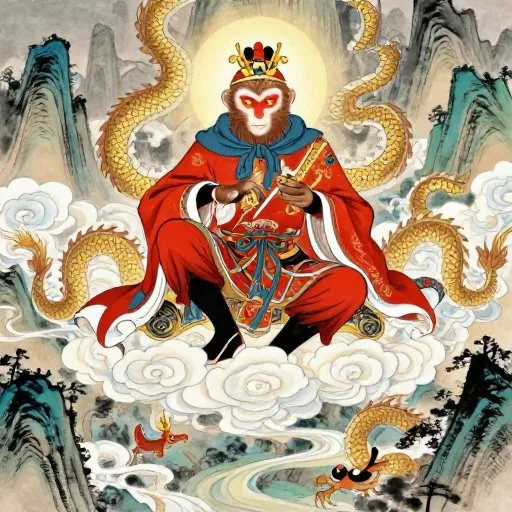
Second: a better title. The Jade Emperor, advised by the pragmatic Daoist immortal Tai Bai Jinxing, gave Sun Wukong a new title: Sage Equal to Heaven. The title was real this time. The office was not. He had a title, a residence, and two celestial peach gardens to wander around in. No actual power. No duties. He was being managed.

Then he ate the Peaches of Immortality. Not a few of them. The most powerful ones. The ones that take nine thousand years to ripen and grant boundless lifespan and union with heaven and earth when eaten. He ate most of a tree.

Then he was left off the invitation list for a divine banquet. The banquet where all the immortals would gather and drink the celestial wine and eat the immortality pills. He found out, arrived at the banquet venue early, and helped himself. Laozi's elixir pills: eaten. The celestial wine: drunk. He sobered up, realized what he'd done, and went home to the Mountain of Flowers and Fruit.

The Jade Emperor sent 100,000 heavenly soldiers.

Sun Wukong fought them all. He had immortality from the peaches. He had power from the pills. He had technique from Subodhi. He had the pillar. He fought the celestial army, which included generals with divine weapons and the combined military might of all of Heaven, and they could not stop him. He pulled a hair from his head, blew on it, and it became a thousand copies of himself. A hundred thousand soldiers against a monkey that could multiply.

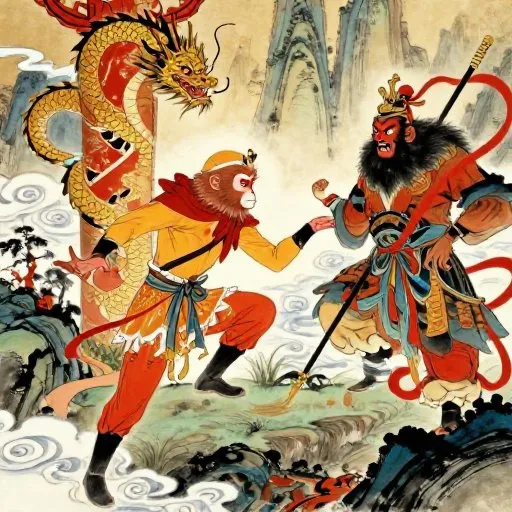
The Four Heavenly Kings. The demon-quelling Marshal Tuo Ta. Erlang Shen, the expert demon-subduer with his third eye and divine hound. One by one they came, and one by one they could not hold him.

The Jade Emperor called the Buddha.

5The Mountain

Chapter 5: The Mountain

The Buddha arrived from his western paradise, looked at the situation, and proposed a wager.

He told Sun Wukong: if you can leap out of my palm, you win. Heaven is yours, the Jade Emperor steps down, and you take your proper place as ruler of all.

Sun Wukong looked at the Buddha's hand. He looked at his own capabilities. He could leap 108,000 li in a single bound. The Buddha's hand was perhaps three feet wide. He had, by any reasonable calculation, already won.

He crouched. He leaped. He traveled to the end of the world: five vast pink columns rising from the ground, the pillars at the edge of all existence. He wrote his name on one of them. Sun Wukong was here. Then he came back.

The Buddha opened his hand. The five columns were the Buddha's fingers. Sun Wukong had never left.

The name was still there, written in monkey fur ink on the middle finger. Right there.

There is no good response to this. Sun Wukong did not have one. He had just discovered that the size of something is not always the size it looks, and that a wager is only as good as your understanding of the terms, and that the one who sets the rules usually wins.

The Buddha pressed his hand down. The fingers became a mountain: five elements, five directions, the Five Elements Mountain sealing Sun Wukong beneath it. A seal made from the Buddha's own hand, carrying a mantra, would hold him there for five hundred years.

Five. Hundred. Years. Under a mountain. For causing a disturbance in Heaven and eating some peaches.

And here is the part the story treats seriously, without jokes, because it earns it: when the five hundred years ended, when the monk Xuanzang came to free him on his way to retrieve the Buddhist scriptures from India, Sun Wukong came out changed. Not broken. Not destroyed. The fire was still there. The wit was still there. But something in five centuries of solitude had settled him just enough that he could serve without destroying everything around him.

He spent the five hundred years thinking. About what he was. About what he wanted. About the difference between power and purpose.

The Buddha, who had already seen what was coming, had waited accordingly.

Mythology Notes