The Mesopotamian flood myth from the Epic of Gilgamesh predates Noah by 1,000 years. The gods destroyed humanity and immediately regretted it. Mesopotamian myth, told properly.
Mythwink
The gods drowned the world. Then they felt terrible about it.
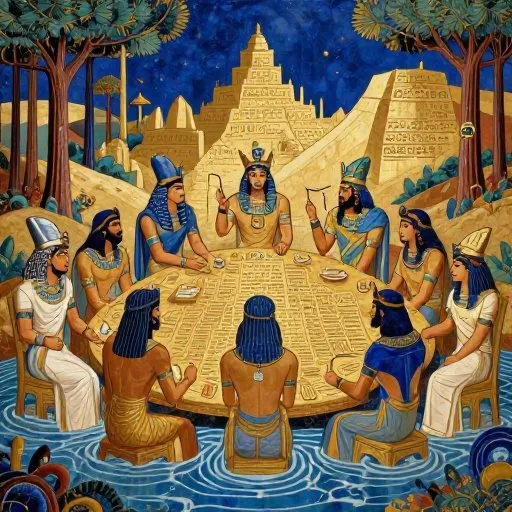
The gods decided to kill everyone. They held a meeting and voted.
Enlil called the assembly. Enlil was the chief god of the Sumerian pantheon, lord of wind and storms, keeper of the Tablets of Destiny, the god who had appointed Humbaba to guard the Cedar Forest and had been furious when Gilgamesh killed him. Enlil had opinions about humans, and those opinions had curdled.
The reason given in the Standard Babylonian Edition of Gilgamesh is that humans were too loud. They were noisy. The noise was keeping the gods awake. Enlil couldn't sleep. The human population had grown, they were everywhere, they were making the kind of noise that an expanding civilization makes, and Enlil had had enough.
You want to sit with that for a second. The entire justification for the destruction of the human race, in one of the oldest versions of the flood story, was noise complaints. Enlil couldn't sleep and decided the solution was murder.
The gods voted. Anu agreed. Adad the storm god agreed. The plan was a flood. A real flood. The kind that doesn't stop until everything is gone.
Ea did not agree. Ea was the god of wisdom, of the sweet underground waters, of craft and magic and cleverness. He had also made humans, or at least been involved in making them, and he had a different view of what they were worth than Enlil did. He did not vote against the flood. He was not in a position to. But he found a workaround.
The rule was: the gods had agreed not to warn humanity. It was a binding decision. They had sworn by the great gods.
So Ea didn't warn a human. He went to the house of a man named Utnapishtim. He stood outside and talked to the wall.
The wall could hear him. The wall, technically, was not a human. Ea told the wall about the flood. He told it exactly what was coming and exactly what needed to be built. He described the dimensions of the boat. He gave the specifications in some detail. And Utnapishtim, who was inside the house and could also hear through walls, took notes.
This is genius-level technical lawyering. Ea kept his oath. He didn't tell a human. The wall found out, and the wall told someone, and that's between the wall and its conscience.
Utnapishtim was from a city called Shuruppak, on the banks of the Euphrates, in what is now southern Iraq. He was described as exceedingly wise and favored by the gods. He was about to need both of those things.
Ea's instructions were specific. Build a boat. Make it equal on all sides. Let its beams be sixty rods in length. Let the surface area be one acre. He should carry the seed of all living things, all the craftsmen he could find, his family, his goods, and the animals.
Utnapishtim asked the reasonable question: what should he tell the city? His neighbors would notice the construction. What should he say when they asked why he was building an enormous boat in the middle of a city on a river far from the sea?
Ea told him what to say. Tell them that Enlil hates you, and you can no longer live in his city, and you are going to go live on the waters with Ea. That part was true. Tell them that while you are gone, the gods will send abundance. That the skies will rain down fish and loaves and bread. That was a lie, but it would keep the neighbors calm while he loaded the boat, and Ea was pragmatic about these things.
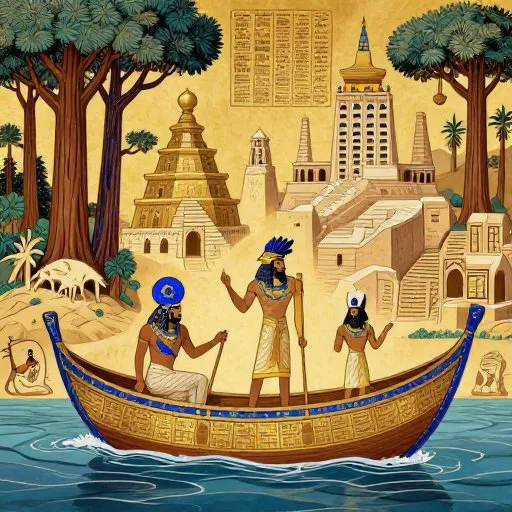
Utnapishtim built the boat. The text describes the work with the specific pride of someone who built a thing they were astonished they managed to build. He used 24,000 shar of pitch for the inside, 12,000 for the exterior. He slaughtered oxen. He killed sheep. He gave the boatbuilders beer, oil, and wine. They drank like a river festival. The construction took, by the text's account, seven days.
He loaded everything. Silver. Gold. All his family. His kindred. The craftsmen. The animals of the field. Wild creatures. The seed of all living things. He poured in beer, wine, and oil as offerings. He drove them in, all of them, and sealed the door.
And then he waited.
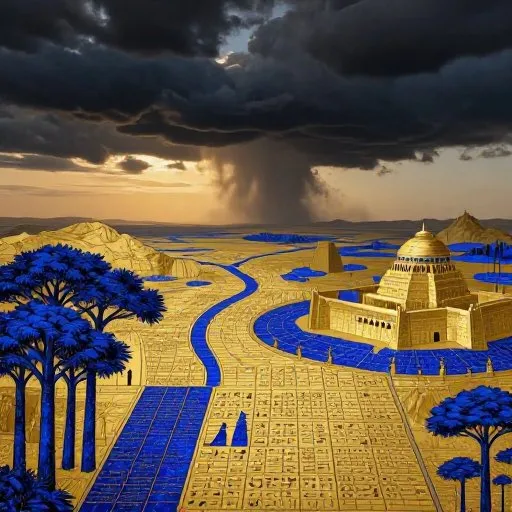
The next morning, a black cloud rose from the horizon.
Adad the storm god was in that cloud. Shullat and Hanish, storm gods, went with him across the mountains. Nergal tore out the dikes. Ninurta made the waterways overflow. The Anunnaki raised up their torches and set the land ablaze with light.
Then the rain came.
The text describes what followed in a passage that has been read aloud in classrooms and lecture halls for over a century, because whoever wrote it down had clearly talked to people who had seen a real flood, or had feared one, and understood the feeling. Even the gods were terrified. Ishtar cried out. She said she had spoken evil in the gods' assembly. She was the one who had agreed to the annihilation of her own people. Now she regretted it and could not stop it.
The gods wept. They sat in the heaven with their knees drawn up, hunched over, weeping.
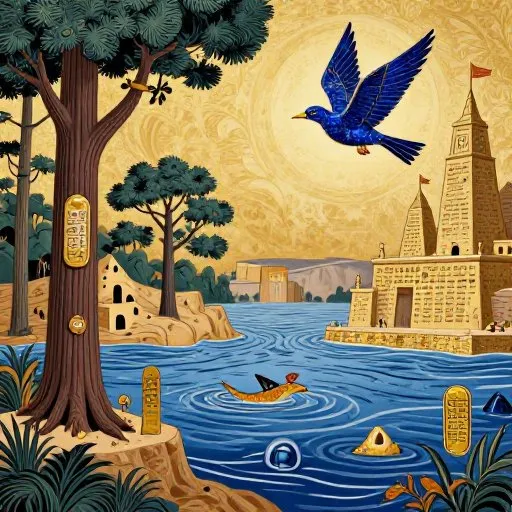
For six days and seven nights, the storm raged. The flood covered the mountains. The boat was tossed. Everything below the boat was mud. What had been humanity was returned to clay.
On the seventh day, the storm slackened. The sea grew calm. The flood became quiet. Utnapishtim opened a vent in the boat and felt the light on his face. He looked around in every direction. He could see nothing but water and the boat and silence.
The entire human race was gone. He was the only one.
He sat down and wept. That is what the text says. He sat down and wept, for he could see nothing but water and the boat.
The boat had come to rest on Mount Nisir. It held there for six days, refusing to budge in any direction.
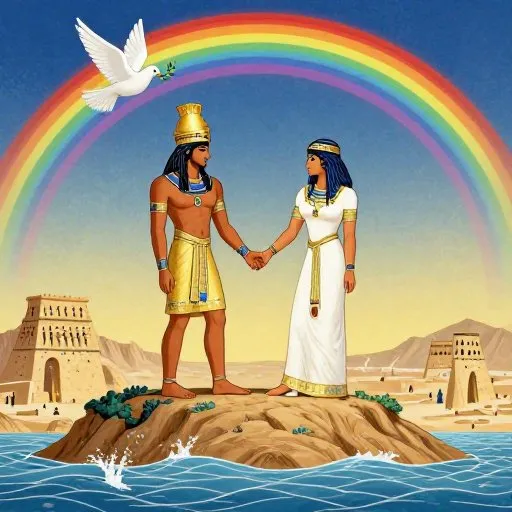
On the seventh day, Utnapishtim sent out a dove.
The dove flew, and found no resting place, and came back. There was nowhere to land. The water was still too high.
He waited. He sent out a swallow. The swallow flew, and found no resting place, and came back.
He waited again. He sent out a raven. The raven flew. And the raven did not come back.
Think about that sequence for a moment. Not because it's dramatic, though it is. Because it's a specific observation about bird behavior used as a flood measurement device. If the dove and the swallow come back, the water hasn't receded enough for a bird to find perch. If the raven doesn't come back, there is land out there. Real land, with things to eat, with places to stand. The raven stayed because the raven found something.
That is three thousand years before Noah. The same birds. The same sequence. Nearly the same logic. The raven even plays the same role: the one that doesn't return. Some scholars count eighteen or more specific parallel elements between the Gilgamesh flood and the biblical version. The parallel is not coincidental and was not an accident of storytelling. One of these stories influenced the other, and the math of which came first has been settled for over a century. The Mesopotamian flood story is older.
Utnapishtim opened all four sides of the boat. He took an animal and made a sacrifice on the mountaintop. He poured reeds and cedar and myrtle into the fire. The gods smelled the fragrance.
And the gods gathered like flies over the sacrifice.
This is how the text describes it. The gods of the ancient Near East, smelling the cooking fire of the last human on earth, gathering like flies. They had killed everyone. They had destroyed everything. And now they were hungry for the smell of a sacrifice, which requires a human being to perform it, which means they had realized the problem with their plan: with no humans, there are no offerings.
Ishtar came. She raised up her lapis lazuli necklace, the one the god Anu had made as a gift, and she swore by it that she would never forget these days. She said: let the gods come to the offering. But Enlil shall not come. He did not consult first. He caused the flood and consigned my people to destruction.
Enlil came anyway.
He saw the boat. He saw that someone had survived. And he was furious. He had called the assembly. He had gotten the votes. He had done this correctly and someone had survived anyway. He wanted to know who had told.
Ea admitted it. Not directly. Ea was too good at this for directly. He said: I did not reveal the secret. I only let the exceedingly wise man hear. Let him hear in a dream.
This was also a lie, but a very smooth one, and Enlil had more immediate concerns. He had destroyed the world and one man had gotten out. He had to decide what to do about it.
Enlil stepped into the boat. He took Utnapishtim's hand. He took his wife's hand. He had them kneel before him. He stood between them and touched their foreheads.
"In the past," he said, "Utnapishtim was mortal. Now he and his wife shall be as gods. He shall dwell in the distance, at the mouth of the rivers."
That was it. That was the decision. Not punishment. Not anger. Enlil stood in the ruins of his own destruction, with the only surviving human in front of him, and gave him immortality. Felt bad, apparently. Or understood, finally, what Ea had understood from the beginning: that humans were worth something. That the noise complaints did not justify what had been done.
Or perhaps he just wanted someone to perform the sacrifices.
The text doesn't tell us which. It tells us what happened. Utnapishtim and his wife were taken to the mouth of the rivers, to the edge of the world, and they lived there forever. Beyond the Waters of Death. Unreachable by ordinary travelers. Immortal, which is another way of saying: outside the story. Outside the part of the world where things happen to people.
Thousands of years later, a king named Gilgamesh would make the journey to find him. Grief-destroyed, terrified of death, looking for the answer. And Utnapishtim would tell him about the flood, explain how immortality works, note that the gods don't give it twice, and watch the king leave with a plant that a snake would eat while he was bathing.
The gods had survived the flood. Humanity had survived the flood. What neither had survived, quite, was what it revealed about the relationship between the two.
The gods had voted to destroy everything. Then they smelled the cooking fire and gathered like flies. That detail, the gods clustering over a sacrifice from the one person left alive, was written down deliberately. The people who wrote this story understood something: that the powerful need the powerless more than they admit, and that this need does not make them grateful. It makes them hungry.
The flood happened. Everything ended. The gods felt terrible. Then they needed dinner.
That is the story. It is four thousand years old and it has not aged at all.