The Aztec myth of Quetzalcoatl: tricked by a rival god, driven from his city, and reborn as the morning star. The full story, with the real history behind it.
Mythwink
He was the wisest god in Mesoamerica. One night with bad company cost him everything.
Before the trick, there was a city. Before the city, there was a god who was different from the others.
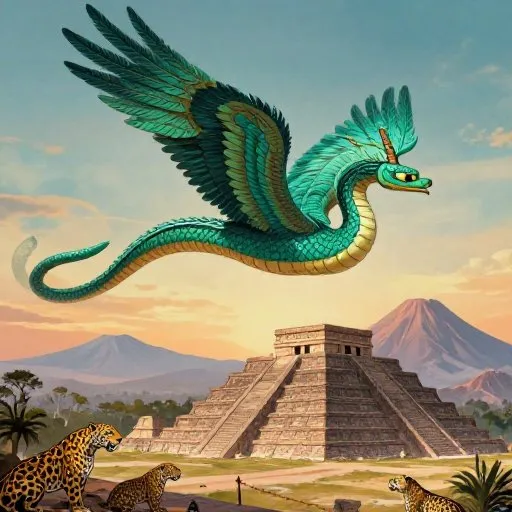
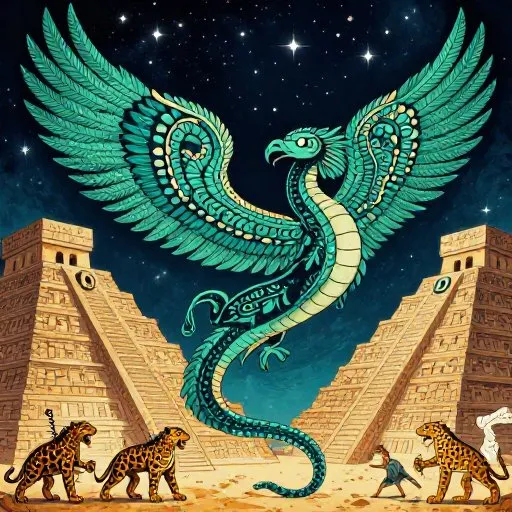
His name was Quetzalcoatl. Feathered Serpent. In the Nahuatl language of the Aztec people, quetzal refers to the resplendent quetzal bird, whose tail feathers ran to three feet long and whose green shimmered like something that had decided to be beautiful on purpose. Coatl means serpent. You put them together and you get the god of wind, learning, craft, and the particular kind of intelligence that separates people from animals.
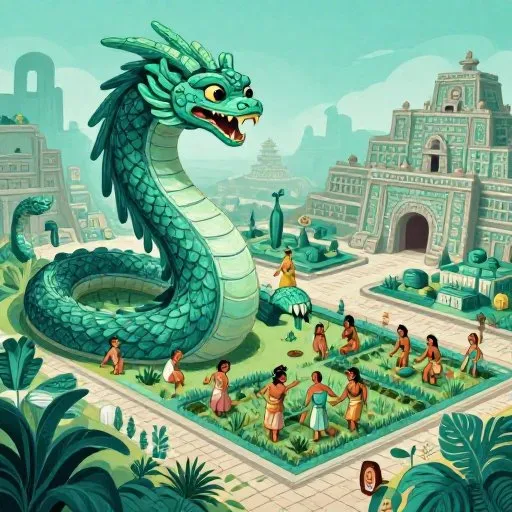
He ruled Tula, the Toltec capital, which the Aztecs looked back on the way people look back on a golden age that may or may not have actually existed. Corn grew in colors that had no names. Cotton came out of the ground already dyed. The city was prosperous and the god at the center of it was good.
Here is the part that distinguished him from every other major deity in the Aztec pantheon: he did not want human sacrifice.
Think about what that means in context. The Aztec religious system ran on blood. The sun itself required it. The gods required it. The entire cosmological machinery required regular human death to keep functioning, and most of the major deities were enthusiastic about this arrangement. Quetzalcoatl burned butterflies on his altars. Jade. Sweet incense. He made his offerings from beautiful things. He was not interested in the other kind.
This was not a minor theological difference. This was the most consequential thing about him.
Tezcatlipoca noticed.
Tezcatlipoca's name means Smoking Mirror.
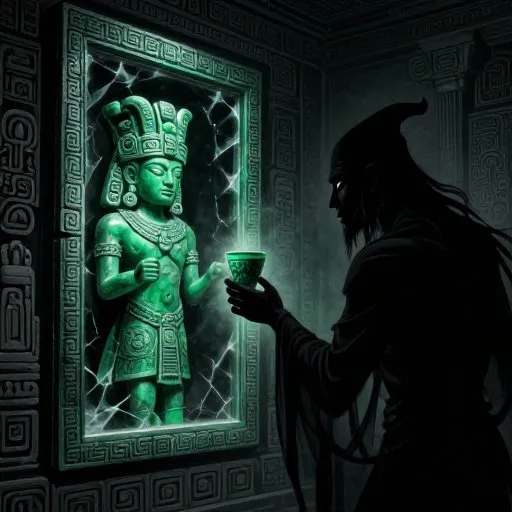
His mirror was obsidian, volcanic glass, black and reflective and slightly wrong the way all mirrors are slightly wrong if you look too long. It did not show you what was in front of it. It showed you the truth behind what was in front of it. He was the god of sorcery, the night sky, jaguars, and the kind of darkness that is necessary rather than evil. He and Quetzalcoatl were opposing forces in the Aztec cosmos. Where there is light, there must be shadow. The shadow arrived in Tula disguised as an old man selling something.
He sent word to Quetzalcoatl's palace that he had a gift: a mirror that would show the god something he had never seen.
You want to know the wildest part? Quetzalcoatl, the god of wisdom and learning, the one who had spent centuries understanding the nature of things, heard "a mirror that will show you the truth" and sent for it immediately. Immediately. No hesitation. No consideration of why a stranger would show up with a magic mirror as a gift.
He held it up. He looked in.
What he saw was his own face. Old. Lined. Something mortal-looking hiding underneath the divine. He recoiled. He had not known. He had been tending his city and his people and his altars with butterfly offerings, and time had been doing what time does, and he had never stopped to look at himself. The god of wisdom, who could read the stars and teach the nature of existence, had not looked in a mirror in a very long time.
Tezcatlipoca did not need to say anything. The first wound was open. He could come back later with the second.
He came back as a physician.
The drink he brought was pulque, the fermented agave beverage that ordinary people used for ordinary forgetting. He told Quetzalcoatl it was medicine. This was, technically, the oldest and simplest lie available to anyone. Tezcatlipoca had gone from a magic mirror to a cup of something blurry, and it was working.
Quetzalcoatl had been fasting since the mirror. Days of penance, trying to work something out about what he had seen. He was tired and depleted and not thinking the way he usually thought. He drank one cup.
One cup tasted like the absence of the thing that had been troubling him. He drank more. The Aztec sources, including the Historia Tolteca-Chichimeca and the accounts compiled by Sahagún in the 16th century, agree on what happened next: he called for his sister Quetzalpetlatl, who had taken the same vows of celibacy and penitence that he had, and she drank too. The night passed in ways that neither of them would have chosen sober. Tezcatlipoca was not even there to see it. He did not need to be. The trap had already sprung.
Morning came.
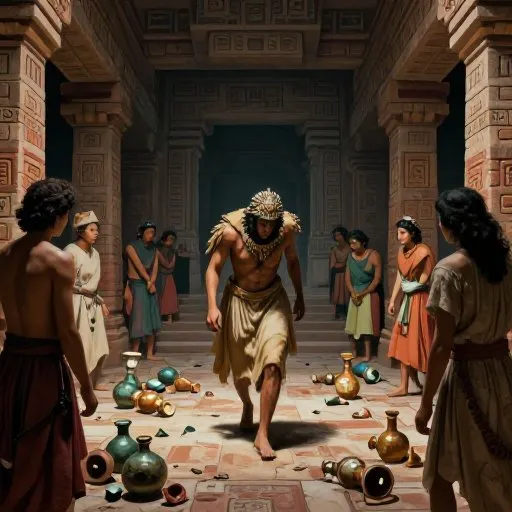
There is no funny version of this. There is no angle from which it gets less serious. Quetzalcoatl woke in the ruins of every promise he had made to himself and understood what had happened with complete clarity. Tezcatlipoca had not made him do anything. He had been presented with an opportunity to betray himself, and he had taken it.
The sorrow that came down on him was cold and patient and not going anywhere.
He could not stay in Tula.
Not forced out. The sources are specific about this. He left because he could not be what the city needed from inside what he had done. There is a difference between those two things, and it mattered to him.
He put on his finest vestments: the turquoise mask, the quetzal feathers, everything that marked him as what he was. He walked east, toward the sea. The people of Tula came out to watch him go. Some followed. Some wept. Some stood in the specific silence of people who cannot find the right words for something that large.
Along the way, he buried things. Skills he had given to the Toltec people: the knowledge of metallurgy, of cacao cultivation, of certain arts and crafts. He buried them in the ground so that Tezcatlipoca could not possess them. He buried them also because he was leaving, and when you leave a place completely you cannot carry everything.
He walked for a long time. Years, some accounts say. The Anales de Cuauhtitlan, one of the most detailed Nahuatl sources for this story, describes a long journey east marked by grief and by things he left behind at each stop: cacao trees that withered to mesquite, birds that flew away rather than follow.
When he reached the coast of the eastern sea, the place that some accounts call Tlapallán, Tula was more memory than location.
He built a pyre. He stood in it. Let me be clear about the accounts here: they are consistent on this point. Quetzalcoatl did not fall. He was not pushed. He did not stumble. He stepped into the fire himself, with the full intention of doing it, the way a person steps into cold water with their eyes open.
The fire took him. Birds rose from the coals when the smoke went entirely black. Every color and feather. And in the east, just before the sun arrived, a star appeared that had not been there before.
Venus does not move the way other stars move.
It appears before dawn, bright enough to cast a faint shadow on a clear night, and then the sun rises and Venus vanishes. It appears again after sunset, hangs in the western sky for a few hours, and disappears when the night deepens. It is always there in the same relationship to the sun: either just ahead of it, announcing the morning, or just behind it, holding the last light.
The Aztec astronomers tracked Venus obsessively. They had tables of its movements accurate to within two hours over a five-hundred-year span. The Venus cycle, which runs 584 days, was incorporated into the sacred calendar. The planet disappeared below the horizon for eight days and reappeared as the morning star. The Aztec astronomers understood that disappearance and reappearance as death and resurrection. Their word for that eight-day disappearance was the same word they used for the underworld.
Quetzalcoatl was the morning star. He had been the light of wisdom in Tula, the thing that came before understanding and announced it. He became the light that comes before the sun. The pattern Venus traces, vanishing into darkness and rising again, over and over: that was his story. He walked into the fire and came out as light.
And then a prophecy grew from it. He would return from the east, from the sea, in a year designated One Reed in the Aztec calendar. The fifty-two-year calendar cycle made One Reed a recurring date, but the prophecy was specifically about a particular return.
In 1519 by the European count, One Reed arrived. Hernan Cortes sailed in from the east, from the sea, with ships and armor and horses that no one in the Americas had seen before.
Whether Moctezuma II actually believed Cortes was Quetzalcoatl is a question historians argue about seriously, and the honest answer is that we do not know. The sources we have were written after the conquest, by people with competing reasons to tell the story a particular way. What we know is that the prophecy existed, that the year was the year, and that the world has a way of providing arrivals for prophecies even when the arrivals are nothing like what was meant.
Quetzalcoatl walked into a fire and became a star that rises every morning before the sun. Tezcatlipoca got what he wanted, and then lost the civilization that worshipped him. The morning star is still there. It arrives before the sun every day, just as it always has, the way something will if it is patient enough and the sky is still working.