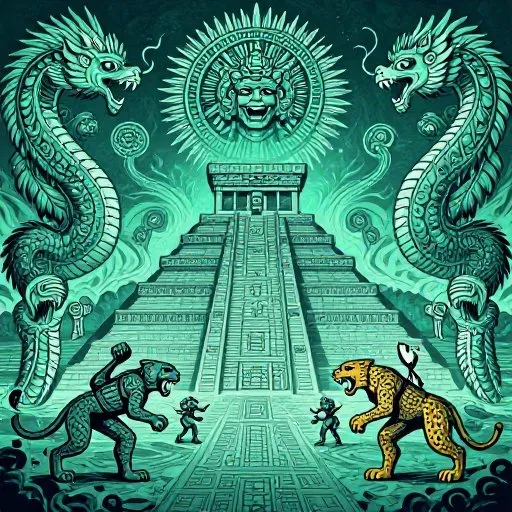
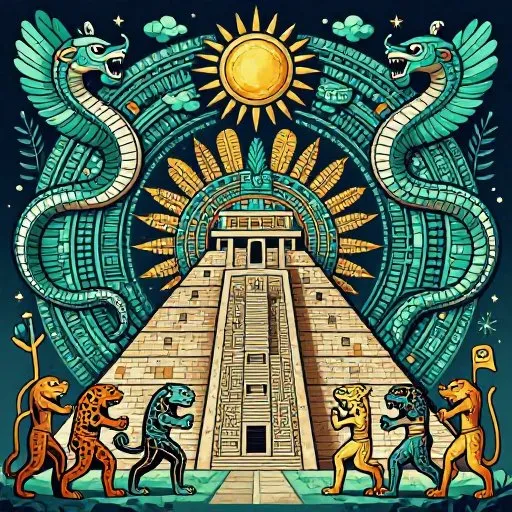
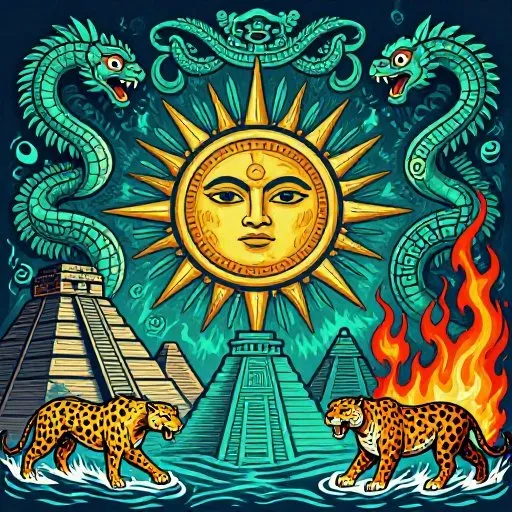
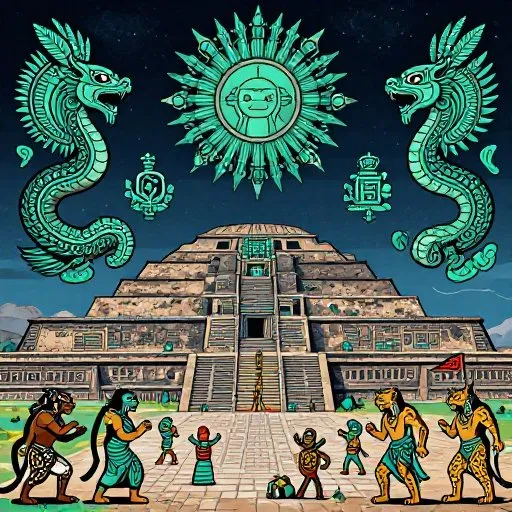
The Aztec creation myth: four worlds built and annihilated by gods who couldn't agree. The fifth sun, ours, was made from courage. It will end in earthquakes.
Mythwink
The gods destroyed the world four times before they got it right. Ours might be the last try.
The world you are standing in is not the first one. That is the starting position of Aztec cosmology, and it is important to sit with it before moving on. Not the first. Not a fresh creation. The fifth. There were four worlds before this one, and each of them was destroyed, and if you ask the Aztec sources why, the answer is more or less: because the gods were fighting.
The Nahuatl-speaking Aztec peoples, the Mexica, recorded this cosmology in several surviving manuscripts. The most complete is the Leyenda de los Soles, the Legend of the Suns, written down in 1558 after the Spanish conquest, partially preserving what had been oral and inscribed tradition for centuries before. There is also the Codex Chimalpopoca. There is the Codex Vaticanus. Different sources, different emphases, sometimes different details. The core structure holds across all of them: four ages have ended, a fifth age is running now, and it too will end.
Each age is called a Sun. Not because of the literal object in the sky, though that's involved, but because in Aztec cosmology each era had its own animating force, its own divine sponsor, its own character. Each one was somebody's project. Each one failed.
The gods who run through all of this are primarily two: Tezcatlipoca, Lord of the Smoking Mirror, god of darkness and sorcery, associated with jaguars and night. And Quetzalcoatl, the Feathered Serpent, god of wind and knowledge, one of the most complex divine figures in any mythology anywhere. These two disagreed about nearly everything. Four worlds is, in retrospect, not surprising.
The first world was Tezcatlipoca's. It went badly from the start.
Tezcatlipoca's Sun was the Sun of Earth. He was the sun itself. He presided over a world populated by giants who ate acorns, which in the original sources is presented as important information. The world ran for 676 years by the Aztec calendar count.
Then Quetzalcoatl hit him with a staff and knocked him out of the sky.
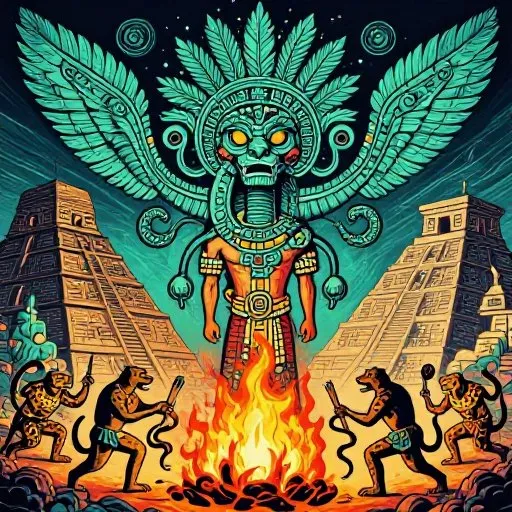
Tezcatlipoca fell into the ocean and became a jaguar, and when he emerged, the jaguars ate everything. Every giant. The entire population of the first world. Gone. The sky collapsed. The world ended in the teeth of great cats.
This is not considered unusual by the Aztec sources. They record it the way you'd record any historical event.
The second Sun was Quetzalcoatl's. Four hundred years in, Tezcatlipoca got his revenge. He turned the people of the second world into monkeys and then unleashed a hurricane that blew everything away. Almost everything. A few people survived by becoming monkeys. Which is an interesting thing to survive as.
The third Sun belonged to the rain god Tlaloc. This one ended in fire. A rain of fire. The people who weren't killed outright became birds. Some versions say it was Quetzalcoatl who set this one burning. The gods kept wrecking each other's projects.
The fourth Sun was presided over by Chalchiuhtlicue, Jade Skirt, goddess of rivers and lakes and the sea. Hers lasted the longest before it went wrong. When it ended, it ended in flood. Fifty-two years of rain. The sky fell into the water. The people became fish. That is four complete extinction events in a row, four worlds, each with its own people and sky and sun, each ending in a catastrophe large enough to reset everything.
Think about what it means to tell this story. The world before yours was destroyed. The world before that was destroyed. The world before that. And the one before that. The ground you stand on is the fifth attempt. The Aztec relationship with existence was not one of permanence. It was one of precarious continuation. The world was not stable. The world could end. The world had ended before and the evidence was all around them.
That context matters for what came next.
The fourth world was over. The sky was dark. No sun, no moon. The gods gathered at Teotihuacan, the place where gods are made, at what is now one of the most visited archaeological sites in Mexico, a city that was already ancient and abandoned when the Aztec encountered it in the 14th century. They named it Teotihuacan: the place where time begins, or the place where men become gods. They did not build it. They found it and understood it as a place where something enormous had happened.
The gods needed a new sun. They needed someone to throw themselves into a great fire and be transformed into light.
Two volunteers came forward.
Tecuciztecatl was splendid. Everything about him was fine: his fir-branch offering was made of coral, his hay balls were made of gold, his cactus spines were made of red coral tipped with actual blood. He was beautiful, prepared, polished. He was exactly the kind of god who expected to be chosen for the important roles.
Nanahuatzin was the opposite. He was humble, poor by divine standards, covered in sores and scabs. His offering of hay was actual hay. His cactus spines were actual cactus spines. His blood offering was from a real wound. He had no gold. No coral. No presentation. He was the kind of figure who is present at important events but rarely mentioned in the official account.
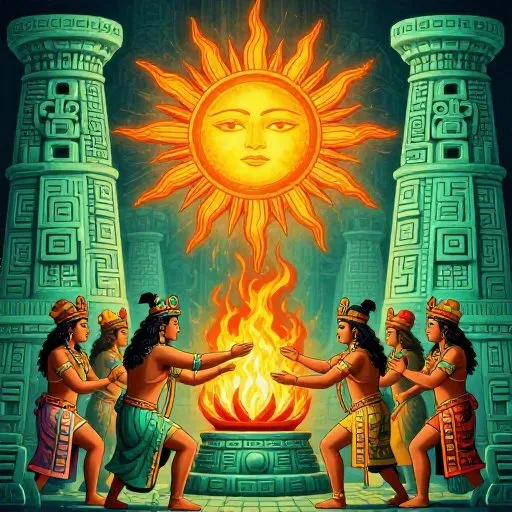
The fire was built. Four days it burned. On the fifth day, the two gods stood before it.
Tecuciztecatl went first. He ran at the fire. The heat hit him and he stopped. He tried again. He stopped again. Four times he ran at the fire and four times the fire stopped him. He was brave enough to volunteer. He was not quite brave enough to finish.
Nanahuatzin stood at the edge of the fire. Everything the Aztec sources say about him is unflattering up to this moment. The scabs. The poverty. The ordinary offerings. He had not made a strong case for himself as the center of the universe.
He looked at the fire for one moment. Then he ran straight into it. No hesitation. No second attempt. He ran in and it consumed him.
And then Tecuciztecatl, shamed, jumped in after him.
The gods waited. Two things rose from the fire. Two suns. Both equally bright. Two suns in the sky would have been untenable; the world would have burned. One of the gods picked up a rabbit and hit one of the suns with it, dimming it. That dimmed one became the moon. You can still see the shadow of the rabbit in the face of the moon, which is not how European cultures read the marks on the lunar surface, but is how Aztec and Nahuatl tradition reads them.
Nanahuatzin's sun was in the sky but it wasn't moving. The Aztec sources are specific about this. The sun hung in the east and did not move. The gods shouted at it. They begged it. Nothing. The sun required blood to move. Required sacrifice. The gods understood this and did the thing the story had been building toward: they sacrificed themselves. All of them. Every god, dead, to set the sun moving. Quetzalcoatl killed them. The sun began to move.
The fifth world, our world, began at that moment.
And here is what the Aztec cosmology is actually saying, underneath the blood and the fire and the jaguars eating everything. The world was not made from beauty or power or perfection. It was made from a diseased, pimply god who didn't hesitate. Courage, not splendor. Willingness, not presentation. The sun in our sky, the one you can see on any clear day, is Nanahuatzin. He made it. He is it.
The gorgeous candidate who practiced for four days and still flinched four times in a row is the moon. Dimmer. Fainter. Marked with the rabbit that hit him.
The fifth Sun will end in earthquakes.
This is not speculation in Aztec cosmology. It is the schedule. Each sun ends in the thing associated with its date in the Aztec calendar system. The fifth sun, our sun, was born on the date 4 Ollin. Ollin means movement. Earthquake. On the day 4 Ollin, at some point in the future, the fifth world ends.
The famous Aztec sunstone, sometimes mistakenly called the Aztec calendar, is carved with this information. The face at the center is often identified as Tonatiuh, the sun deity. Around it are the symbols of the four previous suns, and the four directional claws, and at the outer edge all the days of the calendar. The whole thing is a cosmological map of created and destroyed worlds, read outward from the center. It was carved around 1502 CE and weighs nearly 24 tons.
The Aztec response to knowing that the world would end was not despair. It was maintenance. The sun needed to be fed. Blood sacrifice, in Aztec religion, was not cruelty or theater. It was a mechanical necessity. The sun had been bought by the self-sacrifice of every god. It required ongoing sustenance to keep moving. If it stopped, the world ended, and four previous worlds' worth of evidence showed that was a real thing that happened. You do not let the fifth attempt fail if you can help it.
This is an uncomfortable thing to present in modern context. Aztec human sacrifice was real and it was large in scale and this telling is not going to minimize it. What it asks instead is that you hold both things: the genuine horror of what happened and the genuine theological architecture that required it, in the minds of the people doing it. They were not performing cruelty. They were, by their understanding, keeping the sun moving.
The sun is still moving.
Every culture that has ever built something and understood it might not last has its own version of maintenance, its own way of insisting that continuation requires effort, requires cost, requires somebody to keep doing the hard thing every day. The Aztec version was vivid and specific. But the anxiety underneath it, the awareness that everything ends and the world is borrowed, not owned: that part is not exclusively theirs.
The earthquakes have not come yet. That is all any calendar can tell you.