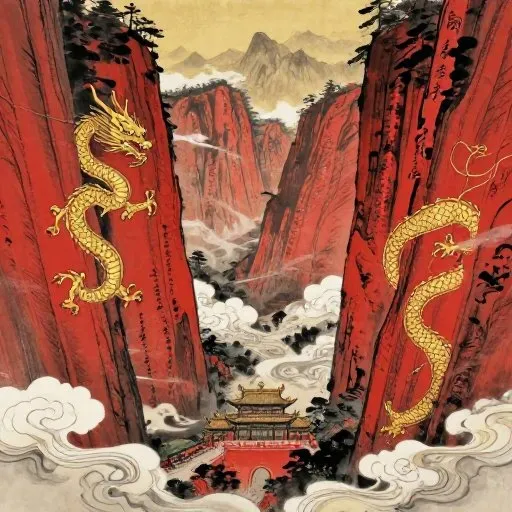
The Chinese myth of the Dragon Gate: carp who leap the Yellow River falls become dragons. The myth behind a metaphor that shaped two thousand years of Chinese ambition.
Mythwink
Every carp in the Yellow River is trying to jump a waterfall and become something else.
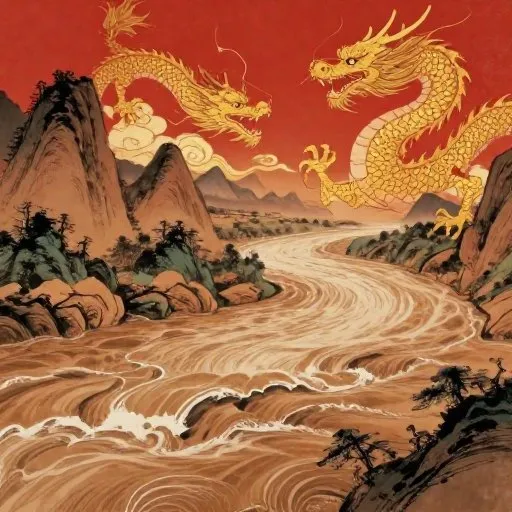
The Yellow River, the Huanghe, carries so much sediment that it runs brown in some stretches and almost orange in others, and has done this for as long as anyone has been watching. It is 5,464 kilometers long. It has flooded catastrophically more than once per century for most of recorded history. The Chinese called it "China's Sorrow" and also, without contradiction, "the cradle of Chinese civilization," because a river does not have to be pleasant to be essential.
In the river there are fish. Carp, specifically. Common carp, whose Latin name is Cyprinus carpio, who have been swimming in Chinese rivers and lakes and ponds for longer than there has been a China. They grow large and live long and are not beautiful in the way ornamental fish are beautiful: they are solid, thick-scaled, orange-brown or gray-green, built for rivers rather than ponds. A mature common carp can reach a meter in length. They can live forty years. They are, by any measure, extremely successful fish.
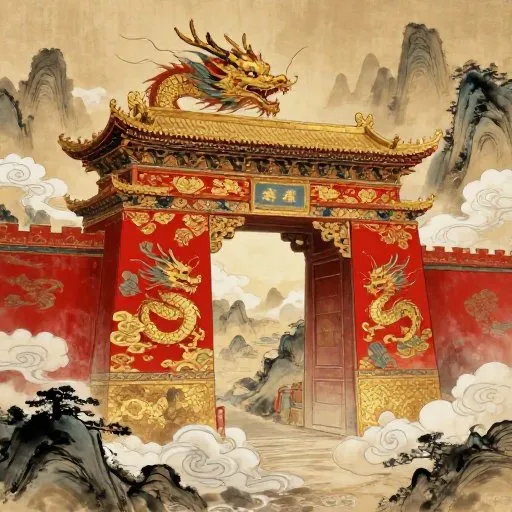
And somewhere in the river, the water picks up speed. The land rises. The current fights back against anything trying to move upstream. At a place called Longmen, the Dragon Gate, the Yellow River pours through a narrow gorge between cliffs, and the water falls.
This is real. Longmen is a real gorge on the Yellow River, on the border of Shanxi and Shaanxi provinces in north-central China. The water is fast and turbulent and cold. The spray comes up in clouds.
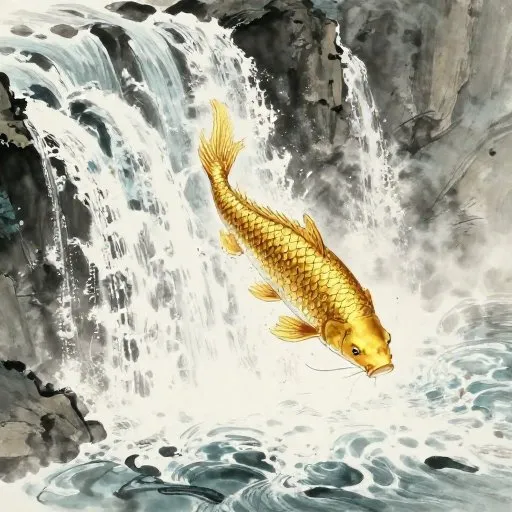
According to the tradition recorded in Han dynasty texts, if a carp reaches this waterfall and jumps over it, it transforms. It passes through the falling water and comes out the other side no longer a carp. It becomes a dragon.
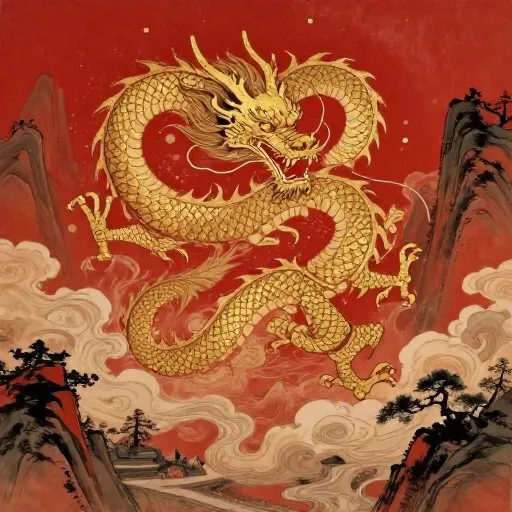
Not a metaphorical dragon. A dragon. The long, scaled, cloud-riding, pearl-carrying, rain-commanding dragon of Chinese cosmological tradition, the creature associated with imperial power and heavenly mandate and the creative force of the universe. A fish goes in. A dragon comes out.
Think about what that costs.
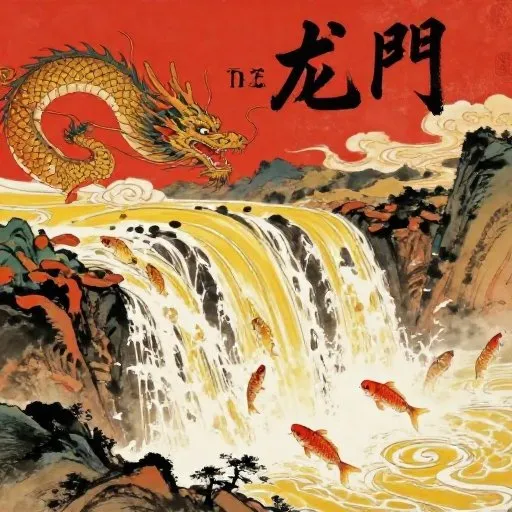
To jump the Dragon Gate, you first have to reach it.
The Yellow River runs from the Tibetan plateau in the west, through loess highlands, through plains, to the sea. The carp swimming toward Longmen are swimming against that current for hundreds, sometimes thousands of kilometers. The river runs fast in places and slow in others. In spring, snowmelt from the mountains pushes the current harder. The water is cold and brown and full of silt that gets into the gills and makes everything harder.
Most carp don't make the attempt. The ones that do are moving against every hydraulic force the river can produce. They fin upstream through the channels and eddies, finding the calmer water near the banks, cutting through the fast sections when they have to. They get tired. They rest against submerged rocks. They start again.
The texts don't describe this in detail. The myth focuses on the gate, not the river. But the river is implied: the gate means nothing if the journey to it costs nothing. A transformation that's free isn't a transformation. It's just a change of scenery.
In autumn, something that Chinese naturalists observed for centuries and recorded in texts going back to the Han dynasty: carp leap. They leap at this particular stretch of the river, at the gorge, visibly and repeatedly. Real carp. Actually jumping. The behavior is still observable today and is consistent with what carp do in fast-flowing water with significant vertical obstacles: they try to get over them, because upstream is where the spawning grounds are.
The Chinese watched this happen. They built a myth around it that said: some of them make it, and when they do, something changes.
Here is the detail the texts most agree on: the ones that fail don't just fail. They are marked.
The carp that attempts the leap and doesn't clear the falls gets scorched across the forehead as it falls back down. A black mark, burned into the scale between the eyes. The Red Rescript of Heaven, some sources call it. The sign that you tried and didn't make it.
You want to know what this sounds like? This sounds like the people who invented this story had watched a lot of carp jumping at a waterfall and noticed that the ones that fell back often had abrasions on their heads from hitting rocks, and they turned that observation into theology.
They also turned it into mercy, of a kind: the mark is not permanent shame. It fades. The fish may try again. The Yellow River doesn't disqualify you. You can keep swimming upstream and try the jump again, for as long as you're alive and strong enough to make it back.
Most still don't make it. The gorge is narrow and the falls are real and physics is not a respecter of ambition, mythological or otherwise. The ones that leap and clear the gate: those are the dragons. They come up through the spray and the mist and they are not what they were when they went in.
The Shuyiji, a collection of mythological accounts from the fifth to sixth centuries CE, describes the moment: fire comes down from heaven, burning away the tail, and the carp is no longer a carp. This detail matters. The fish doesn't just grow scales and a different shape. Something is actively completed by heaven. The transformation requires both the effort from below and the recognition from above.
Some transformations work that way.
By the Tang dynasty, 618 to 907 CE, the phrase "leaping the Dragon Gate" had become a fixed idiom for passing the imperial examinations.
The keju system: the Chinese civil service examinations, the most elaborate meritocratic selection process in the pre-modern world. Open, at least in theory, to men of any background. Tested on the Confucian classics, on calligraphy, on poetry composition, on legal and historical knowledge. The tests ran for days. Candidates sat in individual cells, sealed in, writing from dawn to night. The final examinations in the capital could determine the rank and posting of a man's entire career. His family's status. Whether his children would go hungry.
A farmer's son who passed became an official. An official who passed the highest level might join the emperor's inner council. The transformation was social, financial, and political: you went in one thing and came out another, and the river you'd swum upstream to get there was decades of study and poverty and failed attempts and trying again.
The metaphor was not lost on anyone. Carp and scholars were compared explicitly, in poetry, in official documents, in family letters. Your son studying for the exams: a carp in the river, working toward the gate. If he passes: a dragon. If he doesn't: the mark on the forehead, and try again.
The poet Li Bai, in the eighth century CE, used the image. The poet Meng Jiao wrote about it after passing his exams at age 46, after two previous failures: he described himself as a horse finally let off its tether, a man finally made new. The Dragon Gate metaphor is in the poem without being named. It didn't need to be. Everyone reading it knew.
This is what a good myth does. It gives a civilization a way to talk about what they're going through, a shape to put around experiences that would otherwise be just suffering and trying and hoping. The carp doesn't know it might become a dragon. It just knows the current is strong and the water is cold and it keeps swimming.
Longmen, the Dragon Gate gorge, is real and you can go there. It sits on the border of Shanxi and Shaanxi provinces where the Yellow River cuts through the Qinling-Daba mountain range. The cliffs rise steeply on both sides. The water runs fast. In spring it is loud.
There is also a Longmen in Luoyang, Henan province: the Longmen Grottoes, a UNESCO World Heritage site, 2,300 cave temples carved into the limestone cliffs along the Yi River, beginning in the late fifth century CE and continuing for four hundred years. Over 100,000 Buddhist figures. The largest Buddha figure stands seventeen meters tall. This Longmen is not the Dragon Gate of the fish myth, though the name and the resonance overlap in ways that don't seem accidental.
The carp-to-dragon transformation also explains something in Chinese visual art: why dragons are so often depicted with whiskers that look like catfish barbels, with scaled bodies that seem to reference fish more than any land animal. The dragon is not foreign to the water. The dragon came from the water. That is where it began, before the leap, before the fire from heaven, before whatever it turned into on the other side of the falls.
The golden-scaled carp appears in Chinese New Year imagery, on lanterns and fabric and paper decorations, specifically because of this association: fortune, transformation, the promise that the new year could be the year you clear the gate. Koi, the ornamental carp so widespread in East Asian garden ponds, carry the same symbolism in a more manicured form. They are decorative descendants of the leaping metaphor.
The myth does not promise that every carp becomes a dragon. It promises that some do. That the river is the same for all of them, that the gate is the same gate, and that what you are when you get there depends entirely on what you brought upstream with you.
That is, when you strip it to the frame, what every story about ambition has always been saying. The Chinese put a waterfall on it and made it specific enough to become an idiom that lasted two thousand years.