The Norse myth of Baldur's death: how Frigg forgot to ask mistletoe, how Loki found out, and why one god's funeral set the end of the world in motion.
Mythwink
The most beloved god in Norse mythology. Killed with a plant. By his own blind brother. Because of a loophole.
Every culture has that one figure. The one everybody likes. The one who shows up and the whole room relaxes. In Norse mythology, that figure was Baldur.
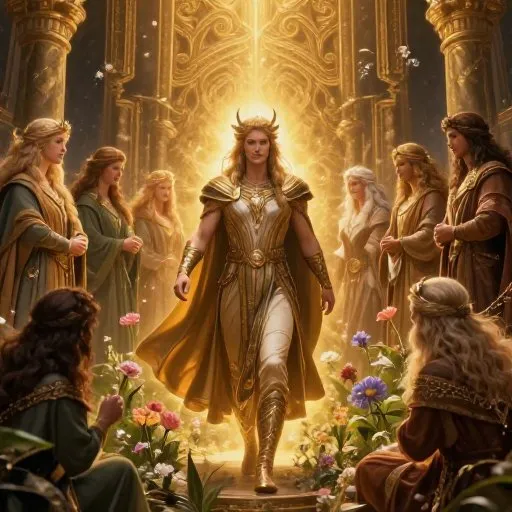
The Prose Edda, compiled by the Icelandic poet Snorri Sturluson around 1220 CE, describes Baldur in terms that make him sound almost too good to be a Norse god. He was beautiful. He was wise. His decisions were always right. Everything around him was bright. His hall, Breidablik, sat in the sky and nothing unclean was permitted near it. He was also described as kind, gentle, and universally loved. In a pantheon that included Odin, who murdered people for poetry, and Thor, who hit everything with a hammer, Baldur was the one who just seemed like a decent person.
You can feel where this is going.
The dreams started. Bad ones. Not the vague-unease variety. The specific kind, where you wake up knowing exactly what you saw and wishing you hadn't. Baldur began dreaming of his own death. Every night. In detail. The Norse took dreams seriously, and these were not the dreams you dismiss over breakfast. These were prophecy.
He told the other gods. And here is the first remarkable thing about this story: they believed him. Immediately. Nobody told him to eat less before bed. Nobody suggested maybe he was stressed. The gods looked at the most beloved god in creation, heard that he was dreaming of dying, and collectively said, "We need to do something about this right now."
That's how loved Baldur was. The gods panicked.
Frigg, his mother, was the wife of Odin. The queen of the gods. She made a decision that must have seemed reasonable at the time. She went to every thing in existence and asked each of them to swear an oath not to harm Baldur.
Every thing.
Fire. Water. Iron. Every kind of metal. Every kind of stone. Earth. Trees. Diseases. Venom. Serpents. Animals. She went down the list and she got oaths from all of it. The fire swore. The iron swore. The diseases, which must have been an interesting conversation, swore. Baldur became, by every reasonable measure, invulnerable to everything in creation.
She missed one.
Mistletoe. It grew on an oak tree west of Valhalla. It was small. It was young. Frigg looked at it and decided it was too young and too small to be worth asking. What was mistletoe going to do?
What mistletoe was going to do would eventually end the world.
Word got around. Obviously. Invulnerability is not the kind of thing you keep quiet about, especially among gods who are primarily interested in tests of strength and who spend a notable portion of their time trying to hit things.
The gods invented a game. Because of course they did.
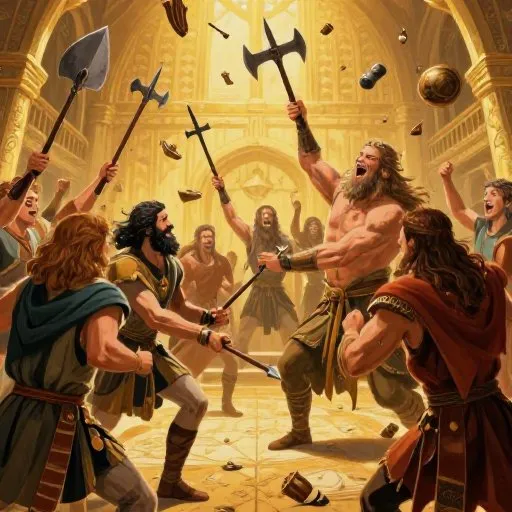
The game was simple. You threw something at Baldur. It didn't hurt him. Everyone laughed. Then someone else threw something. Also didn't hurt him. Also everyone laughed. Stones bounced off. Weapons turned aside. Objects that would kill anything else just sort of fell to the ground around him. Snorri describes this as a form of entertainment, a divine party game, and the gods apparently found it endlessly amusing.
Think about what this looks like. The most beloved god in Asgard, standing in a courtyard, having things thrown at him, unhurt, while everyone cheers. It was celebration. It was relief. It was collective joy that the thing they were all afraid of was not going to happen.
Loki watched this for a while.
Loki. Son of giants, adopted into the Aesir. He was not evil, not exactly, or at least not yet. He was complicated in the way that the most interesting characters in any mythology are always complicated. Clever in ways that made everyone nervous. Helpful until he wasn't. The Poetic Edda and Prose Edda both treat him as a figure who existed between categories, neither fully one of the gods nor fully an outsider, neither a villain with clear motives nor an ally you could trust.
What he saw in that courtyard seemed to bother him. Maybe it was Baldur's joy. Maybe it was everyone else's. Maybe it was the thing that Loki could never quite stand: a situation where everything was going well for everyone and he wasn't the reason why.
He left the courtyard. He went to Frigg in disguise, as an old woman, and he asked her a casual question. Had she really gotten oaths from everything? Everything in existence?
Frigg, proud, relaxed, certain that her son was safe, said almost everything. She mentioned the mistletoe. She mentioned why she had skipped it. Too small. Too young. Too insignificant to bother with.
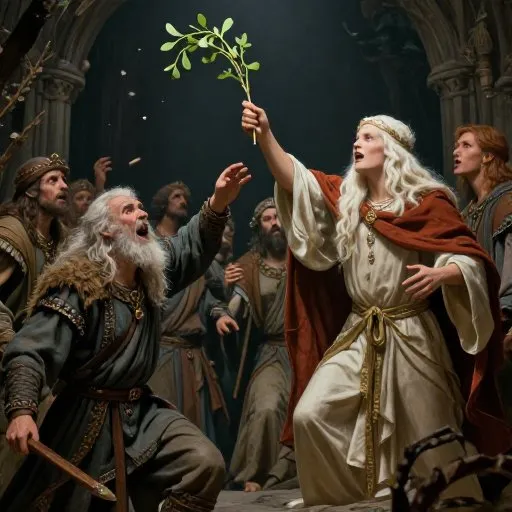
Loki found the mistletoe. Cut it. Shaped it into a dart.
The decision he made next was the hinge point of Norse mythology. Everything before it was prelude. Everything after it was consequence.
Hod was Baldur's brother. He was blind. He was standing at the edge of the gathering, not participating in the game, because there is a particular kind of loneliness in standing outside a joyful thing that everyone else can do and you cannot.
Loki walked over to him. He was friendly. Sympathetic, even. Why aren't you throwing anything at your brother? Shouldn't you honor him too? Everyone else is doing it.
Hod explained. He couldn't see well enough to aim. And he had nothing to throw anyway.
Loki handed him the mistletoe dart. He offered to guide his arm. Point him in the right direction. All Hod had to do was throw.
So Hod threw it.
Baldur fell.
That is it. That is what happened. The most beloved god in all of Norse cosmology, protected by the sworn oaths of every element and creature and force in existence, died because his mother thought a plant was too small to matter and his blind brother was standing at the edge of a party feeling left out.
The gods stood in silence. Snorri writes that they were stunned beyond speech. Then they tried to grab Loki, but he was already gone.
The wailing that followed shook Asgard. The Prose Edda says no one could speak of vengeance while they were still in a holy place. That was the rule. So they stood there, in the wreckage of the happiest moment they had had in years, and they wept. Even Odin, who knew things, who had sacrificed an eye and hung on a tree for wisdom, wept. The Poetic Edda says Odin's grief was greater than everyone else's because only he understood the full weight of what this death meant for what was coming.
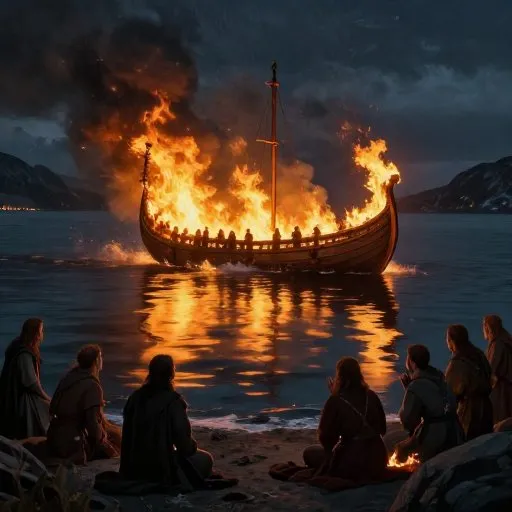
Baldur's wife, Nanna, saw his body on the funeral pyre. Her heart broke. Not a metaphor. She died there, beside him, and was laid on the pyre with him. That detail is in the Prose Edda and it is stated as simply as everything else. She died of grief, and she was buried with him, and the Norse told this without ceremony because sometimes the plainest telling is the only honest one.
They built the greatest funeral pyre that had ever been built. The ship was Hringhorni, the largest ship in existence. They tried to push it to the sea and it wouldn't move, so they sent for a giantess named Hyrrokin, who arrived riding a wolf and using serpents for reins, and pushed the ship into the water so hard that fire sparked from the rollers and the earth shook. Thor was so startled that he nearly hit her with his hammer.
At a funeral. Nearly hit the helper at the funeral. Thor remained Thor until the end.
Odin placed his ring Draupnir on the funeral pyre. The ring that reproduced itself every ninth night, dropping eight identical rings. He whispered something in Baldur's ear before the pyre was lit. Nobody ever found out what it was. Snorri mentions it and moves on. The secret has been sitting there in the text for eight hundred years.
Then Hermod, one of the gods, rode to Hel to ask for Baldur back.
Hel was not just the place of the dead. She was the ruler of it. Daughter of Loki. Half her body was the color of living flesh, half the color of a corpse. Hermod rode for nine nights through valleys so dark and deep that he couldn't see anything. He crossed the Gjoll bridge, which rang underfoot, and at the gate of Hel's realm a giantess told him no ordinary dead man had ridden this way because his road rang too loud for a dead man's horse.
He found Baldur sitting in the seat of honor. Naturally. Even in death, everyone gave Baldur the best seat.
Hermod asked Hel to release him. Hel, who had rules to maintain, made an offer. She would release Baldur if every living thing in all the world wept for him. Every thing. If anyone or anything refused to weep, Baldur stayed.
The gods sent messengers everywhere. To every corner of the nine worlds. To humans, to giants, to animals, to trees, to stones, to metals. Ask everything to weep for Baldur, and everything did. The entire world wept for the god of light. In terms of response rates, this was unprecedented. You could not have achieved this result for anyone else.
Almost everything. In a cave, they found a giantess. Her name was Thokk. She sat there and she refused. She said Baldur had never done anything for her. He could stay in Hel for all she cared. She didn't need him to come back.
The messengers knew. They knew it was Loki. Snorri says so directly. Thokk was Loki in disguise. The gods knew. Loki knew they knew. He had already done what he came to do.
One refusal. That was all it took. Hel kept Baldur. The most beloved god in existence would remain dead until after Ragnarok, after the end of the world and the beginning of the next one. The gods knew this. They had always known this was how it would go. Odin had known from the beginning. And Loki had just moved the whole thing one step closer to its conclusion.
Here is what you need to understand about Baldur's death in the context of Norse mythology.
It wasn't an accident. Not cosmically. The dreams were prophecy, which means the outcome was always coming. The question was never whether Baldur would die. The question was how the gods would respond to the knowledge that he would.
And the answer was that they tried. Frigg tried. The gods tried. The messengers riding across nine worlds trying to get a teardrop from every grain of sand and every stone on every mountain floor tried. Norse mythology is full of this quality, the attempt against the inevitable, the effort that is made fully knowing it will not be enough. They tried anyway. Every time.
The gods captured Loki eventually. After Baldur's death, after he fled, after he changed into a salmon and hid in a river. They caught him. They bound him in a cave with the entrails of his own son. A serpent was placed above him to drip venom onto his face. His wife Sigyn sat beside him and held a bowl to catch the drops. When the bowl filled and she had to empty it, the venom hit him and he writhed in such agony that the earth shook. The Norse explained earthquakes this way.
He is still there. He will be until Ragnarok.
Baldur's death broke something that could not be repaired. Not just in the gods. In the structure of the world. Snorri, and the older Eddic poems he was drawing from, understood this death as the first domino. The chain of events that would end in Fimbulwinter and the great wolf and the fire from the south. The world was not the same after Baldur died. It couldn't be. You don't lose the best thing in the room and simply continue as before.
What makes this myth remarkable, what has made it last more than a thousand years in the telling, is not the trick with the mistletoe. It is the moment after. When everything in creation wept. When the stones and the iron and the fire and the trees and the rivers all agreed, for one moment, that this was a loss that mattered. That something genuinely good had been taken from the world.
One giantess in a cave said no. And that was enough.
The Norse were not naive about the world. They knew what one refusal could cost.