← All Stories

The Chinese myth of Niulang and Zhinu, the Cowherd and the Weaver Girl separated by the Milky Way. The story behind Qixi Festival and two stars you can see right now.

The Cowherd and the Weaver Girl

Mythwink

The Cowherd and the Weaver Girl

She was a goddess. He was a farmer. They got one night a year. That had to be enough.

1The Weaver and the Farmer

Chapter 1: The Weaver and the Farmer

Zhinu wove clouds.

Not fabric made to look like clouds. Actual clouds. The silver-gray ones that pile up before rain, the feathered high ones that appear on clear days, the thick white ones that catch the sunset light and turn pink and orange over the mountains. She sat at her loom in heaven, the daughter of the Jade Emperor himself, and she made the weather's ceiling, and she was very good at it.

She was also lonely, though the texts take longer to say that. A daughter of divine rank, doing skilled and important work, with everything she was supposed to want. The kind of loneliness that looks, from outside, like contentment.

Niulang had a cow.

Not a metaphor. A cow. He was an orphaned farmer, young, poor, living with a cruel older brother and sister-in-law who had taken the family inheritance and left him with the worst field, the worst house, and this one old ox that everyone else had given up on. He plowed with it and fed it and talked to it the way people who have no one else talk to animals, and the ox listened, and this is the kind of detail mythology doesn't put in by accident.

The Taihe Zhengyin Pu and other sources give the cow a history: it was a heavenly divine ox that had broken a rule and been sent to earth as punishment. The cow knew exactly what was happening around them. It knew about Zhinu.

One day the cow spoke.

It told Niulang: go to the river tomorrow. The heavenly maidens come to bathe. One of them will be Zhinu. Take her robe while she bathes. She cannot return to heaven without it. Speak to her.

This is the awkward part. Different sources handle it differently, and none of them handle it perfectly, because what the cow is describing is not, by any modern standard, a good way to begin a relationship. He takes her robe. She cannot leave. They talk.

The texts that follow this line tend to skip quickly to the marriage, to the happiness, to what followed. They let the beginning be what it was, not dwell on it, and trust the rest of the story to do the work of making you care about both of them. This mostly works, because the rest of the story earns it.

2The Marriage

Chapter 2: The Marriage

She stayed. That is what the story insists on: she chose to stay.

Whatever the circumstances of the beginning, by the time Niulang spoke to her and she looked at him, she stayed. They married. She stopped weaving clouds. He kept farming. They lived together in the way of mortals: with seasons, and harvests, and cold winters and hot summers and the smell of rain on dry ground. They had children. Two of them, a son and a daughter.

Zhinu still knew how to weave. She wove cloth now: ordinary cloth, though made with a goddess's skill. What she made was finer than anything a mortal loom could produce, and the household had enough, and the children grew, and for a while the texts describe a kind of happiness that is specific and ordinary. Not the happiness of heaven. The happiness of enough, together, in a particular place.

This is the part of the story that different readers have different feelings about. Did she grieve the loom, the clouds, the work that was hers alone and cosmic in scale? The texts are quiet about this. She is described as content. Whether content is the same as happy is a question the story doesn't raise and maybe should have.

In heaven, the Jade Emperor had noticed.

His daughter was gone. His daughter was living in a field with a farmer. His daughter, whose weaving had kept the sky stocked with clouds, had stopped weaving entirely, which meant the sky was getting a bit short on clouds, which was a practical problem on top of a dynastic one.

He sent his soldiers to retrieve her.

Niulang came home to an empty house. Again. The children were there, and the ox was there, and Zhinu was gone. He had done this once before, gone home to find her missing, and that time the ending had been marriage and children and years of ordinary happiness. This time the story went differently.

3The Silver River

Chapter 3: The Silver River

The dying ox told him what to do.

It was time. The old divine cow that had led him to Zhinu in the first place, that had been with him since the beginning of everything, was dying. It told Niulang: when I am gone, keep my hide. If you wear it, you can fly. Go after her.

This is a thing myths do that real life doesn't: the thing that helped you get here helps you one more time, at the cost of itself, and then it's gone.

Niulang put the children in baskets, hung them from a carrying pole, wrapped the old hide around his shoulders, and flew. Up into the sky. Chasing the soldiers who had taken his wife. The children, in the baskets at either end of the pole, are a detail that appears in paintings and woodcuts of this story for centuries: the farmer flying through the sky with a child at each shoulder, impossibly underpowered for the situation and still going.

He was gaining on them. He could see her. The distance between them was closing.

The Jade Emperor's wife, or in some versions the Jade Emperor himself, took a hairpin from her hair. She drew it through the sky.

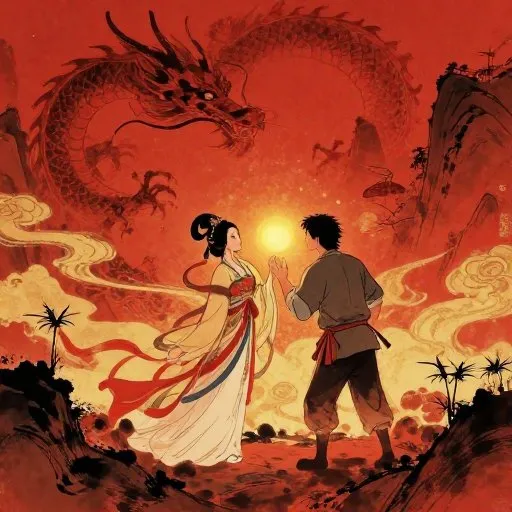
Where the hairpin passed, the Silver River appeared: the Tianhe, the Heavenly River, the Milky Way. Vast, cold, made of stars, uncrossable. On one side: Niulang with the children and the carrying pole and the old ox-hide. On the other side: Zhinu, looking back.

The Silver River in Chinese astronomy was not a vague poetic description. It was a specific astronomical feature, and it separated two specific stars. Altair, in the constellation we call Aquila. Vega, in the constellation we call Lyra. Two bright stars, clearly visible from anywhere in China on a summer night, separated by the white band of the Milky Way. When the Chinese named these stars Niulang and Zhinu, they weren't just telling a story. They were pinning it to the sky where everyone could see it, permanently.

They are separated by approximately sixteen light-years. For reference, the fastest spacecraft humans have ever launched would take about three hundred thousand years to cover that distance. The Jade Emperor drew a thorough line.
4The Magpies

Chapter 4: The Magpies

The Jade Emperor had made his point. His daughter was returned. The farmer was stopped. The hierarchy of heaven was intact.

And then Zhinu wept.

The texts describe this simply. She wept, and she did not stop, and the sound of it was not a small thing. She was a goddess, and she was weeping, and the Jade Emperor was still her father. These two facts do not resolve each other, and the story doesn't try to make them.

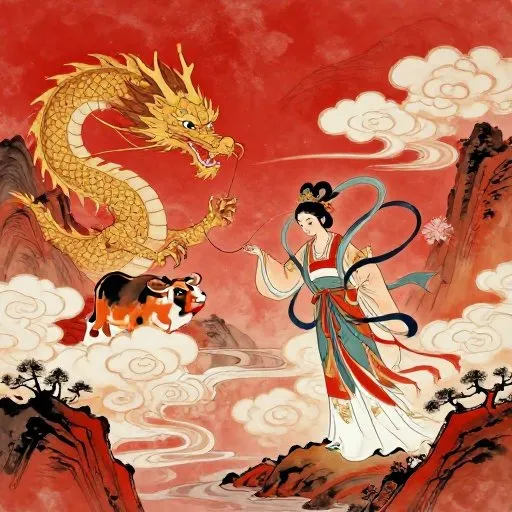
He allowed one visit. Once a year, on the seventh day of the seventh lunar month, the magpies would gather. All of them: every magpie in the world would fly to heaven and form a bridge of wings and bodies across the Silver River, and Niulang and Zhinu could cross to each other.

One night. Then the magpies would scatter and the river would return and they would be on their opposite banks again until next year.

The magpie bridge is a specific and strange detail. Why magpies? The sources don't explain, though the magpie in Chinese tradition is a symbol of joy and good fortune, the bird whose call is considered auspicious. The omen-bird forms the bridge. The lucky thing that costs the two lovers nothing except everything.

Chinese farmers looked at magpies for centuries and noted that in early July by the old calendar, the flocks behaved strangely. They were less visible. Their numbers seemed to thin. The folk explanation was that they were in heaven, building the bridge. This is the kind of mythological thinking that starts with something observable and finds the story inside it, rather than starting with the story and making the observation fit.

On the seventh day of the seventh month, the sky in many parts of China is overcast. Rain falls, or drizzle. This is also noted in the texts. The rain is their tears: the weeping when the night ends and they must separate again.

5The Festival

Chapter 5: The Festival

The Qixi Festival falls on the seventh day of the seventh lunar month, which in the Gregorian calendar lands somewhere in July or August depending on the year. It is one of the oldest continuously observed festivals in Chinese history: references to the seventh-night festival appear in Han dynasty texts from the second century BCE, though the Niulang and Zhinu story as the central narrative becomes standard in the period after.

Women, traditionally, were the festival's main practitioners. They would set up altars, offer melons and fruit, place needles in water and try to thread them by moonlight, or watch the shadow the needle cast. If the shadow split into a complex pattern, it meant skill. If not: try again. The festival was associated with weaving, with women's work, with skill and craft and the prayer for clever hands. Zhinu the weaver was its patron.

Girls prayed for a good husband. Women prayed to see a magpie bridge form in the Milky Way if they looked at the right moment. They prayed for what the story had: the love that the universe tried to stop and only partially succeeded.

The modern version of Qixi, sometimes called Chinese Valentine's Day, has taken on the commercial character that holidays tend to take on when romantic love becomes their theme. Restaurants fill up. Flowers sell. Gift retailers have feelings about it. The shape of it has changed.

But on a clear night in July or August, if you go somewhere without too much light pollution and look south, you will find Vega: bright, slightly blue-white, among the highest stars. And across the Milky Way, lower in the sky, Altair: bright, yellowish, flanked by two dimmer companion stars that the Chinese called the children in the baskets. And between them, the Milky Way, the Silver River, the line that was drawn.

They are still there. They have been there, looking like this, for the entire duration of human civilization. Every person who ever told this story could look up and see the exact picture the story described.

Some myths have to reach for resonance. This one just points at the sky.

Mythology Notes