The Hindu myth of Samudra Manthan: gods and demons churn the cosmic ocean using a mountain and a serpent. What came up was not what anyone expected.
Mythwink
The gods needed immortality. Their plan was to stir the ocean with a mountain. It mostly worked.
The gods were losing.
Not in a close fight. Not in a battle that could have gone either way on a different afternoon. They were losing slowly, the way a fire loses when nobody feeds it. A curse had touched Indra, the king of the gods, and spread from him into every divine being in the heavens. Their strength went. Their eyes went dull. They lost battle after battle to the asuras, the demons who had been waiting below for exactly this kind of opening, and now the whole cosmic order was going the wrong direction.
This is the setup for Samudra Manthan, the Churning of the Ocean of Milk, and it appears in both the Bhagavata Purana and the Mahabharata. The universe was in crisis. The gods were in crisis. They went to Vishnu.
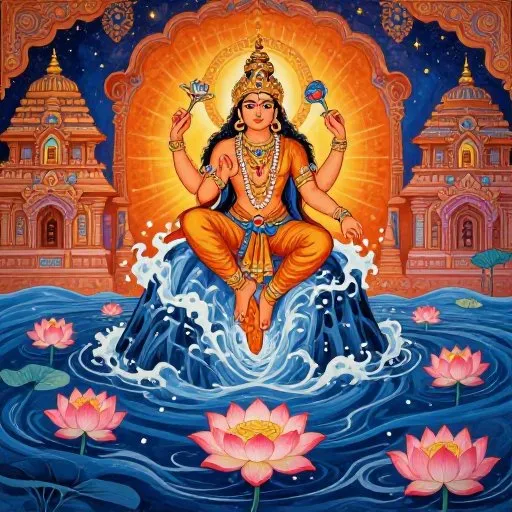
Vishnu is the Preserver of the universe, one of the three supreme beings in Hindu tradition alongside Brahma the creator and Shiva the destroyer. When things are coming apart, Vishnu is the one who figures out how to put them back together. He is, structurally, the person in the room who says "there is a way." He said it now. At the bottom of the Kshira Sagara, the cosmic ocean of milk, lay the amrita: the nectar of immortality. Drink it, and no curse could hold. Get it out, and the natural order could be restored.
Getting it out required a churning rod. The churning rod they needed was a mountain. The mountain was Mount Mandara. It was, according to the Vishnu Purana, thirty-two thousand yojanas above the earth and thirty-two thousand yojanas below it. A yojana is approximately 8 to 15 kilometers depending on the source. Work out the math and you have a mountain somewhere between 512,000 and 960,000 kilometers tall, sitting in a cosmic ocean.
This is the scale at which Hindu mythology operates. Keep that in mind.
The gods needed help moving it. They went to the demons.
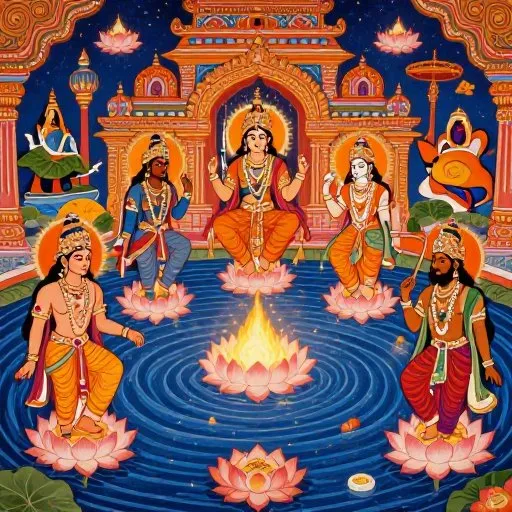
Here is how the deal worked. The demons would help churn the ocean. Everyone would share the amrita at the end. That was the agreement. Both sides shook on it.
Neither side intended to honor it. The gods knew the demons would try to steal the nectar the moment it appeared. The demons knew the gods would try something. Both sides agreed anyway, because necessity does not care what you think of your business partners. When the alternative is continued cosmic collapse, you negotiate with whoever is standing there.
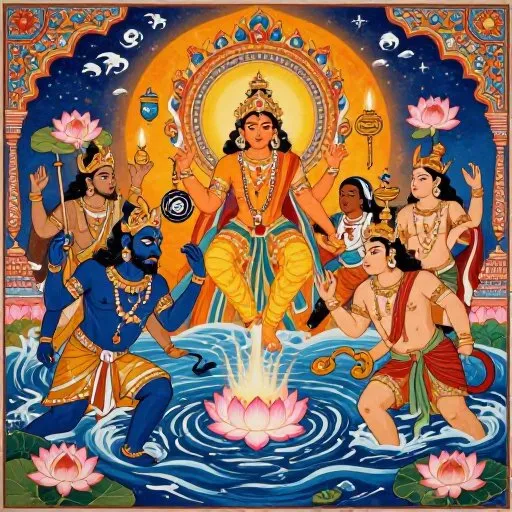
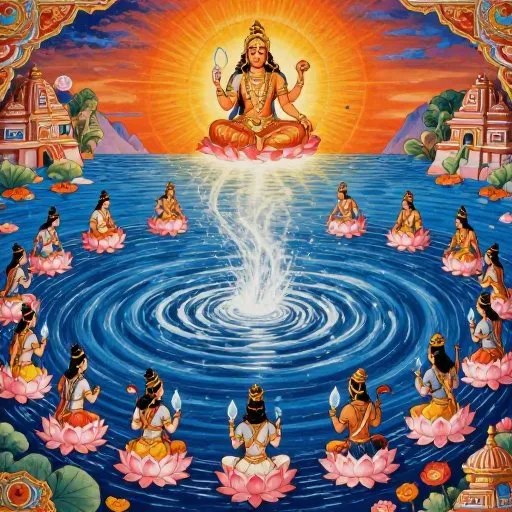
Together, gods and demons uprooted Mount Mandara. This was a significant physical accomplishment. They brought the mountain to the ocean and used the great serpent Vasuki as a churning rope, wrapping him around Mandara the way you'd wrap a rope around a spindle. Vasuki is one of the nagas, the great serpent beings of Hindu mythology. He had a thousand hoods and was not consulted about this plan before it was implemented.
The demons, being proud, insisted on holding the head end of Vasuki. The gods took the tail.
Vishnu had suggested this quietly, without explanation, and the demons had not thought to ask why. When the churning started and Vasuki breathed poison smoke directly into their faces for what turned out to be a very long time, they found out why.
Then something else happened. Mandara, which was enormous and heavy in the way that only a cosmic churning-rod mountain can be, sank straight through the ocean floor. The gods and demons were dragged with it. The whole project, before it had produced anything useful at all, was about to end at the bottom of the sea.
Something rose from below.
Something old. Patient. Large.
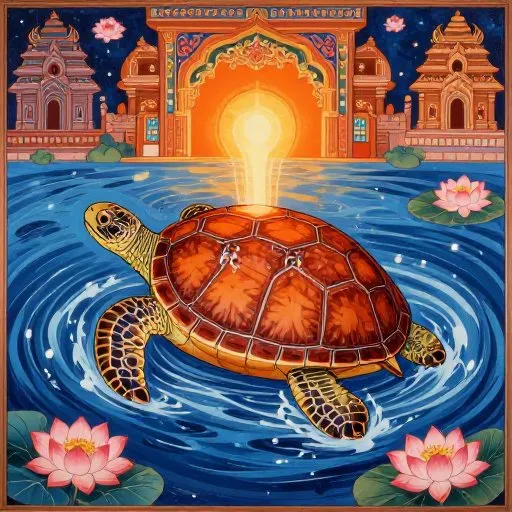
Vishnu, who apparently had been thinking several steps ahead the entire time, appeared in the form of Kurma: a vast cosmic turtle rising from the deep. He placed Mount Mandara on his shell. The mountain steadied. The churning could begin.
The gods chose not to comment on the fact that the Preserver of the Universe was currently sitting at the bottom of the cosmic ocean in the form of a reptile, holding a mountain on his back, as the chosen solution to the problem of divine immortality. Some things you simply accept.
Pull and release. Pull and release. The serpent's thousand hoods thrashed. The ocean of milk churned. Strange things began to rise from the depths.
Kamadhenu, the wish-granting cow, floated up first. Then Varuni, the goddess of wine. Then the Parijata tree, which could grant any wish and whose flowers never wilted. Then the apsaras, the celestial dancers, rising from the foam looking remarkably cheerful about their origin story. Then the divine physician Dhanvantari surfaced, holding a white pot of amrita. Then the goddess Lakshmi rose from the water, looked over the assembled gods and demons, and chose Vishnu as her consort. This last part is entirely unremarkable to the gods, because of course she did. Then the moon rose from the sea. Fourteen treasures in total, depending on which Purana you're reading.
And then, before any of that, something else came up first. A column of black, thick and shimmering, rising from the depths and spreading across the water. The trees on the shore withered. The gods stepped back. Even the demons, who had opinions about most things, went quiet.
This was Halahala. The poison that could end all worlds. Nobody had mentioned it would be in there.
The Halahala spread. The air above the ocean turned wrong. Gods who had never been sick in their existence were having what you would have to call a very bad time. The amrita was not even visible yet. The plan was collapsing under the weight of a poison that had been sitting at the bottom of a cosmic ocean since before any of them could remember.
Then Shiva came.
He had been watching from his mountain, which is where Shiva tends to be: apart from things, waiting for the moment when everyone else has exhausted their options. He walked down to the shore. He looked at the Halahala spreading across the water. He picked it up.
He drank it.
Not a considered, ritual sip. The way you drink water when you are thirsty. The whole of it. In one motion. The thing that could end all worlds, and Shiva swallowed it like it was a minor inconvenience he was handling on behalf of everyone else.
His wife Parvati was standing beside him. She grabbed his throat with both hands before the poison reached his stomach. It stopped in his neck. It turned his throat blue.
Think about that. The god drinks the world-ending poison. His wife grabs him by the throat. The poison stops where her hands were. It is blue there to this day, which is why one of Shiva's most recognized epithets is Neelakantha: "the blue-throated one." Every time you hear that name, you are hearing the record of Parvati's hands.
Shiva walked back up his mountain. He did not ask for a celebration. He is not the kind of god who asks for celebrations. He handled a cosmological emergency and went home, and the gods and demons stood on the shore and looked at each other and at the ocean and at the very long churning job still ahead of them.
The greed was fully restored. Back to work.
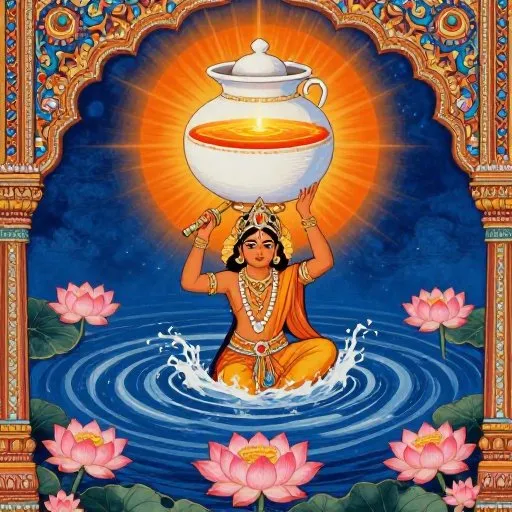
Dhanvantari surfaced again, this time with the white pot above his head. Inside: the amrita. The nectar of immortality, finally drawn up from the deep, glowing in an ordinary clay jar.
The demons grabbed it and ran.
This was expected. The agreement had lasted exactly until the prize was real, which is how long most agreements between gods and demons last. They snatched the pot and moved fast, and for a moment it looked like the entire Samudra Manthan, the mountain and the serpent and Vishnu sitting at the bottom of things in turtle form, had been done for nothing.
Vishnu became a woman.
Her name was Mohini. She was, according to the Bhagavata Purana, the most beautiful being anyone present had ever seen. Beauty, in that specific moment, was worth more than any army. While the demons argued about who should drink first, which is an argument that was going to take a long time because demons have strong opinions about precedence, Mohini appeared and offered to handle the distribution herself. The demons, delighted, formed a line. The gods formed a line. Mohini walked down the line of gods and poured every last drop of amrita into their mouths. By the time the demons understood what had happened, the pot was empty.
Almost.
One demon had been clever. His name was Svarbhanu. He had disguised himself as a god, taken a place in the divine line, and gotten one mouthful down before Vishnu's Sudarshana Chakra, the spinning disc weapon, took his head off. But he had already swallowed. He could not die. His head became the demon Rahu. His headless body became the demon Ketu.
They are in the sky right now. According to the Rigveda and the tradition of Hindu astrology, Rahu and Ketu are the causes of eclipses: the severed demon chasing the sun and moon, swallowing them when he catches up, unable to keep them because he has no throat to hold them in.
The world goes dark. Then light again. Then dark.
That is what Vishnu's Sudarshana Chakra made, when it stopped a demon from drinking immortality. It made the reason the sky goes dark.