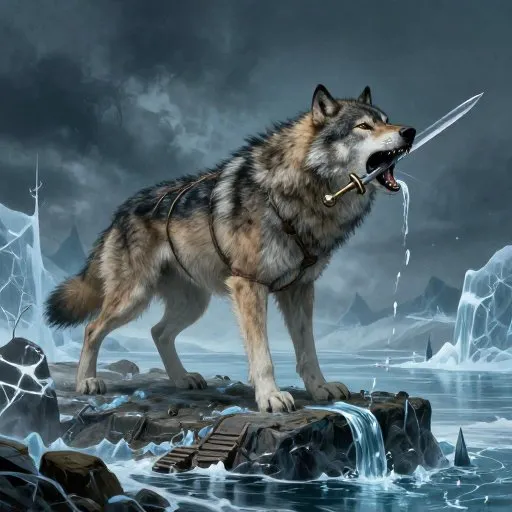
The Norse myth of Fenrir the wolf, son of Loki, bound by the gods with a magical ribbon called Gleipnir. How a trick, a hand, and some impossible ingredients held back the end of the world.
Mythwink
They bound the most dangerous creature in the nine worlds with a silk ribbon. It cost one god his hand and bought everyone else maybe a thousand years.
Fenrir was not just a big wolf. A big wolf you can handle. A big wolf has a limit.
Fenrir did not have a limit.
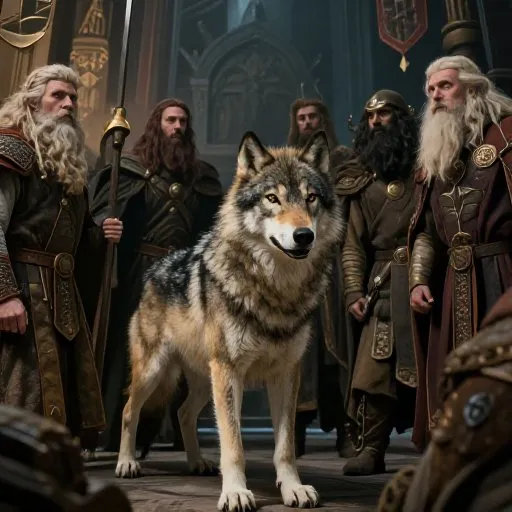
He was the son of Loki and a giantess named Angrboda, which is already a sentence worth pausing on. When two forces that should not exist choose to make something together, the result is not usually reassuring. Fenrir was the result. Born in Jotunheim, the world of giants, and already, even as a pup, the kind of thing that made the other gods go quiet when they looked at him. Not afraid. Quiet. There is a difference. Fear is loud. What the gods felt looking at Fenrir was something older than fear. Recognition. This animal was going to end the world. They could see it in the way he moved.
So they brought him to Asgard. Think about that choice. They looked at the wolf they believed was going to kill Odin and swallow the sky, and they said: let's keep him close. This is the logic of people who have convinced themselves that watching a problem is the same as solving it.
Only one god was brave enough to feed him. Tyr, the god of law and justice. Every morning, meat in hand, standing right next to the jaws. The wolf took the food carefully. Something passed between them over those mornings. Call it trust. Call it whatever you want. It was real.
The wolf grew.
Not the way a large dog grows, filling out and leveling off. He grew the way a river floods: always past the mark you thought was the limit, always more than the last time you checked. The gods measured him against the ash trees of Asgard and came back to find the mark at his shoulder. They measured again three months later and could not find the mark at all. He was above the treeline.
Something had to be done. Everyone agreed. Nobody wanted to say it first.
Here is what the gods tried: iron.
They forged a chain called Laeding. Iron, thick as a man's wrist, heavy enough that two gods had to carry it together. They brought it to Fenrir with the careful casualness of people attempting a surprise they know has already been noticed. "Let's see if you can break it," they said. The sporting challenge. The game.
Fenrir looked at the chain. He looked at the gods. He was not stupid. He was the opposite of stupid. But he was also young, and there is a particular satisfaction in being underestimated when you know you are not. He let them put it on him.
He flexed. The chain burst like thread.
The gods collected the pieces from the ground of Asgard and nobody said anything for a while.
They came back with Dromi. Twice as heavy. Forged with different intentions worked into the metal, which is how Norse smithcraft works: the purpose matters as much as the materials. They made the same offer. Fenrir thought about it longer this time. He could see the nervousness. The tight smiles. The hands that did not know where to rest. The gods of Asgard trying to look casual while presenting a chain designed to hold a wolf forever.
He let them put it on him.
He shook himself. Dromi shattered into pieces that scattered across the grass. The gods stood there. The wolf looked at them. There was an understanding in that moment that everyone recognized and nobody wanted to be the first to name.
Iron was not going to work.
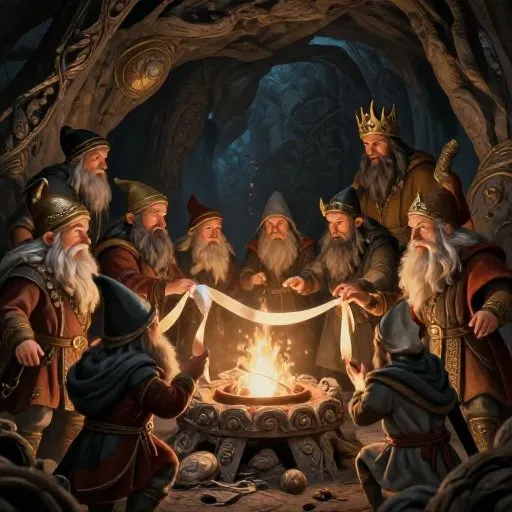
So they sent a message to Nidavellir, the realm of the dwarves, the greatest craftsmen in the nine worlds. The request was simple: make something that cannot be broken. The dwarves knew that the strongest things are the ones that do not exist. They asked what they had to work with.
The gods told them the ingredients. The sound of a cat walking. The roots of a mountain. A fish's beard. The sinews of a bear. The breath of a fish. The spittle of a bird.
The dwarves said that would do.
What came back from Nidavellir looked like a ribbon.
A length of silk, pale as winter light, no heavier than a bandage, lying in the god's hand like it was nothing. They passed it around. They pulled at it. They tried to cut it with a blade that could cut stone. The blade turned aside. The ribbon was fine.
This was Gleipnir. Made from things that do not exist, which is why it cannot be broken by anything that does.
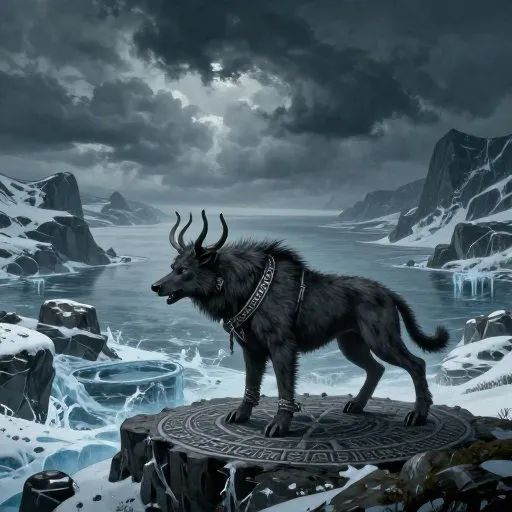
They took it to an island called Lyngvi, a small cold place in the middle of a dark lake, and they brought Fenrir. They spread the ribbon on the rock in front of him. The wolf looked at it for a long time.
He understood chains. He understood iron. He had broken iron twice without breathing hard. This thing was not iron. It was not a chain. It was a silk ribbon lying in the grass, and the gods were smiling with slightly too much ease, and the whole scene had the texture of something that was not actually a game.
He said: I will let you bind me with that ribbon. But only if one of you puts a hand in my mouth while you do it. As a pledge. As proof.
The gods looked at each other.
The silence went on long enough to mean something.
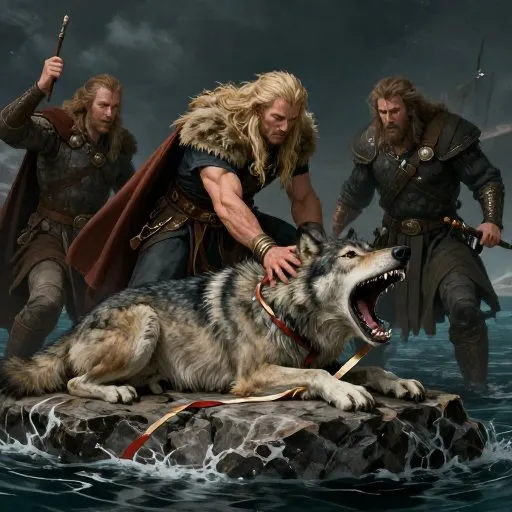
Then Tyr stepped forward. The god who had fed him every morning. The one who had stood within reach of those jaws more times than anyone else had dared. Tyr placed his right hand between Fenrir's teeth, and the wolf went still, and the gods wrapped the ribbon around him.
Gleipnir tightened with each pass. Thinner than silk, harder than anything iron had managed to be. The more Fenrir fought, the tighter it became. He could not break free. He had known, before they finished wrapping, that he would not break free.
He looked at Tyr. He already knew.
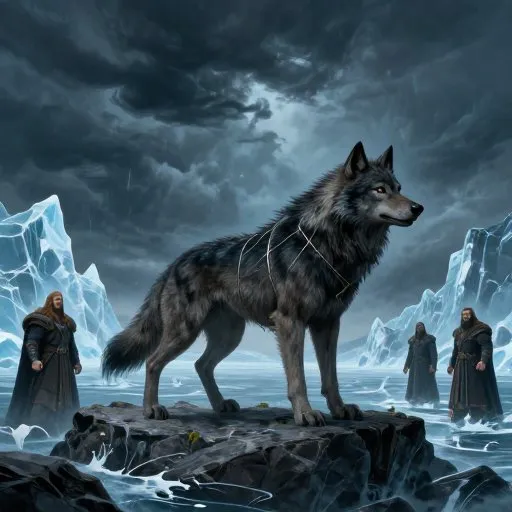
When it was clear that Gleipnir had done what iron could not, Fenrir closed his jaws.
Tyr made no sound. The other gods stood very still. None of them moved to help, because there was nothing to help with and they knew it. The hand fell into the grass of Lyngvi. Tyr held his wrist, blood running down his arm, his face showing the grief of someone who has done the only right thing available and knows it did not feel like enough.
Let that sit.
Tyr was the god of law and justice. The god whose name is related to the Latin deus and the English word day, a name ancient enough that it predates the Norse religion we know by centuries. He was, before Odin rose to the top of the pantheon, possibly the original sky-father. He had given his sword hand, the hand of a war god, for this. He had put it between a wolf's teeth and waited for the ribbon to hold, knowing what would happen when it did.
He got what he paid for. Fenrir was bound.
Then the gods drove a sword through Fenrir's jaw to hold his mouth open. He lay on the rock of Lyngvi, pinned through the face, while the gods who had tricked him stood around him.
The Prose Edda says he howled so loud it could be heard across the nine worlds. That's what it says. And then it says he will lie there until Ragnarok.
Until the end.
Not forever. The Norse people were precise about this. Not forever, just until everything ends. Tyr's sacrifice did not save the world. It postponed the part where the world gets eaten. At Ragnarok, Fenrir breaks free. He swallows Odin whole. He crosses the battlefield with his jaws stretched so wide the upper jaw scrapes heaven and the lower jaw drags along the earth. He has been waiting the entire time, and when the wait is over, he is exactly as ready as he was when they put the ribbon on him.
Tyr's hand bought time. That is all it bought. Not safety. Not victory. Time.
The lake is still there in the stories. Lyngvi, the island of heather, in the cold black water. Fenrir is still there too, in the versions where the world has not yet ended, which is most of the versions, because the stories were told by people who wanted to believe it.
Here is the thing about the Norse people and the way they told these stories: they knew how it ended. This was not a mystery. Ragnarok was not a secret. They knew the wolf got free, knew Odin died, knew the world came apart in fire and flood. The skalds who composed these poems were not hiding the bad news. The bad news was the whole point.
And they kept building ships anyway. They kept planting fields and raising children and sailing into fogs they could not see the other side of. They told the story of the wolf on his island and then they went to sea.
There is something in that worth holding on to. Not that the binding holds forever. It doesn't. Not that Tyr's hand was worth it in any clean sense. It wasn't. But that you look at the thing coming for you and you think: what do I have that might hold it, for as long as it needs to hold, and what am I willing to pay for that?
Tyr had a sword hand and a wolf that trusted him and six impossible materials the dwarves wove into a ribbon.
He used what he had.
The wolf is still on the island. The ribbon is still holding. You go on.