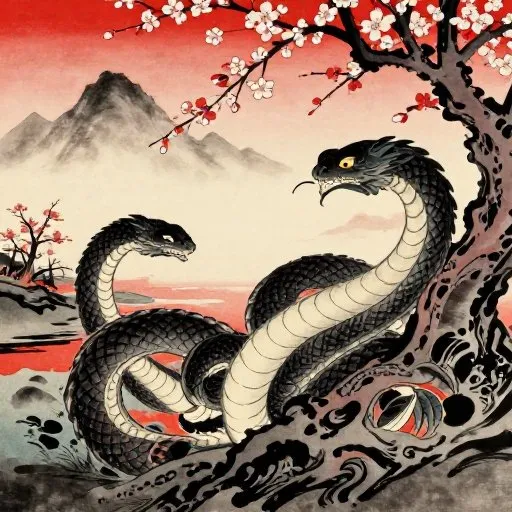
Susanoo, exiled from heaven, finds a family losing daughters to an eight-headed serpent. His solution: brew enough sake to make eight giant heads very, very drunk.
Mythwink
Eight heads. Eight vats of sake. One very good plan.
Susanoo arrived on earth with nothing.
He had come from heaven, expelled for the damage he had done to his sister Amaterasu's realm. The fingernails torn out. The beard shaved as punishment. Stripped of the marks of his divine standing. He descended to the province of Idumo, the region in what is now Shimane Prefecture on the western coast of Honshu, and he landed beside a river called the Hi.
He was, by most measures, starting from a very low point.
But storms do not stay quiet, and Susanoo was the storm. Whatever his situation, he still had his eyes and his mind and whatever remained of his considerable divine capacity. He was not a man to feel sorry for himself for long. He would find something to do. He always did.
What he found was a pair of old people weeping by the river.
Between them was a young woman. The parents were Ashinazuchi and Tenazuchi, divine figures of the region, their names meaning something close to "foot-stroking elder" and "hand-stroking elder." Names that describe tenderness. Parents who had spent their years holding their children gently. And they were weeping at the edge of the Hi River because they were about to lose the last one.
Susanoo asked what was wrong.
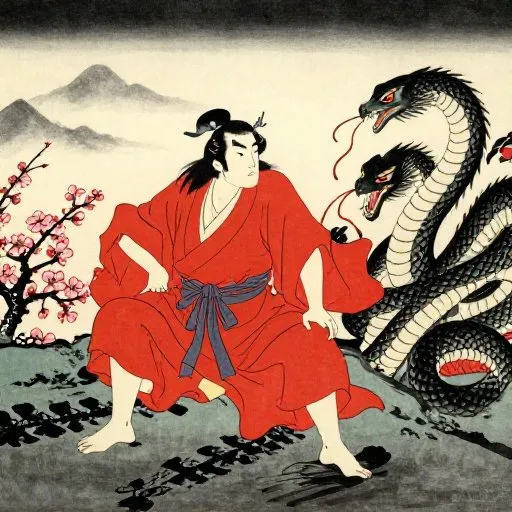
The story came out. They had eight daughters. Seven of them had already been taken, one per year, by the serpent that came down the river annually. Its name was Yamata no Orochi. It had eight heads and eight tails. Its body was so large it covered eight valleys and eight hills simultaneously. It had eyes red as winter cherries. Fir trees and cypresses grew from its back. It had come for seven years. The eight daughters were gone. Now it was coming for Kushinadahime, the youngest.
Susanoo looked at the young woman. He had a thought.
He asked Ashinazuchi and Tenazuchi for her hand in marriage, which under the circumstances, with a date certain for when their daughter would be dead, was an offer that required some consideration but not very long.
They said yes.
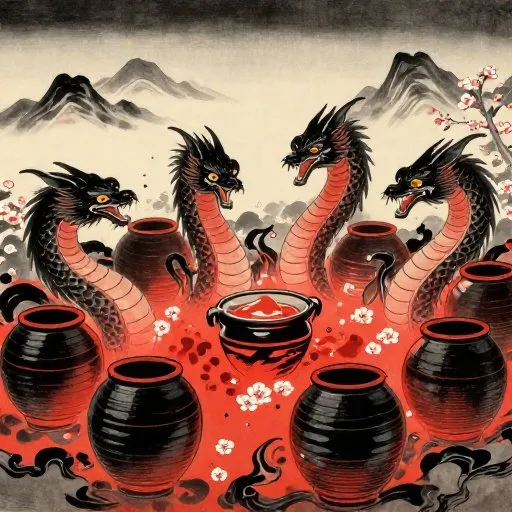
Susanoo's plan was: get it drunk.
This is, in the strategic literature of monster-defeating, not the most dignified approach. It is also not the approach of a man who has never thought practically about a problem. Yamata no Orochi had eight heads. Eight heads meant eight independent decision-making units. Eight opportunities to be offered something appealing. Eight opportunities to make a bad choice.
He turned Kushinadahime into a comb and placed her in his hair to keep her safe while he worked. This is one of those mythological details that sits calmly in the text without explanation and expects you to accept it. A woman became a comb. It is in the Kojiki. It happened. Moving on.
The preparation was specific. He told the parents to brew sake. Not a modest amount. Eight vats. Each vat had to be filled with sake refined eight times over, which is to say very strong sake. He built a fence around the area with eight openings in it, and at each opening he placed a platform. On each platform he placed one vat of sake. Then he waited.
Yamata no Orochi came down the Hi River.
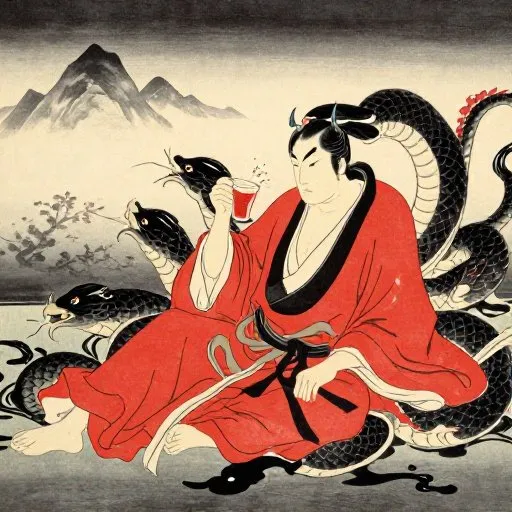
It saw the vats. All eight heads sniffed the sake and each of them made the same assessment independently, which is that this was appealing and they should drink it. All eight heads bent down to their individual vats. They drank.
There is a specific pleasure in this image. The monster of monsters, the dread creature that had swallowed seven daughters, reduced in a matter of minutes to eight separate heads all quietly and enthusiastically drinking sake out of wooden vats. The ancient Japanese storyteller who first told this part of the story knew exactly what they were doing. The pause before the violence matters. The comedy of the eight heads all drinking is part of it.
They drank until they fell asleep.
All eight heads. All at once. The vast body of the serpent settled to the ground, crushing the grass under it, eight tails slack, the fir trees on its back swaying and then going still.
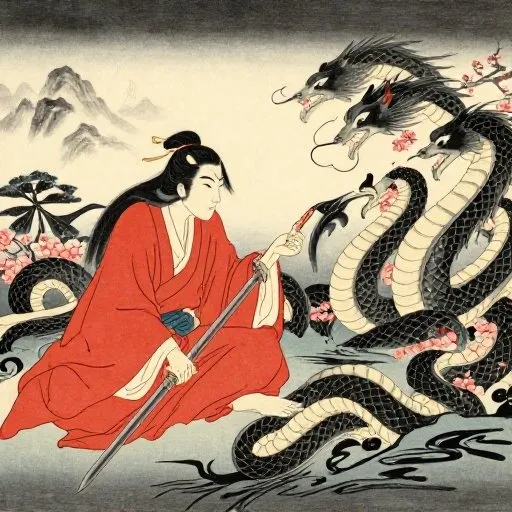
Susanoo drew his sword.
He cut it apart.
This is described in the Kojiki with some enthusiasm. He moved through the serpent from head to tails, and the Hi River, the accounts say, ran red. The body that had covered eight hills and eight valleys was cut into pieces. All eight heads, which had just spent their last conscious moments drinking very good sake, were separate. The serpent was done.
In the fourth tail, his sword struck something.
The blade notched. A good blade does not notch on flesh or ordinary bone. He cut open that section of the tail more carefully and found, inside, another sword.
Its name was Ame-no-Murakumo-no-Tsurugi, the "Sword of the Gathering Clouds of Heaven." It is also called Kusanagi no Tsurugi, the Grass-Cutting Sword. It is one of the Three Imperial Regalia of Japan, the same collection that contains the mirror Amaterasu used to coax herself out of the cave. The sword that was found in the body of a drunk eight-headed serpent by a disgraced storm god in the river province of Idumo is today one of the most sacred objects in Japan.
It is kept at Atsuta Shrine in Nagoya. It has not been publicly displayed in modern times.
Susanoo recognized that a sword found inside a divine serpent was not a sword you kept for yourself. He sent it up to his sister Amaterasu in heaven as an offering. Whether this was penance for the damage he had done to her domain, or simple acknowledgment that something this significant belonged with the chief deity of heaven, the gesture was real. He gave it away.
He had arrived on earth with nothing. He had a sword more sacred than anything else he would ever find and he sent it to his sister.
Then he built a home.
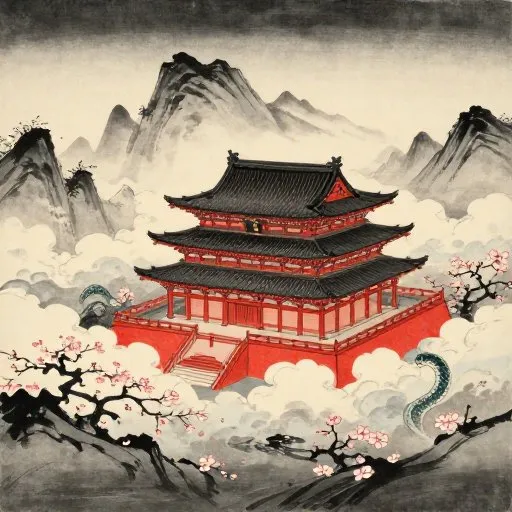
He built it in Suga, in Idumo, and the clouds that gathered there when he built it were, the Kojiki tells us, clean white clouds. Not the storm clouds of his tempests. Clean ones. He composed a poem. It is considered the first poem in Japanese history.
The poem is about those clouds. About the multi-layered clouds forming over Suga, the new home he was making with his wife. About the fence of clouds encircling their home. About marriage and a new place and the beginning of something. The man who had raged and wept and destroyed and been expelled and stripped of his dignity composed a poem about building something and it was the first poem anyone wrote down.
This is not incidental. The tradition that preserved this story placed the first act of Japanese poetry immediately after Susanoo's redemption. As if the capacity for it came with the settling. As if being the storm and then being the man who builds a home after the storm are different enough states that only the second one could write anything.
He and Kushinadahime lived in Suga. She had been a comb in his hair while he fought the serpent, and now she was his wife, and the clouds over their home were clean and white.
The lineage from their marriage led, through several generations, to a god named Okuninushi, who would become the great divine ruler of the earthly realm before the heavenly gods eventually came down and negotiated him out of it. Susanoo's line populated the mythological history of Japan's western provinces. The storm god who arrived with nothing and was stripped of everything ended up founding a dynasty.
The myth is in the Kojiki, recorded in 712 CE, but the tradition it captured is much older.
The Idumo region, modern Shimane Prefecture, was historically a semi-autonomous area with its own strong local religious traditions centered on Izumo Grand Shrine, one of the oldest and most important Shinto shrines in Japan. The myth of Susanoo and the Orochi is partly the origin story of that region's special divine status. Where the serpent died, where Susanoo built his home, where Japanese poetry began: these are all in Idumo.
The Hi River is real. The Izumo region is real. Atsuta Shrine in Nagoya, where the sword Kusanagi is kept, is real and active and visited by millions of people annually.
Yamata no Orochi has been interpreted as many things. Some scholars read it as an allegory for the Hi River itself, prone to flooding, branching into tributaries, requiring the management of a powerful local authority. Eight heads as eight tributaries. The drunkenness as the flooding season. Susanoo as the technology of water management brought to a dangerous landscape. This kind of reading is appealing and may be partly true.
But it is also just a very satisfying story. A disgraced god, arriving with nothing, meets a family who has lost seven children and is about to lose the eighth. He makes a plan. The plan involves brewing a very large quantity of excellent sake. The monster comes, gets drunk, falls asleep, and the disgraced god cuts it apart and finds an impossible sword inside.
The sword that Susanoo gave away ended up being more important than anything he kept. That detail did not end up in the story by accident. The tradition preserved it specifically. A god who gave away the most valuable thing he had ever found, because it was too significant to belong to him.
The sword is still in Nagoya.
The sake vats are long gone.