The Pacific Northwest myth of Raven, who stole the sun, moon, and stars from a chief's locked boxes. Trickster logic, total darkness, and a smoke-stained ending.
Mythwink
Raven Steals the Sun
The world was dark. Raven found that unacceptable.
The Pacific Northwest myth of Raven, who stole the sun, moon, and stars from a chief's locked boxes. Trickster logic, total darkness, and a smoke-stained ending.
Mythwink
The world was dark. Raven found that unacceptable.
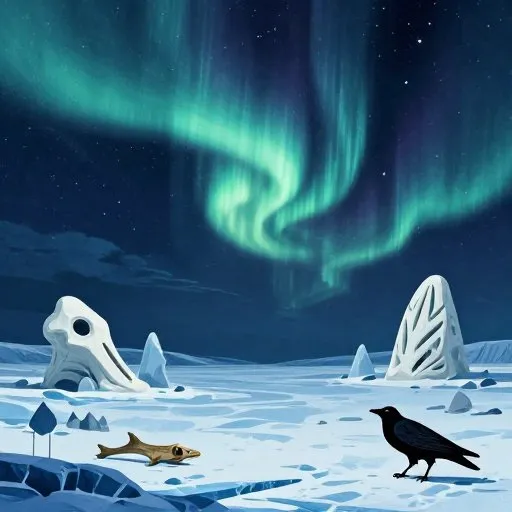
In the beginning, there was nothing to see. Not dim. Not twilight. Total, absolute darkness. The kind where your hand in front of your face is a philosophical question. No sun. No moon. No stars. Just the sounds of the world operating in the blind dark, which, if you think about it, is considerably more unsettling than the dark itself.
The peoples of the Pacific Northwest coast, the Haida, the Tlingit, the Tsimshian, each with their own version of this telling, knew this darkness wasn't some natural state of the universe. It was a decision. Someone had the light. Someone had put it in a box and locked the box and was keeping it.
That someone was an old chief who lived in a house at the mouth of the Nass River.
He had three boxes. Inside the boxes: the stars, the moon, and the sun. All of it, sealed up. All of it his. The world stumbled around in total darkness while one old man sat in a house with everything. Why did he keep them? The stories don't explain his reasoning. Maybe he liked having things. Maybe he just never thought about it. Some people sit on things of enormous value their whole lives simply because it never occurs to them that this is a strange thing to do.
Into this darkness came Raven.
Raven is not a protagonist in the conventional sense. He is not a hero. He is not noble. He steals, he schemes, he lies without guilt, he creates chaos and benefits from the fallout. He is, depending on the story, the most important being in the cosmos. He is also deeply annoying. The coastal peoples who told these stories understood that the most consequential figure in creation doesn't have to be admirable. He just has to be impossible to stop.
Raven heard about the boxes. Of course he did. Raven always hears about the boxes. And he decided that the light belonged to everyone, which was true, and that he was going to get it, which was the real point.
The plan he came up with was, by any objective measure, insane.

Here is the plan. Transform into a pine needle. Fall into a river. Wait for the chief's daughter to come and drink. Get swallowed. Be born as her child. Then, as a baby, cry until you get the boxes.
Take a moment with that. Raven looked at this heavily guarded situation, the house with the boxes, the old chief who wasn't giving anything to anyone, the total absence of any conventional point of entry, and he decided the correct approach was: become a pine needle and get eaten.
The daughter came to the river. She drank. She swallowed the pine needle that was Raven. She went home. In some versions she tastes something odd. In some versions she notices nothing. Either way the result is the same. The daughter of the chief becomes pregnant, and Raven, in the darkness inside of her, waits.
He was born as a human baby. Dark eyes. Loud. Demanding. The old chief looked at his grandchild and something happened to him that happens to grandparents across every culture in human history. He became completely helpless. All that power. All those boxes. All of it could not compete with the fact of a baby who looked up at him.
The chief carried the baby everywhere. He sang to him. He fed him. He let him have whatever he wanted.
Raven looked at this situation and filed it away.
The plan was working.
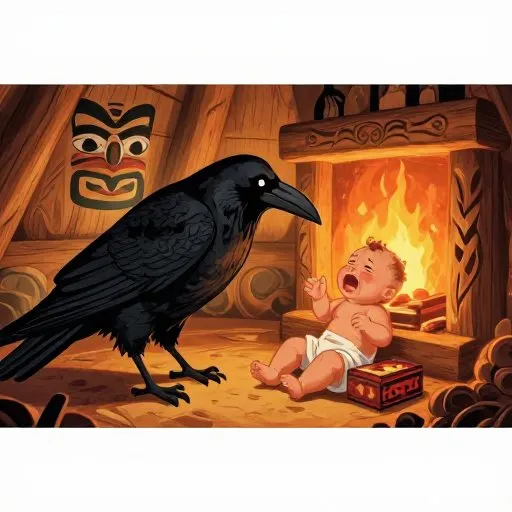
The crying started gradually. A baby fussing, pointing, reaching. Babies communicate almost entirely in vague gestures and escalating volume, which it turns out is an effective negotiating strategy if the other party loves you enough.
Raven, as the baby, pointed at the corner of the house where the boxes sat. He pointed and he cried. He pointed and he cried some more. He would not stop.
The chief was not foolish. He had kept those boxes a long time. He understood, on some level, that giving away things in boxes is how you stop having things in boxes. But the crying. The relentless, unbroken, escalating crying of a grandchild was wearing something down in him. Something that power and caution couldn't protect.
He opened the first box. The small one. He handed his grandchild the stars.
The baby, delighted, played with them. Examined them. And then, before anyone could react, threw them up through the smoke hole in the roof.
They scattered across the sky. Every direction. Thousands of points of light appearing all at once in the darkness. The world had stars now. The chief stared up through the smoke hole at what had just happened to his smallest box, and then looked at the baby in his arms, and the baby looked back at him with an expression that was not quite what a grandchild's expression should be.
He should have stopped there. He absolutely should have stopped there.
But the crying started again.
Raven pointed at the second box, the medium one, and cried. And the chief, who had already given the stars away and couldn't un-give them, and who was looking at a baby whose face was doing something he couldn't explain, gave him the moon.
The moon went through the smoke hole. The world now had stars and a moon. Light was accumulating in the sky. The night was still dark but it was nothing like the nothing it had been before.
The chief looked at his one remaining box. He looked at the baby. The baby pointed at the big box and opened its mouth.
Here is what the chief should have known: you do not negotiate with Raven. Nobody in these stories ever learns this, but that's the nature of Raven. He operates on a frequency that rational people can't quite detect until it's too late. By the time you understand what he is, he already has what he came for.
The chief picked up the last box, the big one, with the sun inside it. He held it. He looked at the baby. The baby reached for it with both hands and cried with the specific urgency of someone who has already gotten two things and knows a third one is available.
The chief gave him the box.
Raven opened it.
The light that came out was not like the stars. Not like the moon. It filled the house completely. The chief stumbled back. His daughter shielded her eyes. Everything in the house was suddenly visible in a way that nothing had been visible for as long as anyone could remember. The box was open and light was everywhere and the baby that had been placed in the chief's arms weeks ago was not a baby.
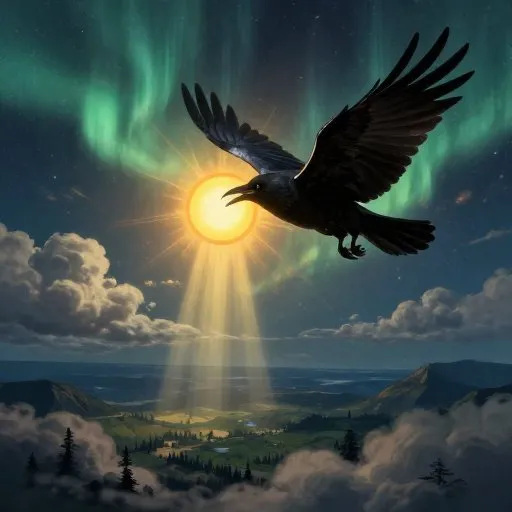
It was a bird. Black feathers. Bright eyes. A beak already gripping the sun.
Raven shot through the smoke hole.
He came out of the darkness and into the sky with the sun and there are no words in any language adequate for what happened next, but the stories try anyway. The sky turned. The world below lit up. Every surface, every rock and river and face, catching light for the first time. Animals that had moved by sound and memory looked up. People who had never seen color saw it all at once.
The world had a sun.
The smoke hole had been burning for the chief's fire, and as Raven passed through it the smoke caught his feathers. In the versions that account for this, Raven had always been white before. The smoke from that last exit, from the moment he stole the most important thing in the world, turned his feathers black. He has been black ever since.
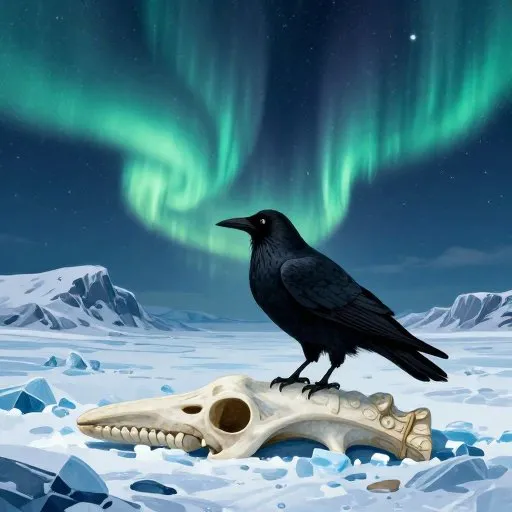
You can see ravens anywhere on the Pacific Northwest coast. Black as the darkness that used to cover everything. Some stories are visible in the world, if you know where to look.
Raven did not do this for anyone in particular. That's worth being clear about. He is not a savior. He didn't see suffering humans stumbling in the dark and feel compassion well up inside him. Raven wanted the sun because someone had it locked away, and locked-away things are an affront to Raven in the most fundamental possible sense. He stole the light because he steals things. He released it because holding onto a sun while flying is impractical.
The result for the world was incalculable. Navigation. Agriculture. The ability to see predators. The entire visual experience of being alive. All of it arrived because a trickster was annoyed that something existed and he didn't have it.
The old chief sat in his empty house. All three boxes open. All three things gone, scattered into a sky that had been his and was now everyone's. The stories don't say how he felt about this. The stories don't particularly care. What matters is the result, not the grief of the person who was hoarding what should never have been hoardable.
The coastal peoples who kept this story have always understood something about it that the story doesn't have to state directly. Light doesn't belong to anyone. The world doesn't belong to anyone. Things of enormous value that one person keeps in boxes while everyone else fumbles in the dark: these things have a way of getting out, eventually. Often through the most chaotic possible agent. Often at great cost to the person keeping them.
Raven flew across the sky with black feathers and an excellent sense of satisfaction.
Somewhere below, a world that had been dark since before memory was figuring out what color looked like.
Get on the list before the myths do.
New retellings from world mythology, gods behaving badly included. This list is just starting, so nothing has gone out yet, only a place in line.
Nothing has been sent from this list yet. You'll be among the first to hear once new myths start going out, and you can leave anytime.