The Haida story of Raven finding the first humans hidden inside a clamshell on the beach at Rose Spit. Creator and trickster, in the same feathers.
Mythwink
He didn't set out to create humanity. He was just curious about the noise.
Start with what Raven is, because it matters.
Raven is not a hero. He is not a god in the way Zeus is a god, sitting on a throne handing down decrees. He is not benevolent, not particularly interested in your welfare, not working toward any larger plan. He is curious, he is hungry, he is easily bored, and he is the most capable being in the Haida universe. He made the world partly by accident, partly by meddling, and partly because things interested him and he wanted to see what would happen next.
The Haida people have lived on Haida Gwaii, the archipelago off the north coast of present-day British Columbia, for at least twelve thousand years. Their oral traditions are among the richest and most complex in the world. Their art, their social structures, their relationships with the natural world: all of it is woven through with Raven. Not as a symbol. As a presence. Raven is still out there. Raven is always out there. He made the world you live in and he has no particular intention of stopping.
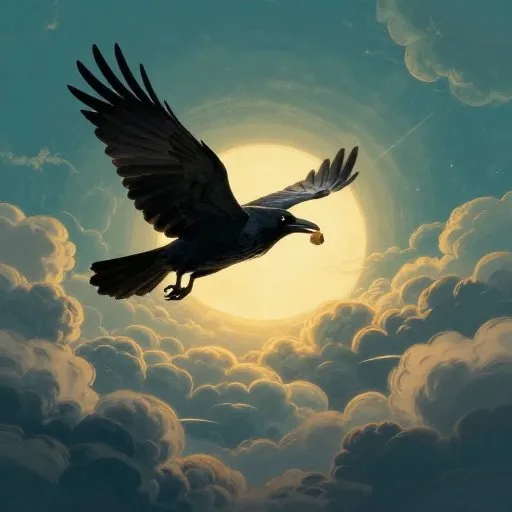
Raven brought light to the world. That is his most famous act, stealing light from an old man who kept it locked in boxes, because Raven wanted it and also because the world was dark and he couldn't see what he was doing, which was annoying. He put the sun in the sky. He put the moon up there. He released the stars. He did all of this while trying to get his hands on something he wanted, and the whole world benefited as a side effect.
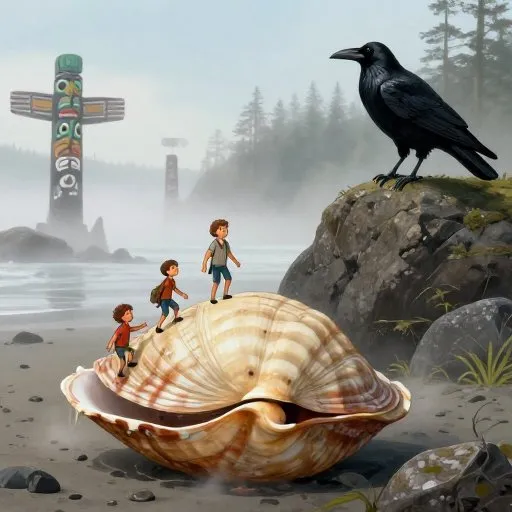
Then, on a beach at the northern tip of Haida Gwaii, a place called Rose Spit, Naikoon, the long curved spit of sand where the two seas meet on the northeast corner of Graham Island, he heard something strange.
Something small. Something thin and frightened. Coming from inside a clamshell.
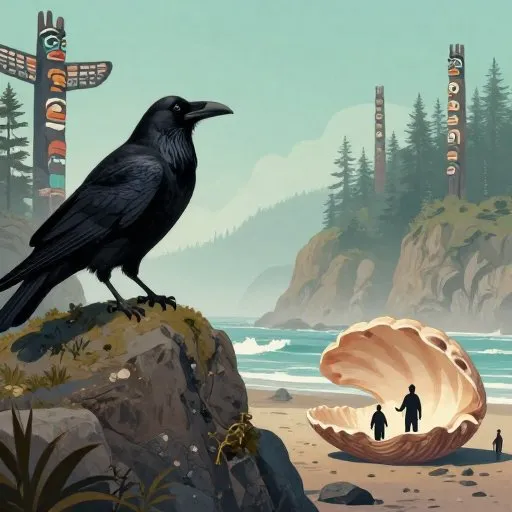
The shell was enormous. Much larger than an ordinary clam. It sat on the beach at Rose Spit, half in the sand, and it was making a sound. Not an animal sound. Not a bird sound. Something new.
Raven cocked his head. He walked around the shell. He looked at it from different angles. The sound was coming from inside, and it was quiet and frightened, and it was unlike anything he had heard before. Raven had heard everything. He had been around since before the world took its current shape. He had stolen fire and light and arranged the geography. He had heard everything that existed up to that moment.
This was new.
He called to whatever was inside. He coaxed. He cajoled. He made sounds he thought might be reassuring, which, given that this was Raven, probably also had an element of personal entertainment in them. But something in his voice or his persistence worked.
Slowly, the clamshell opened.
Inside were the first people. Tiny, crumpled from being folded up in a shell, blinking in the light that Raven himself had put in the sky. They were frightened. They were bewildered. They had existed inside the shell in a state of not-quite-living, protected and enclosed, and now there was a massive black bird standing over them and the world was very large and very bright and very much not a clamshell.
Raven looked at them.
Bill Reid, the great Haida artist who died in 1998, created his monumental sculpture "The Raven and the First Men" in 1980. It now sits in the Museum of Anthropology at the University of British Columbia in Vancouver. Yellow cedar. The raven perched on the enormous open clamshell, leaning down with one eye fixed on the tiny humans spilling out. Reid described working on it as one of the most meaningful things he ever did. The image he created captures the exact quality of this moment: Raven is not gentle. He is not soft. He is enormous and black and ancient and curious, and the little people looking up at him are at the beginning of everything.
They came out slowly.
Raven was patient, which is unusual for him but apparently the situation called for it. He wanted to see what these things were. He wanted to see what they would do. He stood back and let them look at the world and take it in.
The world at that point, the Haida world, the archipelago of Haida Gwaii, was very much itself. Forests that ran to the water's edge. The sea full of salmon and halibut and the creatures the Haida have been in relationship with for thousands of years. Mountains. The particular quality of light on the north coast, which anyone who has been there will tell you is unlike anywhere else on earth. The first people came out of their clamshell and the world they walked into was fully realized, specific, wild, and already complete without them.
Raven showed them. Not out of altruism. Out of the same impulse that made him steal light and rearrange the sky: because he wanted to see what would happen. What would these small frightened things do when they saw the salmon? What would they do with the forest? They didn't know anything. They had been inside a shell. They knew nothing of the world and Raven knew all of it and the gap between those two states is, apparently, enormously entertaining if you are Raven.
They were frightened and then they were curious. That's the thing about humans, it seems. The fear doesn't last as long as the curiosity. They started looking around. They started touching things. They made sounds at each other and at Raven. They found the beach interesting and the forest frightening and the water both.
Raven watched all of this and found it satisfying in the way that interesting things are satisfying.
He did not love them, exactly. Love is a settled feeling and Raven does not settle. But he was interested in them. And for Raven, interest is what everything depends on. The things Raven loses interest in stop mattering. The things he stays interested in get shaped and changed and pushed in directions even he didn't plan. Humans, it turned out, held his attention.
Let's be specific about what Raven is responsible for and what he isn't.
He put light in the sky. He found the humans. He introduced them to the world. In other Haida stories, his meddling and trickery shaped geography, established relationships between species, set certain natural laws in motion. He did all of this while pursuing his own interests. The world that resulted was not a plan. It was the accumulated consequence of a very old and very curious being following his attention wherever it led.
This is what makes Raven different from most creation figures. Zeus has a throne and a hierarchy and laws. The Haudenosaunee Sky Woman fell through a hole and did her best. Even Coyote operates with something like intention. Raven is not working toward an outcome. He is the most powerful being in his world and he operates on pure interest, pure curiosity, pure appetite. Things get made. Things get changed. The humans exist.
It is worth sitting with that. The first people were inside a clamshell at the end of a beach at the tip of an island, and the reason they exist in the world is that Raven heard a sound he hadn't heard before and went to find out what it was. Not because the world needed people. Not because it was destined. Because something was making an unfamiliar noise, and Raven cannot walk past something unfamiliar.
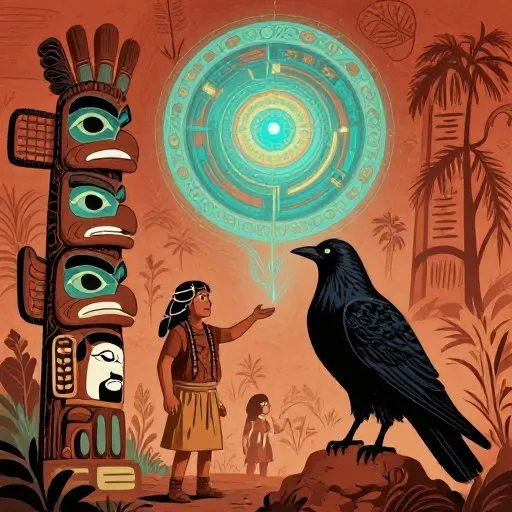
The Haida relationship with Raven is not the relationship of worshippers to a god, exactly. It is the relationship of people to a force that made them and doesn't particularly need them but remains interested, intermittently, in what they'll do next. He shows up in their art everywhere. On poles. On boxes. On the prows of canoes. Not as a distant deity but as a neighbor, a troublemaker, a presence that is right there, in the forest, on the beach, watching.
The sculpture at UBC is worth thinking about carefully.
Bill Reid was Haida on his mother's side and spent much of his life reclaiming a heritage that residential school policies had systematically tried to erase from his family. "The Raven and the First Men" was, among other things, his act of restoration. He spent two years working on it with four other carvers. The raven's eye in the finished piece is fixed on the humans coming out of the shell. Not warmly. Not coldly. With absolute attention.
That eye is the story.
The humans do not know what they are yet. They are brand new, crumpled, blinking. Some are climbing out eagerly. Some are still hesitant. One is being coaxed by the raven's enormous beak. They are at the exact moment before they become what they'll become, and the thing looking down at them is the thing that found them, the thing that made the light they're seeing by, the thing that has been alive longer than anything and still finds them worth leaning down to look at.
That's creation, in the Haida account. Not a divine plan. Not a moral architecture. A trickster who could not resist a strange sound on a beach, and the small frightened people who came out when he coaxed them, and the world they walked into that was already complete and ready and full of everything they'd need, if they were curious enough to look.
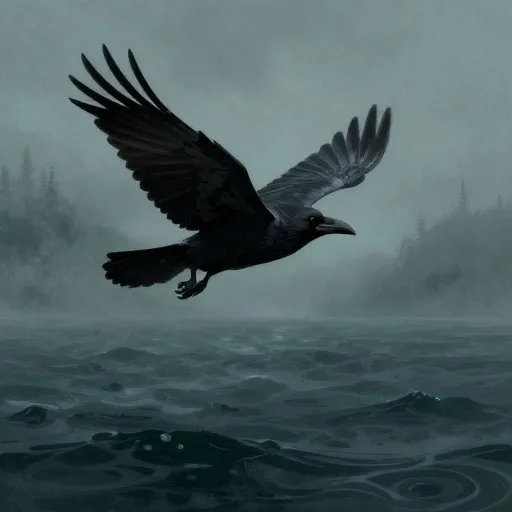
Raven is still on Haida Gwaii. Still in the trees. Still at the edge of the water.
You'd know him if you saw him. He'd be the one watching.