← All Stories

The Ramayana: Rama's wife Sita is kidnapped, a monkey army builds a bridge out of floating stones, and a demon king with ten heads discovers the hard way that they grow back.

Rama and the Bridge to Lanka

Mythwink

Rama and the Bridge to Lanka

The demon king had ten heads. Rama had one solution. It took a while to get to it.

1The Demon King's Calculation

Chapter 1: The Demon King's Calculation

Ravana was not a fool. This is important to understand before everything else. He was one of the most powerful beings in existence. He had ten heads, which the Valmiki Ramayana explains as representing his mastery of the four Vedas and six schools of Hindu philosophy. He was a scholar. A ruler. A devotee of Shiva who had performed austerities so extreme that Brahma himself gave him a boon of near-invincibility.

The boon said no god, no demon, no divine being could kill him. He had negotiated this personally. He had thought it through. He had covered every angle.

He didn't ask for protection from humans because he didn't think humans were worth asking about.

This is the kind of oversight that, in retrospect, is very obvious.

His kingdom was Lanka, an island fortress beyond the southern tip of India. Some scholars place it at modern Sri Lanka. Others argue for a site further south that's now submerged. What all the sources agree on is that it was across water, heavily fortified, and ruled by someone who genuinely believed he was unreachable.

Rama was a prince of Ayodhya, the seventh avatar of Vishnu, and at the moment Ravana became interested in him, was living in a forest with his wife Sita and his brother Lakshmana because of a complicated succession dispute. A fourteen-year exile. He had accepted it without complaint. He was that kind of person.

Ravana sent his sister Surpanakha to scout. She fell for Rama and was rejected. There was a confrontation. Her nose was cut off. She went back to Lanka and described Sita to Ravana in terms that made him lose his judgment entirely.

He came himself. He used a trick, a golden deer that turned out to be a disguise, to lure Rama and Lakshmana away from Sita. Then he crossed the line of protection Lakshmana had drawn in the forest floor.

He took her. He took her across the sea to Lanka.

2Hanuman

Chapter 2: Hanuman

The search for Sita would have failed immediately without Hanuman.

You need to understand what Hanuman is. He is the son of the wind god Vayu. He is the commander of a monkey army. He can change his size at will, fly through the air, move faster than thought. He has, at various points in the Ramayana, lifted an entire mountain because he couldn't remember which herb grew on it and brought the whole thing rather than waste time looking. He can make himself as large as a mountain or as small as an insect.

He is also, more than any of this, devoted to Rama with an intensity that the entire Ramayana treats as one of its organizing principles. Hanuman serves Rama not because he has to, not because he was assigned to, but because he looked at Rama and decided this was the thing his existence was for. The texts treat this as the correct decision.

Rama and Lakshmana found the monkey army through Sugriva, their king, who had his own problems that Rama helped resolve. Sugriva told them Hanuman was the one to send.

Hanuman crossed the ocean alone. He flew across. He found Lanka. He found Sita in the Ashoka grove, guarded and held but unbroken. He delivered Rama's ring to prove he had come from him. She gave him her hair ornament to take back as proof.

Then, because stealth is not the Ramayana's primary mode, Hanuman let himself be captured so he could be presented to Ravana. He insulted Ravana to his face. Ravana tried to kill him. Hanuman's tail was set on fire. Hanuman used the burning tail to set half of Lanka on fire before flying back across the ocean.

He had completed a reconnaissance mission. He had burned a significant portion of the enemy's capital. He had delivered a message and retrieved proof. He had done all of this because someone asked him to go look, and he is Hanuman, and looking was apparently never going to be the end of it.

3The Bridge

Chapter 3: The Bridge

The army assembled. Hundreds of thousands of vanaras, the monkey warriors. They gathered at the southern shore. Lanka was across the water. Someone needed to figure out the crossing.

The ocean would not cooperate at first. Rama stood at the shore and asked it to let them pass. The ocean god didn't respond. Rama notched an arrow and the ocean god appeared very quickly after that, because Rama with a bow is not someone an ocean wants to argue with for long. The ocean told him: build a bridge. I'll hold it.

The engineer was Nala. The architect of the bridge. Nala's story is specific and interesting: he was the son of Vishwakarma, the divine architect. He had been given a boon that anything he touched would float. This had been presented to him as a general gift, not as preparation for a specific engineering project, but here he was.

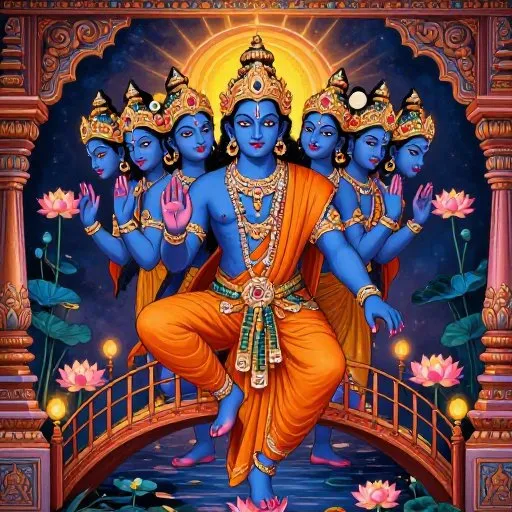
The vanaras brought stones. They wrote Rama's name on them: Ram. The name held the stones on the surface of the water. The bridge extended stone by stone, one hundred yojanas long. A yojana is an ancient Indian unit of distance, roughly eight miles. That's an eight hundred mile bridge built by a monkey army writing a word on rocks.

There is a geological feature between the southeastern tip of India and Sri Lanka called Adam's Bridge, or Rama Setu. It is a chain of limestone shoals and sandbanks stretching thirty miles, shallow enough to have once been walkable. Satellite photographs published in 2002 reignited debate about whether it was natural or constructed. NASA clarified that their images showed a natural formation. The debate continues regardless. The shoals are real. Whether the story came from them or the memory of them, it is not an accident that the bridge lands exactly where geology says it should.

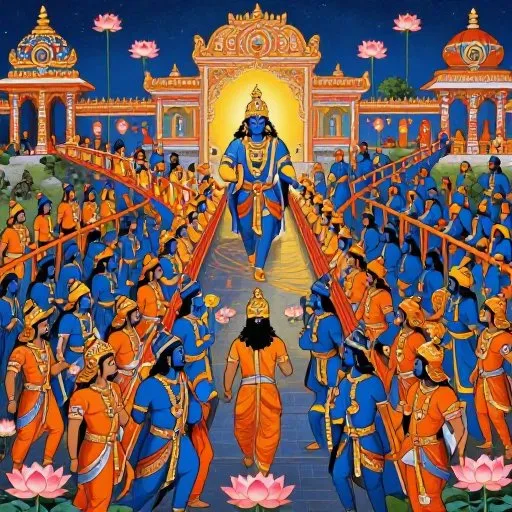
The army crossed. Rama walked at the front. Behind him, hundreds of thousands of vanaras carrying weapons, filling the sky and the water and the land with the sound of an army that had built an impossible bridge and knew it.

Ravana watched from Lanka. He had advisors who told him to return Sita. He had a brother, Vibhishana, who begged him to return Sita. He didn't listen to any of them, because listening would have required admitting he had made an error, and men who have ten heads and near-invincibility do not easily admit errors.

4The Ten Heads

Chapter 4: The Ten Heads

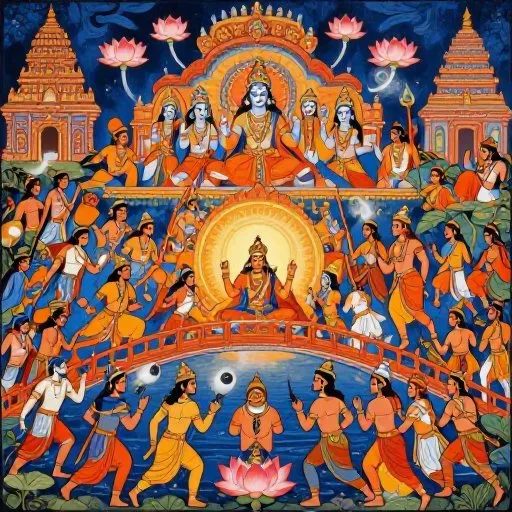
The battle for Lanka was not quick. It was vast, chaotic, and devastating on both sides. The Valmiki Ramayana devotes enormous sections to it, individual combats and their outcomes, weapons divine and mundane, the deaths of great warriors on both sides.

The core problem was this: Ravana had the boon. No god, no demon, no divine being could kill him. Heads came off and grew back. Weapons that would have ended anything else bounced off of him. Rama could injure him. He could drive him from the field. He could cut off every one of his ten heads in sequence and watch them grow back, which he did, and which the texts describe with the calm reporting of someone who understood they were watching something extraordinary.

The heads grew back. Every time. You could see it happening. Rama would cut one off and watch it regrow before the body hit the ground.

The sages Agastya and Matali arrived. Agastya told Rama he needed the Brahmastra, the Brahmaanda weapon given by Brahma himself. The weapon of the cosmos. Valmiki describes it: its tip was made of fire and wind, its middle of Meru and Mandara mountains, its weight the mass of Meru and Vindhya. It was not a metaphor. It was a specific weapon for a specific problem.

The boon protected Ravana from gods and demons. It did not protect him from a human being holding a weapon made from the fundamental forces of the universe.

Rama fired it into Ravana's chest. His heart. His chest. Not a head. All the heads in the world don't matter if you hit the thing they're attached to.

Ravana fell.

Lanka went quiet.

5The Fire

Chapter 5: The Fire

Here is where the story gets complicated, and the Ramayana does not pretend otherwise.

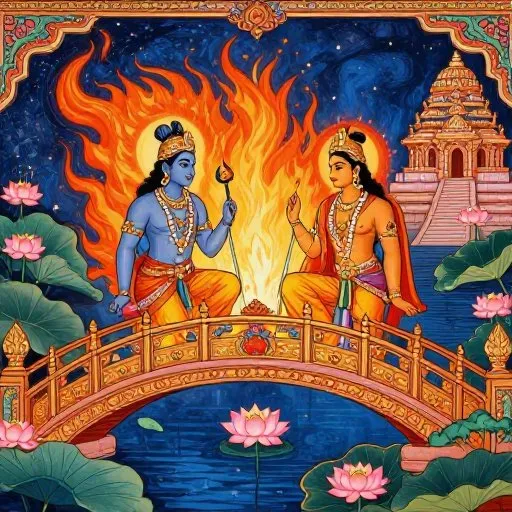
Sita was freed. She had been held in the Ashoka grove, guarded, untouched because Ravana could not have her against her will due to a curse that would kill him if he forced anyone, but held. Months in a garden belonging to the man who had taken her, with death as the alternative to cooperating.

She came to Rama. Rama looked at her and said the words that have troubled readers of the Ramayana for two thousand years. He said: I fought this war for my honor. For the honor of my lineage. I cannot take you back without knowing what happened. A woman who has lived in another man's house cannot return without proof of her purity.

Sita heard this. She asked Lakshmana to build a fire.

She stepped into it. She stood in the flames and did not burn, because she was Sita, and the fire knew her, and Agni the fire god would not consume someone innocent. She walked out of the fire unharmed.

Rama had known she was innocent. The texts suggest this, in various ways, in various versions. He knew. He asked anyway. Some scholars argue he had to, for the kingdom, for the people who would have questioned without the proof. Some argue this is exactly what it looks like: a husband asking his wife, who has survived captivity and all that comes with it, to prove herself in fire.

Both things can be true at once. That is, perhaps, what the Ramayana is saying.

They flew home to Ayodhya on Pushpaka Vimana, the aerial chariot of Ravana. The lamps were lit across the kingdom: the return of Rama, the festival of lights. Diwali. A celebration that has been observed across South Asia for more than two thousand years, lit in honor of a man and a woman coming home.

The Valmiki Ramayana does not offer a clean ending. Later versions added contentious passages. The tradition has been wrestling with the fire scene since before it was written down. A story that a billion people still tell, and the most important question in it is still open.

Good stories are like that.
Mythology Notes