← All Stories

Ragnarok, the Norse apocalypse: three winters, a ship made of fingernails, a wolf that eats the sun, and why the world ends and starts again. The full story.

Ragnarok

Mythwink

Ragnarok

The Norse gods always knew how the world would end. They showed up anyway.

1The Winter That Never Ends

Chapter 1: The Winter That Never Ends

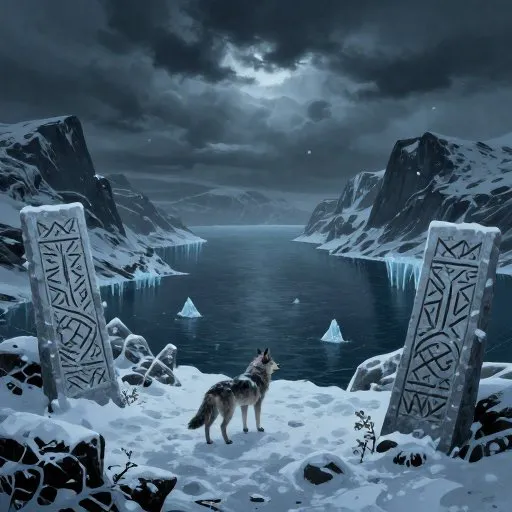
The first sign is not a wolf. It is not fire. It is not the dead rising or the sea heaving or the giants marching. The first sign is three years of winter with no summer in between.

Fimbulwinter. The great winter. Three consecutive winters, snow from every direction, biting cold across the whole world, and not one summer between them to let the ground recover. The Prose Edda describes it. The Voluspa, the great cosmological poem of the Poetic Edda, saw it coming from the beginning. Fimbulwinter is not just weather. It is the signal that the world's structure is starting to fail. The thing that holds summer and winter in their proper order has stopped working. The mechanism is broken.

What follows, the Voluspa makes clear, is not natural disaster. It is collapse. Social, moral, familial collapse. The poem describes what Fimbulwinter does to people: brothers fight each other, families turn on each other, the old bonds of loyalty and obligation that held Norse society together dissolve in the cold. This is the apocalypse's first movement. Not monsters. Failure from within.

The Vikings who listened to these poems lived in a world where winter was genuinely dangerous. Where food stores ran out. Where cold killed. Fimbulwinter was not an abstraction to them. Three winters without summer was not hyperbole. It was a description of a thing that would end everything they knew before the first wolf showed up.

But the wolves do show up. Their names were Skoll and Hati. They had been chasing the sun and the moon across the sky since the beginning of time. Every day, the sun crossed the sky with Skoll behind it. Every night, the moon crossed with Hati in pursuit. This was a known fact of the cosmos. The sun and moon ran and the wolves chased and everybody understood this was how the sky worked.

At Ragnarok, the wolves catch them.

Skoll catches the sun. Hati catches the moon. The sky goes dark.

Everything that was light is gone. Everything that was warm is gone. What is left is the cold, the dark, and what is coming next.

2The Chains Break

Chapter 2: The Chains Break

They had known about Fenrir for a long time.

Loki's son. A wolf. When Fenrir was born, the gods brought him to Asgard because they wanted to keep an eye on him. He grew. He kept growing. The gods looked at the size he was reaching and had a collective realization that this animal was not going to stop, and that when it was fully grown it was going to be a problem that no amount of keeping an eye on was going to solve.

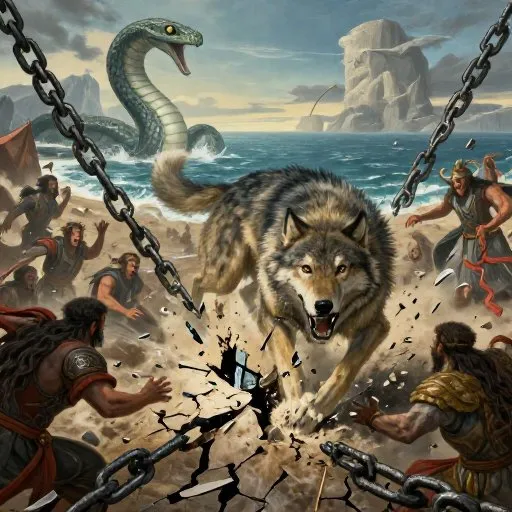
They tried to chain him twice. The first two chains, enormous iron constructions, Fenrir snapped like string. He was amused. So the gods commissioned the dwarves for something more subtle. The dwarves created a binding called Gleipnir. It felt like a soft ribbon. It was made from six impossible things: the sound of a cat's footstep, the beard of a woman, the roots of a mountain, the sinews of a bear, the breath of a fish, the spittle of a bird. Things that don't exist, woven together into something that could not be broken by force because there was nothing in it to push against.

Fenrir agreed to be bound with Gleipnir on one condition. One of the gods had to put their hand in his mouth as a guarantee. If the binding was a trick, the god would lose the hand. If it wasn't, no harm done.

Tyr put his hand in.

The binding held. Fenrir bit off Tyr's hand. The god of justice lost his hand to give the gods time. Not a metaphor. His actual hand, bitten off, as the price of buying a few more centuries. The Norse did not traffic in comfortable trade-offs.

Fenrir was bound on an island. He would be there until Ragnarok. Then Gleipnir would snap, and the jaw that had been straining against the impossible ribbon since before anyone currently living was born would finally close.

At Ragnarok, Fenrir gets free.

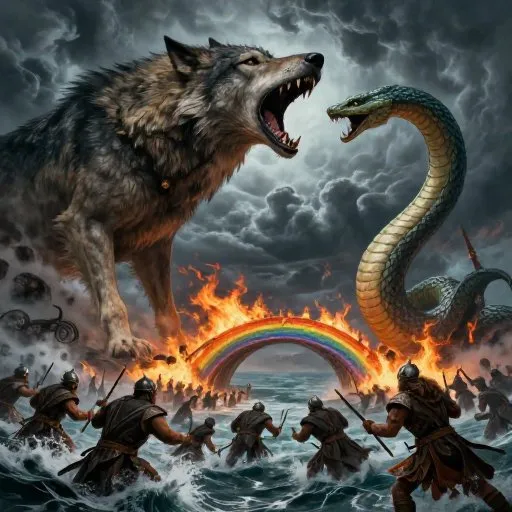
The Prose Edda describes him running with his upper jaw scraping the sky and his lower jaw dragging the earth, consuming everything between. He is running toward Odin. He has been waiting, for the entire history of the world, to reach Odin.

Jormungandr, the World Serpent, rises from the sea at the same time. Also Loki's child. It had been lying coiled beneath the ocean, grown so large it encircled the entire world and could bite its own tail. When it releases that grip and rises, the oceans flood the land. This is not described as metaphor. The water comes.

And somewhere in the chaos, Loki breaks free of the cave where he has been bound since Baldur's death. He boards a ship called Naglfar and he sails it toward Asgard.

A word about Naglfar. The Prose Edda is specific about its construction. Naglfar is made from the fingernails and toenails of the dead. Every human who died without trimmed nails contributed material to this ship. This is why, the Prose Edda notes directly, it was considered a bad thing to die with long nails: you were helping to build the ship that would carry the dead against the gods. It is a practical concern. Clip your nails, or you're working for the enemy.

Naglfar is crewed by the dead and sailed by Loki, and it is headed for the last battle.
3The Last Stand

Chapter 3: The Last Stand

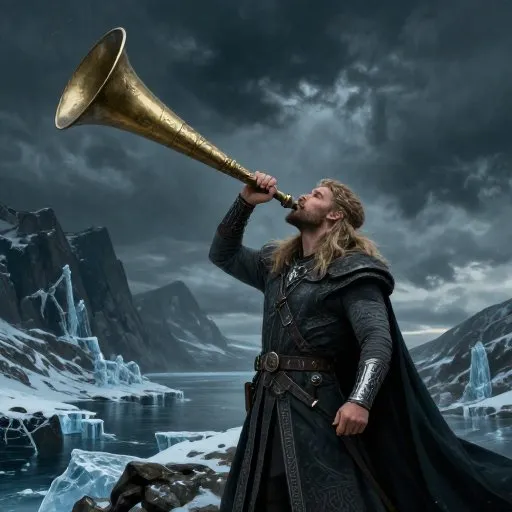
Heimdall blows the Gjallarhorn. One note. One enormous note that is heard across all nine worlds. The gods know what it means. They have always known what it means. Odin rides to the Well of Mimir one last time for counsel and comes back saying nothing about what he heard.

They meet on the field of Vigrid. The Prose Edda says Vigrid is one hundred and twenty leagues in every direction. Even the battlefield was made for a story this size.

The forces arrayed against the gods are the forces of every giant clan in the nine worlds, the dead from Naglfar, Fenrir loose and growing, Jormungandr poisoning the air with its breath, Loki leading everything that had ever been opposed to the Aesir. Surtr, the fire giant from Muspelheim, rides at the head of a column of fire with a sword that burns brighter than the sun. He has been waiting in the south since the beginning of creation for exactly this moment.

The gods know they lose. This is important. The Norse cosmology was not built on the assumption of divine victory. The Voluspa, the Prose Edda, all of it: the gods lose at Ragnarok. They have always known they lose. They showed up anyway. They picked up their weapons and they went to the field and they fought. This is the central moral fact of Norse mythology. Not triumph. Not a guaranteed good ending. The willingness to fight the thing you know will beat you because the alternative is to not fight it.

Consider what that asks of a person, sitting in a longhouse in Iceland in the eleventh century, listening to this poem. The world ends. The gods die. The lesson is not that good wins. The lesson is that you go anyway.

Odin fights Fenrir. The wolf swallows him whole.

The Allfather, who sacrificed his eye for wisdom, who hung on the World Tree for nine days and nine nights to learn the runes, who sent ravens across the world every day to understand it better, who had known for centuries exactly how his life would end, was swallowed by a wolf.

He went anyway.

4The Deaths and the Killing Stroke

Chapter 4: The Deaths and the Killing Stroke

The battles of Ragnarok are specific. The Prose Edda pairs each god with their opponent and records what happens. It is not vague. It is a ledger.

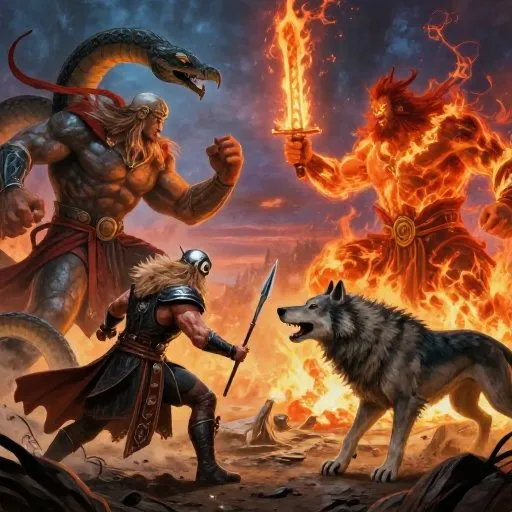
Fenrir swallows Odin. His son Vidar, who had been raised for this exact purpose, immediately kills Fenrir. He plants his foot on the wolf's lower jaw, and some sources say he has a special shoe built for this moment, and he tears the wolf's jaws apart. The shoe is important. Leather scraps from every shoe ever made by humans were saved and used to make Vidar's boot. This is why cobblers were careful about the scraps they left. Every tiny piece of discarded leather contributed to the boot that killed the wolf that swallowed the king of the gods. Norse mythology operated at this scale of domestic detail.

Thor fights Jormungandr. He has been fighting the World Serpent in one form or another his whole life. He kills it. He takes nine steps away from the body, and on the ninth step he falls, dead from the venom. Nine steps. He counted them. Or the story did.

Tyr, already missing a hand from the binding of Fenrir, fights Garm, the hound of Hel. They kill each other.

Freyr, who had given away his magic sword as a gift and has been fighting without it ever since, faces Surtr. Without his sword he cannot win. He dies. The Prose Edda notes specifically that he gave the sword away out of love and that love was the price of his life at Ragnarok. The Norse built these connections with precision.

Loki and Heimdall fight each other. They have been enemies since the beginning. They kill each other. Two gods who opposed each other from the start finish each other at the end. Balanced, in the worst way.

And then Surtr raises his sword and sets the world on fire.

Everything burns. The nine worlds. The great ash tree Yggdrasil that connects them. The earth sinks into the sea, the fire follows it down, and what is left is water and silence and nothing.

For a moment.

5The World That Rises

Chapter 5: The World That Rises

The Voluspa doesn't end with fire. This is what people miss about Ragnarok.

After the destruction, after the water and the silence, the poem describes the earth rising again from the sea. Green and new. Unburned. Waterfalls running. Eagles flying. Fields growing without anyone planting them. The world that comes back is not the same world. It is better. The Voluspa describes it as fertile in a way the old world never quite managed.

Some of the gods return. Baldur comes back from Hel. His brother Hod, the blind god whose hand was guided to throw the mistletoe dart, comes back too. They meet on a field where Asgard used to stand and they talk to each other. They find, in the grass, the golden gaming pieces the gods used to play with before everything happened. Those small ordinary objects, lying in the new grass. The Voluspa places this detail with intention.

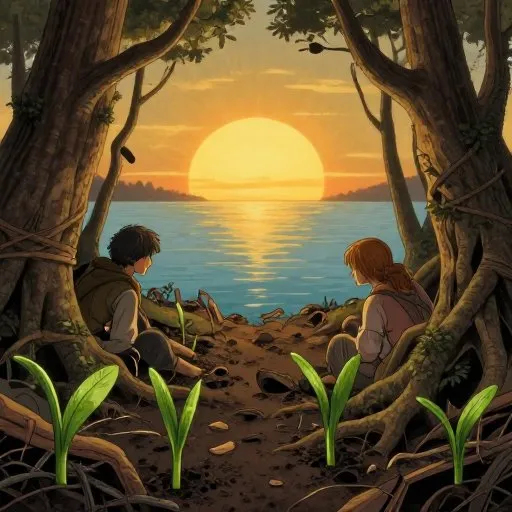
Two humans survive. Their names, according to the Prose Edda, are Lif and Lifthrasir. They hid in the wood of Hoddmimir, which some scholars believe was inside Yggdrasil itself, hidden in the one thing that could not be entirely destroyed. They ate morning dew. They came out after the fire and they repopulated the world. The whole cycle begins again.

There is a hall described in the Voluspa. Its roof is gold. It stands at Gimlé, south and higher than the sun. Survivors gather there. Good people. The poem doesn't specify the terms exactly, but the implication is that the survivors of the moral collapse that preceded Ragnarok, those who maintained the old bonds through Fimbulwinter, are the ones who come through.

Think about what the Norse were building with this. A cosmology where the world ends completely, where the gods die, where everything known is destroyed, and the next line is: and then it rises again, green, new, with the gaming pieces still in the grass. They built the worst thing they could imagine into the center of their mythology and then they built resurrection into the same poem. Not as a reward. Not as a rescue. As a structure. The world ends and the world begins and the cost of that was everything they had.

The Voluspa closes with a dragon. A dark one, flying from below, carrying corpses. The old world's last remnant. Winding its way into obscurity. The poem ends before the dragon does anything. It is just flying. Maybe it always flies, between one world and the next, carrying what the old one left behind.

The Norse left it unresolved. They usually did.

Mythology Notes