← All Stories

The Greek myth of Prometheus, who stole fire from the gods and paid for it with his liver. Every day. For thirty thousand years. The full story, told properly.

Prometheus Steals Fire

Mythwink

Prometheus Steals Fire

He gave humanity fire. Zeus gave him thirty thousand years to think about it.

1The Dumbest Brother in Mythology

Chapter 1: The Dumbest Brother in Mythology

Prometheus means "Forethought." His brother Epimetheus means "Afterthought." Their parents named them this. At birth. On purpose. The Greeks looked at two newborn Titans and went, "You're going to be the smart one, and you're going to be an idiot." And they were right. They were absolutely right.

Here's what happened. The gods needed someone to hand out survival traits to all the new animals. Claws, fangs, venom, thick hides, speed, camouflage. Important stuff. The stuff that determines whether you live past Tuesday. And they gave this job to Epimetheus. Afterthought. The one whose name literally means he doesn't think about consequences until it's too late. They put him in charge of distributing the tools of survival to every living thing on the planet.

He gave it all away. Every last trait. He got to humans and there was nothing left. Nothing. No claws, no fangs, no venom, no fur, no shells, no speed. He had given speed to cheetahs. He had given armor to turtles. He had given venom to snakes. By the time he got to people, the cupboard was bare. Humans got upright posture and anxiety. That's it. That's what they walked out of creation with.

Think about that. Really sit with it. The most consequential supply-chain failure in the history of existence, and it happened because someone put the guy named Afterthought in charge of logistics.

Meanwhile, Prometheus had been busy. He had gone down to the riverbanks, gathered clay, and sculpted human beings with his own hands. Shaped their faces. Bent their limbs. Stood them upright. Depending on which ancient source you read, either Athena breathed life into them or Prometheus figured that out himself. Hesiod says one thing. Apollodorus says another. Hyginus says a third. The Greeks could not agree on how humans came alive, but they all agreed on who made them.

And now he had to watch them shiver. His people. The ones he built. Naked, freezing, eating raw meat, dying of everything. Every animal on earth had the equipment to survive, and humans had nothing, because his brother was exactly the person their parents said he would be.

2The Stick

Chapter 2: The Stick

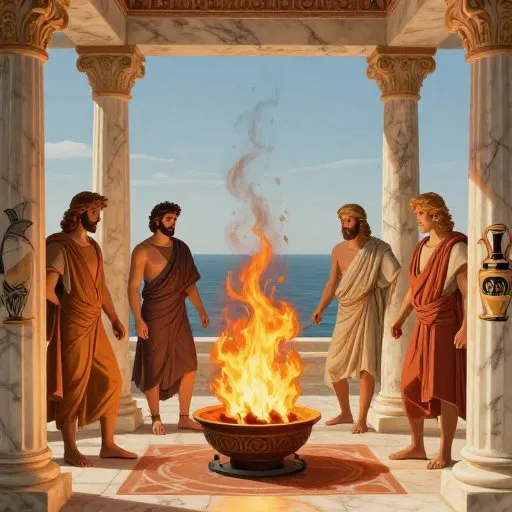
The gods had fire. The humans did not. And this was not an accident.

Zeus knew exactly what fire would do. Cooked food. Warmth. Light at night. Forged metal. The ability to stop being terrified all the time. He understood all of it, which is precisely why he was keeping it. Think about it from his perspective. Cold, starving, terrified humans are humans who pray. Humans who can cook their own food and build their own shelters start asking uncomfortable questions like "What exactly do we need gods for?" Every person who has ever held power has understood this math. Zeus was not the first. He was just the one who could throw lightning at you.

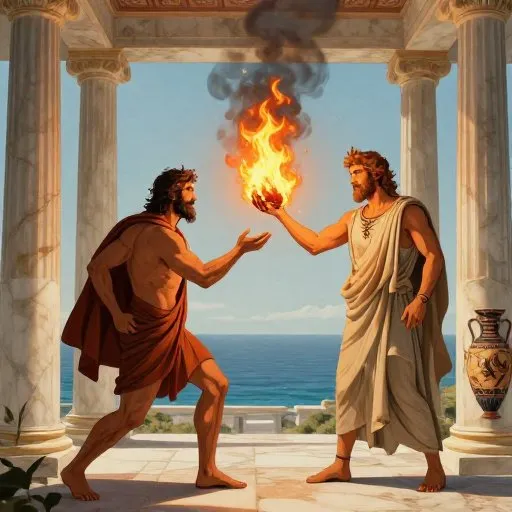
So Prometheus decided to steal fire from the gods. And his plan, his entire plan, was a stick.

Not a magic stick. Not a divine artifact forged in celestial flame. A fennel stalk. Ferula communis. It's a plant. It grows all over the Mediterranean. You can still find it. The thing about giant fennel is that the dried pith inside the stem smolders slowly without burning through the outer casing. You can put a lit coal inside a fennel stalk and carry it around for hours and it just looks like you're holding a stick. It's genuinely brilliant. It's also just botany.

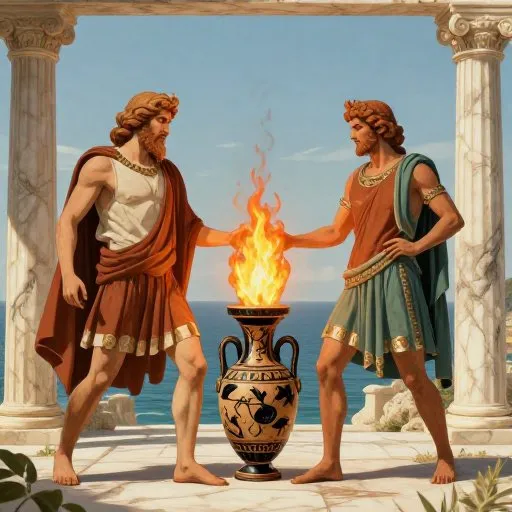
Prometheus walked into the forge of Hephaestus on Mount Olympus. This is where Zeus's thunderbolts were made. This is where divine weapons were produced. It was not a casual place to visit uninvited. He walked in, touched the pith of his fennel stalk to the divine fire, and walked out. Aeschylus, writing in the fifth century BCE, says nobody noticed. The god of the forge was hammering metal ten feet away and never looked up.

That's it. That's the heist. The most important theft in the history of mythology, the one that changed what it meant to be human, was a man walking through a door with a stick while someone was busy. No disguise. No magic. No elaborate scheme. A stick with a coal inside it.

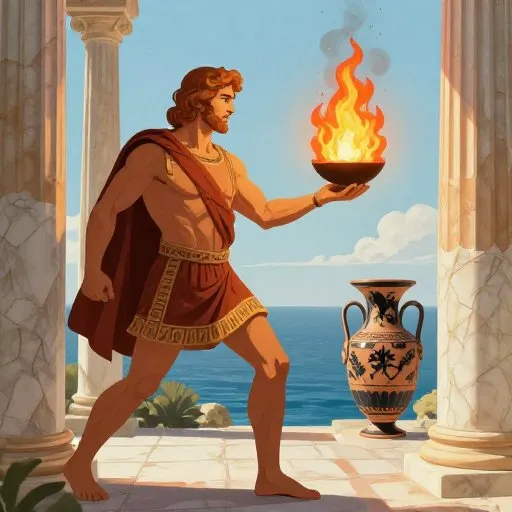
He carried it down the mountain. He gave fire to his humans. And Zeus, eventually, found out.

3What Happens When You Give People Fire

Chapter 3: What Happens When You Give People Fire

They did not mess about.

Aeschylus, in Prometheus Bound, lays out what followed, and the list is staggering. Agriculture. Writing. Mathematics. Medicine. Astronomy. The domestication of animals. Whether Prometheus literally taught them each of these things or whether fire was simply the first domino depends on which source you're reading. The Greeks disagreed on the mechanism. They did not disagree on what happened.

Cooked food meant better nutrition. Better nutrition meant bigger brains. Bigger brains meant the ability to figure out everything else. Forged metal meant tools. Tools meant agriculture. Agriculture meant surplus. Surplus meant cities. Cities meant you needed writing to track who owed what to whom. The entire chain of human civilization, every piece of it, traced back to one stolen coal inside a hollow plant carried down a mountain by a Titan who couldn't stop caring about things he'd made out of mud.

You want to know the wildest part? It worked too well. Zeus watched it happen, and what he saw was not progress. What he saw was a threat. Humans with fire were humans who could survive without him. Humans with tools and writing and agriculture were humans who could organize. Who could build. Who could look up at Olympus and think thoughts that cold, starving, desperate people do not have the energy to think.

The punishment that came next was not about what Prometheus had done. It was about making sure nobody, for the rest of time, ever considered doing it again. And Zeus, you have to give him this, he really committed to that goal.

4The Mountain

Chapter 4: The Mountain

Zeus sent two enforcers. Their names were Kratos and Bia. Strength and Force. That's what they were called. Not as titles. As names. Their mother looked at them and said, "You are Strength, and you are Force," and that was that. The Greeks named things what they were and did not find this unusual.

Kratos and Bia brought Hephaestus with them. The blacksmith god. The god whose forge Prometheus had robbed. Zeus ordered Hephaestus to build the chains that would hold Prometheus to a mountain for eternity.

Now. Think about Hephaestus for a second. He is being ordered to forge a prison for a man whose only crime was stealing from his workshop. A man who never did anything to him personally. A man who stole fire to help people who had nothing. Aeschylus, who wrote the only surviving play about this scene, says Hephaestus wept while he worked. He drove the pins into the rock. He fastened the chains. He did all of it. And he cried the entire time. Because Kratos was standing right there, and the alternative to obedience was becoming the next person chained to something. That is how Zeus operated. You do what I say, or you become the example.

Let that sit for a moment. Don't rush past it. A god who didn't want to do this, building a thing he didn't want to build, for a punishment he knew was wrong, because the person giving the order was too powerful to refuse. That's not mythology. That's Tuesday.

They pinned Prometheus to a peak in the Caucasus mountains. For a Greek in the fifth century BCE, the Caucasus was the end of the world. Past the Black Sea, past the colonies, past the last place anyone you knew had ever actually been. Zeus wasn't just punishing him. He was erasing him.

Then came the eagle. Every morning. Every single morning. It landed on Prometheus and tore him open and ate his liver. Not his heart. Not his lungs. His liver. The Greeks believed the liver was the seat of the soul. The organ where courage lived. Where emotion lived. Zeus was not picking an organ at random. He was taking the specific part of Prometheus that had looked at freezing, starving humans and decided to do something about it. Every day. He was taking that part every day.

And every night, the liver grew back. Because Prometheus was immortal. And immortality, when someone wants to hurt you, is the worst thing you can be.

Hyginus records the duration. Thirty thousand years.

Thirty thousand years. An eagle eating your liver. Every morning. Growing back every night so it can happen again. For context, all of recorded human history is about five thousand years. Prometheus was on that mountain for six times longer than humans have been writing things down. That is not a punishment. That is a career. The eagle had a longer work history than most civilizations.

And why? Because a man gave people fire. That's it. That's the whole crime. He gave cold people the ability to be warm, and this is what happened to him. Zeus chained a man to a mountain at the edge of the world and sent a bird to eat his organs every day for thirty thousand years because the man handed someone a stick.
5The Arrow and the Ring

Chapter 5: The Arrow and the Ring

Heracles showed up because he was already in the area. This is how things work in Greek mythology. Nobody arrives on purpose. They arrive because the story needs them there, and the Greeks were honest about it.

He was in the middle of his twelve labors. The impossible tasks he had to complete as penance for killing his own family during a madness sent by Hera. That is its own story and it is exactly as grim as it sounds. The eleventh labor took him toward the western edge of the world to fetch the golden apples of the Hesperides, and his route passed through the Caucasus. Past a Titan who had been screaming on a mountain for longer than most civilizations manage to exist.

Heracles shot the eagle. One arrow. The bird that had clocked in every morning for thirty thousand years dropped out of the sky and that was the end of it.

Then he broke the chains. The sources don't agree on how. Some say Heracles smashed them. Others say Hephaestus came back and undid his own work. Quietly. The god who built the chains, taking them apart. If that version is true, and I hope it is, then Hephaestus has the saddest arc in this entire story. He wept when he made the prison, and he came back to unmake it when he finally could.

And here is the thing the Greeks certainly noticed, the detail that makes the whole structure click: Heracles was Zeus's son. Zeus's own child freed the prisoner that Zeus had tortured for thirty thousand years. Greek mythology was full of this kind of structural irony. They did not do it by accident. They knew exactly what they were saying about fathers and sons and the things that power does to people.

After the chains came off, Zeus had one more requirement. Prometheus had to wear a ring. For the rest of eternity. It was made from a link of his own chains, set with a stone from the Caucasus peak where he had spent thirty millennia. A piece of his prison, shrunk down to fit on a finger. According to Apollodorus, this is why humans wear rings. We inherited the habit from a freed god who was never allowed to forget what freedom cost.

Whether the Greeks actually believed that, who knows. But they told the story. And you don't invent a detail like that, a link of chain and a chip of mountain stone on a finger, unless it means something real to you.

Prometheus walked down the mountain. Fire was already everywhere. His humans had done things with it that even a Titan with foresight for a name couldn't have predicted. And on Olympus, Zeus still sat on his throne. Still powerful. Still in charge. But ruling a world that didn't belong entirely to him anymore, and hadn't for a very long time.

That was Prometheus's doing. Thirty thousand years earlier. A hollow stick that smelled like fennel and burned like the beginning of everything.

Mythology Notes