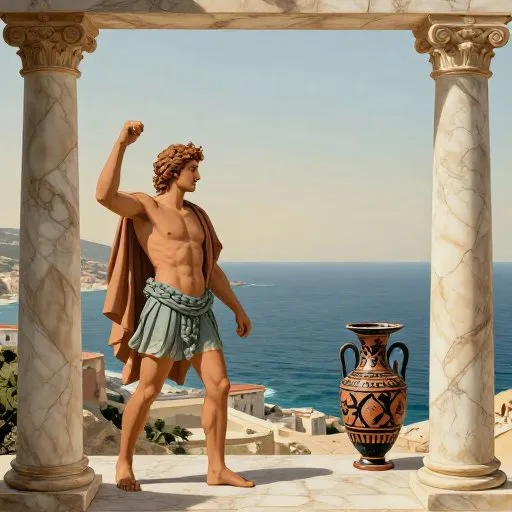
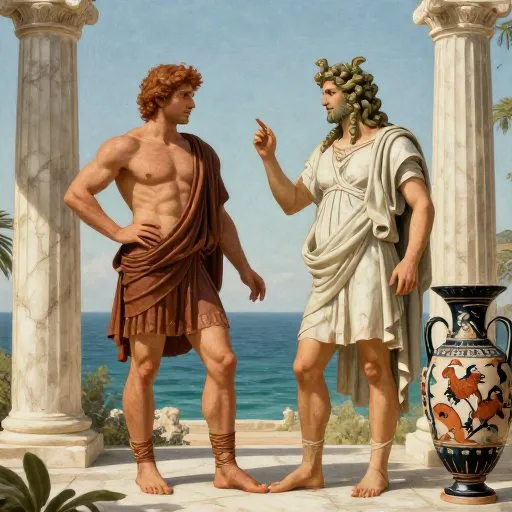
The Greek myth of Perseus, Medusa, and the shield that worked as a mirror. One look turned people to stone. He never looked directly at her. The full story, told properly.
Mythwink
He was sent on a suicide mission. He came back with a bag of heads.
King Polydectes of Seriphos wanted to marry Perseus's mother. That's where this starts. Not with monsters. Not with gods. With a middle-aged man who wanted something and needed the son out of the way to get it.
Perseus and his mother Danae had washed up on Seriphos in a chest. That is not a metaphor. When Perseus was an infant, his grandfather Acrisius, king of Argos, had been told by an oracle that his own grandson would kill him. The usual response to oracles in Greek mythology is to do something that accidentally ensures the prophecy happens, which we'll come back to. Acrisius's specific response was to lock his daughter Danae in a bronze tower so she could never have a child. Then Zeus appeared to her as a shower of gold. Perseus was born nine months later. Acrisius, unable to kill his own daughter but also unwilling to simply accept the situation, sealed Danae and the infant in a wooden chest and threw them into the sea.
They survived. They washed up on Seriphos, where a fisherman named Dictys, brother of King Polydectes, found them and took them in. Dictys was decent. His brother was not.
By the time Perseus was grown, Polydectes had fixed his attention on Danae and Danae did not want his attention. Perseus stood between them. The boy was big enough and angry enough that Polydectes couldn't simply push through him, which was a problem. So Polydectes announced he was getting married. Not to Danae. To someone else. He told everyone he needed wedding gifts, and the specific wedding gift he wanted was a horse. Perseus, who had no horse and no money, said he would bring anything Polydectes named.
Polydectes named the head of Medusa.
Take a moment. Sit with the geometry of this. He didn't say "bring a horse." He said "bring the severed head of the monster whose gaze turns every living thing to stone." There were stone statues scattered around Medusa's lair, the sources say. They were the people who had gone there before. The stone statues were the previous attempts. Polydectes knew exactly what he was asking for. He was asking for a young man with no resources, no weapons, no plan, and no experience to go get himself turned into a piece of garden statuary, and then Danae would have no one to protect her.
Perseus said he'd do it. Because of course he did. He was the son of Zeus, raised poor, made to feel inferior in Polydectes's court for years, and someone had just told him to do the impossible. When you tell that person to do the impossible, you have badly miscalculated.
The gods were paying attention.
Perseus needed help and he got it from people you would want help from.
Athena appeared to him first. Goddess of wisdom, strategy, and crafts. She had a specific interest in this mission because Medusa had once been a priestess in her own temple, and Poseidon had assaulted her there, and Athena had transformed her. The mythology is honest about the fact that Athena punished the victim rather than the perpetrator, and it does not explain this in a way that makes it better. The ancient Greeks understood it as divine prerogative. Modern readers understand it as something else. Both readings are in the text.
Athena gave Perseus a polished bronze shield. Not to block weapons. To use as a mirror. You could look at Medusa's reflection without turning to stone. The reflection was safe. Direct eye contact was not. The shield was his primary tool.
Hermes appeared next and gave him a curved sword, the harpe, with a blade specifically designed for cutting rather than stabbing. Also a pair of winged sandals. Also a cap of invisibility, the helm of Hades, though in some versions he had to borrow these last items from the Nymphs of the North. Also the kibisis: a bag, a special bag, that could safely contain Medusa's severed head without the gaze working through the material. You could put the head in the bag and carry it around and it was inert. Without the bag, you had a live weapon with no off switch.
Think about the kibisis for a moment. Someone designed a head-sized bag specifically for containing the gaze of a creature that turns people to stone. This is product development. Someone at some point in the manufacturing chain had to solve that specific brief. The Greeks just gave it to a hero and moved on.
Perseus also got directions. The path to Medusa ran through the Graeae, three ancient sisters who shared one eye and one tooth between them. They passed the eye back and forth when they needed to see. Perseus found them in the act of passing the eye between them, grabbed it mid-transfer, and refused to give it back until they told him where Medusa lived.
He was extorting blind old women. He wasn't wrong to do it. He needed the information and this was how you got it. The Greeks didn't write their heroes as uniformly virtuous people. They wrote them as effective people, and those are not always the same.
There were three Gorgons. Stheno and Euryale were immortal. Medusa was not, which is the whole reason this mission was theoretically possible. You could not kill the other two. Medusa could die, which did not make killing her safe, just technically achievable.
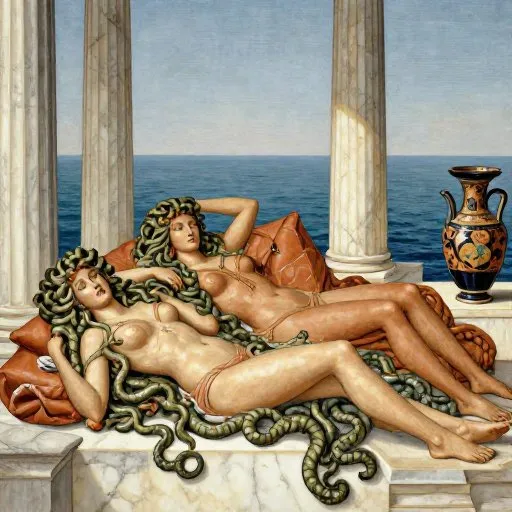
Perseus found them sleeping.
The accounts, from Pindar in the 5th century BCE onward, describe the Gorgons as having serpents for hair, bronze hands, golden wings, and tusks. They were not ordinary creatures and they were not meant to be understood as ordinary creatures. They were forces. The kind of thing Greek mythology generated to put a face on overwhelming danger, to make the incomprehensible slightly more negotiable by giving it a form you could theoretically approach.
He kept his eyes on the shield.
This is the technical achievement of the whole story, and it doesn't get enough credit. Holding a shield steady enough to see a clear reflection while also maneuvering to make an accurate cut on the neck of a creature you cannot look at directly, while the creature sleeps but might wake up, while the other two immortal sisters are right there. The shield had to serve as both mirror and map. Every adjustment he made to his position had to be read from a reflection, which reverses everything. Left is right. Right is left. You are navigating entirely backwards.
He cut off her head. One stroke. The harpe did what it was designed to do.
Two things came out of Medusa's neck. Two living things, fully formed, that had been inside her. Pegasus, the winged horse, and Chrysaor, a warrior carrying a golden sword. Their father was Poseidon. Medusa had been pregnant at the moment of her death, and the children had been growing inside a Gorgon. That is where Pegasus came from. The most beautiful creature in Greek mythology was born from the severed neck of a monster, into a scene of blood and stones that used to be people.
Pegasus flew off. Perseus didn't try to catch him. He had a head to bag.
He put Medusa's head in the kibisis. He put on the cap of invisibility. Stheno and Euryale woke up to find their sister dead and the intruder gone. They searched by the sound of his winged sandals, circling and diving, unable to find something they couldn't see. He was already above the clouds and moving.
On the way home from the edge of the world, Perseus passed over the coast of Ethiopia.
He looked down and saw a woman chained to a rock at the waterline. He descended.
Her name was Andromeda. Her mother was Cassiopeia, queen of Ethiopia, who had made the mistake of claiming that Andromeda was more beautiful than the Nereids, the sea nymphs. The Nereids had complained to Poseidon. Poseidon had sent a sea monster called Cetus to devastate the coast. The oracle had told King Cepheus, Andromeda's father, that the only way to stop the destruction was to sacrifice Andromeda to the creature. So there she was. Chained. Waiting.
Perseus spoke to her. She told him the situation. He flew up to find Cepheus and Cassiopeia, who were watching from the shore, and made them a deal: he would kill Cetus and Andromeda would be his wife.
They agreed. The monster arrived. Perseus killed it. The sources are not detailed about the method. Some say he used the head of Medusa, which would mean he opened the kibisis and held it out and Cetus turned to stone mid-attack. Others say he killed it with the harpe. Either way, the monster died and Andromeda was unchained and Perseus had a fiancée.
There was a complication. Andromeda had been previously promised to her uncle Phineus. Phineus had not shown up to save her or object to the sacrifice, but he had strong feelings about Perseus taking her. At the wedding feast, he arrived with a force of armed men.
Perseus asked for this situation to be resolved peacefully. When it was clear that wasn't happening, he reached into the kibisis.
A significant number of Phineus's men immediately became marble. Phineus himself, unable to look away in time, turned to stone mid-appeal, in the posture of a man begging. Ovid describes the statue in the Metamorphoses: arms extended, face upturned, caught between aggression and fear. Technically speaking, that is a monument to very bad timing.
Perseus took Andromeda home to Seriphos.
Polydectes had not expected Perseus to come back. He had also, in the time Perseus was away, been pressing his suit on Danae with more insistence, which was the point of the whole thing. By the time Perseus returned, Danae had taken refuge at an altar, the last protection available to her against a king who had decided she was his.
Perseus walked in.
Polydectes did not believe he had the head. This is the part that makes you wonder about the judgment of people who send young men on suicide missions. You sent him to get the impossible thing. He came back. Maybe update your assumptions.
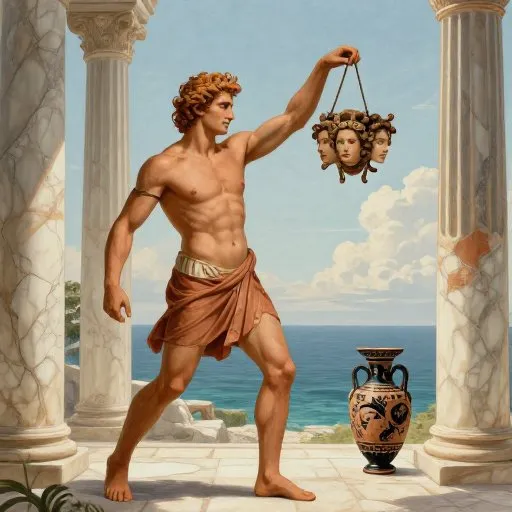
Perseus asked if he wanted proof. Polydectes said he did. Perseus opened the kibisis.
Polydectes and everyone in his court who looked directly at the head turned to stone. Diodorus Siculus records this. The fishing village Dictys, the decent man who had rescued Danae from the sea, became king of Seriphos instead. The stone figures of the court, presumably, remained where they were.
Perseus returned the divine equipment: the winged sandals, the cap of invisibility, the kibisis. He gave the head of Medusa to Athena, who placed it on her aegis, the divine shield she carried from then on. Medusa's gaze continued working after her death. Her head became a weapon on a goddess's armor. She had been a monster, and then a corpse, and then a trophy, and then an installation on celestial arms. None of this was her choice, from beginning to end.
Then Perseus went home to Argos. His grandfather Acrisius, you'll recall, had been told that his grandson would kill him. Having heard this, Acrisius had put his daughter in a tower, thrown her and the infant into the sea in a chest, and spent years trying to create the circumstances of his own prophecy. He had fled Argos when he heard Perseus was coming.
He ended up in Larissa, in northern Greece. There was an athletic competition. Perseus competed. He threw a discus. It went wide, struck a spectator in the crowd, and killed him. The spectator was Acrisius. The old king had run all the way to Larissa and it found him there in the crowd at a sporting event, on a day when nobody meant for any of it to happen.
The oracle was right. The oracle, in Greek mythology, is always right. The only variable is how much damage you can do to yourself and everyone around you trying to stop it.