← All Stories

The Hawaiian myth of Pele, goddess of fire and volcanoes, who fled her sister across the island chain. Her journey is still visible. Kilauea is still active.

Pele and the Volcano

Mythwink

Pele and the Volcano

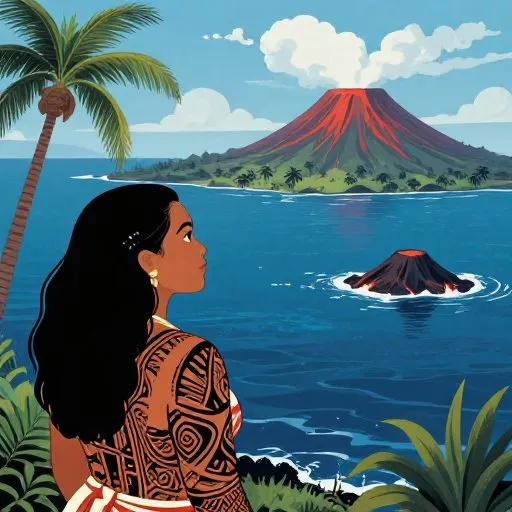
She ran across the Pacific, island by island, and the sea followed her the whole way.

1Where She Came From

Chapter 1: Where She Came From

Pele did not start in Hawaii. She came from somewhere else, driven out, crossing the ocean, looking for a place where the sea couldn't reach her. That part of the story matters. The goddess of fire and volcanoes is fundamentally a refugee.

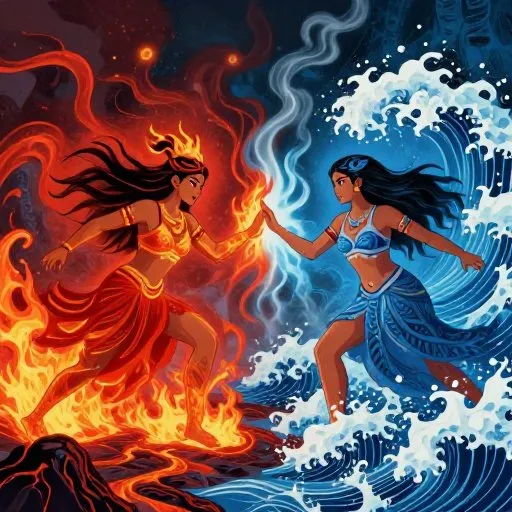
The Hawaiian tradition recorded in texts like the Pele and Hi'iaka cycle, preserved by Native Hawaiian scholars and oral historians over centuries, tells this: Pele came from Kahiki, understood variously as Tahiti or a more abstract ancestral homeland. She had siblings, many of them. She had powers of fire that she hadn't fully settled into yet, a dangerous restlessness that she hadn't yet turned into something permanent. And she had a sister, Namakaokahai, the goddess of the sea, who was her enemy in the way that fire and water are always enemies.

The reason for the enmity depends on which version you read. Some say Pele seduced Namakaokahai's husband. Some say the conflict was older and more cosmological than any single event. What all versions agree on is the result: Namakaokahai wanted Pele dead. Pursued her with the ocean itself. And Pele ran.

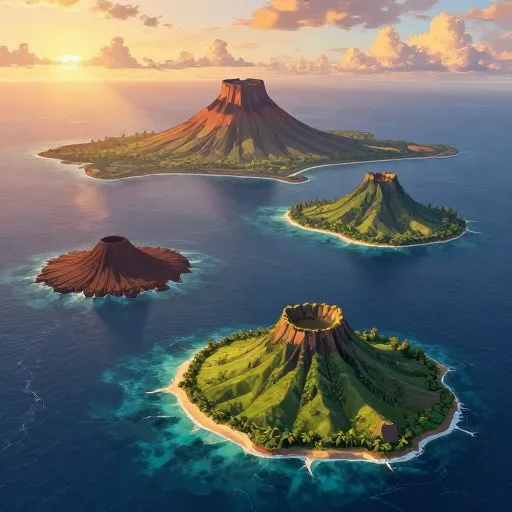
She ran with her family, in canoes, across the Pacific. She was looking for land deep enough that the sea couldn't flood what she built. Looking for a fire pit her sister couldn't drown. The Hawaiian archipelago stretches about 1,500 miles from northwest to southeast. The geological age of the islands runs in the same direction: the oldest islands in the northwest, the youngest in the southeast. The Big Island, Hawaii itself, is the youngest of all, still growing, still erupting.

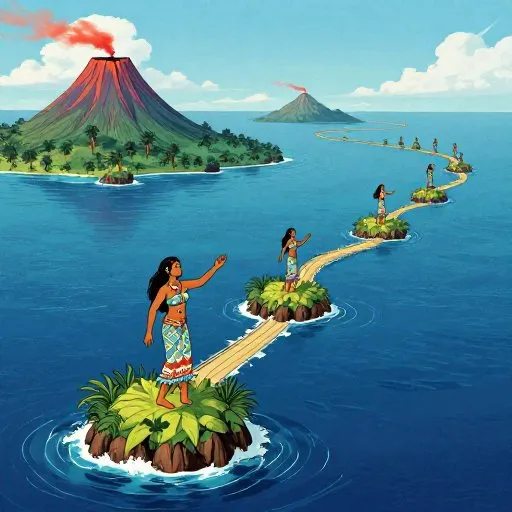
Pele landed on the oldest island first. She dug a fire pit. Her sister came and drowned it. Pele moved southeast to the next island. She dug a fire pit. Her sister came and drowned it. Island by island, southeast, each island younger and deeper and more geologically active than the last. Each fire pit a little more durable. Each one extinguished anyway.

She was not running away from a story. She was running through geology.

2The Chase

Chapter 2: The Chase

Stand on a map of the Hawaiian islands and trace the chain from northwest to southeast. Kure Atoll. Midway. Pearl and Hermes Reef. Laysan. Gardner Pinnacles. French Frigate Shoals. Each one smaller, lower, older, more eroded. Then: the main islands. Ni'ihau. Kaua'i. O'ahu. Moloka'i. Lana'i. Maui. Hawai'i.

Each step southeast is a step toward the geologic hotspot that has been punching through the Pacific plate for 70 million years, producing island after island as the plate slides over it. The northwestern islands are what Hawaii becomes, eventually: eroded flat, then drowned. The Big Island is what Hawaii is right now: being made.

The Pele tradition, told long before modern plate tectonics, described exactly this pattern. Pele moving southeast. Pele's older fire pits becoming extinct. Pele's current home being the youngest, most active site. The myth is a geological field study rendered as a chase scene.

Namakaokahai kept coming. The sea is persistent in ways that fire is not. Fire burns and moves on. Water fills every depression, finds every crack, works without urgency and without end. Every fire pit Pele dug, the sea found eventually. Kaua'i: extinct. O'ahu: extinct. Maui: Haleakala, dormant. And Pele kept moving.

The conflict between them is not a war with a winner. It is a process. The fire builds the island, the sea erodes it. The island exists for the duration of the argument. When the argument is finally over, the island is gone.

On one of these islands, the stories say, Namakaokahai caught Pele and tore her apart. Her bones became a hill called Ka-iwi-o-Pele, the bones of Pele, on Maui. In many traditions this is not Pele's death. She was not mortal in the way the body she left there was mortal. She reformed, she continued, she kept going southeast.

The chase had one more island to cross.
3Kilauea

Chapter 3: Kilauea

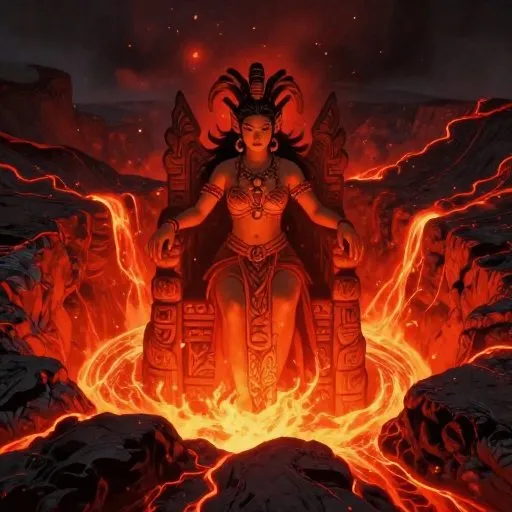
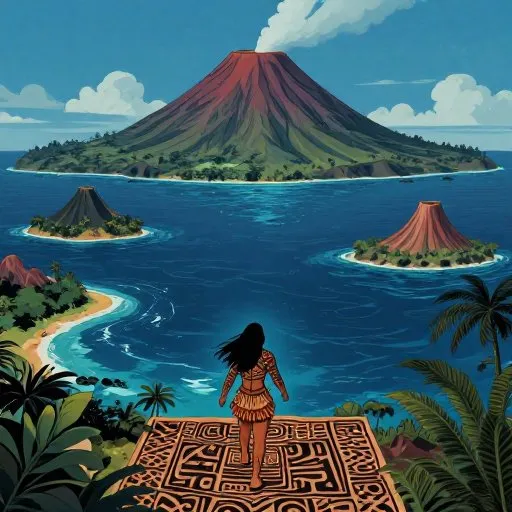
She settled at Kilauea.

On the Big Island. On the youngest island. On the place where the hotspot is directly below, where the crust is thinnest, where the fire comes up through the floor of the ocean and builds land in real time. Where the lava still flows some years all the way to the sea, adding new rock to the edge of the island, making it fractionally larger than it was.

Kilauea is one of the most continuously active volcanoes on earth. It erupted for thirty-five years with very little interruption between 1983 and 2018. It erupted again in 2020, 2021, and has had activity since. The caldera at its summit, Halema'uma'u, is where Pele lives in Hawaiian tradition. Not where she lived. Where she lives. Present tense. This is not a historical belief. It is a current one.

When lava flows, Native Hawaiian practitioners understand that as Pele's movement. When Kilauea erupts violently, it is Pele doing what Pele does. The Hawaiian tradition does not treat this as metaphor. The relationship between the deity and the geological event is direct. The volcano is not a symbol of Pele. It is Pele.

People leave offerings at the caldera. Flowers, food, sometimes other things. The park service has asked people not to do this inside the national park boundaries, which creates a complicated situation: a federally managed piece of land that is, for a significant portion of the people who live around it, a sacred site with ongoing religious practice. These tensions are real and unresolved. They are part of what it means for a living culture to exist alongside institutions that were built without them in mind.

Namakaokahai still comes. The Big Island is surrounded by the ocean. The southeastern coast is where lava enters the sea, hissing, hardening, steam rising in columns. Fire and water, still at it. The island exists in the space between them.

4The Lava Rock Rule

Chapter 4: The Lava Rock Rule

Don't take lava rocks from Hawaii.

This is the rule. You will hear it from Native Hawaiian people, from hotel desk staff, from tour operators, from the National Park Service's informal signage, and from the stacks of packages that arrive at Volcanoes National Park every year: rocks mailed back by people who took them and then experienced what they describe as bad luck.

The returns come with letters. "I took this rock five years ago and since then my marriage ended, my business failed, and I have had three car accidents." "Please return this to where it belongs, I am sorry, I didn't believe the rule." The park has received so many returned rocks over the decades that there is a designated area for repatriating them. The letters are sometimes heartbreaking. The rocks are, geologically speaking, ordinary basalt. The rock does not know what happened to the person's marriage.

But here is the thing about the rule: it predates the tourism version of it. The practice of not removing things from Pele's domain is part of Hawaiian tradition. The curse narrative that circulates among tourists, the personalized bad luck, may have been amplified or even partially invented for cultural transmission to outsiders who wouldn't respond to religious prohibition. Nobody is certain when the tourist version started. What is certain is that the underlying principle, that lava belongs to Pele and removing it is a violation of something real, is genuinely Hawaiian.

You can argue about whether rocks cause car accidents. You cannot argue that a culture's relationship to its sacred landscape is not worth taking seriously. The practical effect of the rule, whatever its origins, is that people think twice before pocketing a piece of an active volcano. As outcomes go, that one is defensible.

Pele is worshipped. Practiced. People speak to her, make offerings, ask permission before certain activities on her land. Indigenous Hawaiian spiritual practice, suppressed for over a century by colonial and missionary pressure, has experienced significant revival since the Hawaiian cultural renaissance of the 1970s. Pele is part of that. She is not a character from a finished story. She is a deity with active practitioners.

5What the Chase Built

Chapter 5: What the Chase Built

Namakaokahai never stopped. That's the ending. Not a resolution, not a victory, not a moment where the conflict was decided. The sea is still out there. The fire is still underneath. The chase that started in a mythological homeland is still happening in the Pacific right now.

The Big Island gains land on its eastern coast where lava hits the ocean. It loses land on its western coast to erosion, to wave action, to the ordinary work of the sea over time. Pele builds. The sea takes. The island exists between the two of them, in the temporary space the fire manages to hold before the water claims it.

There is an island forming southeast of the Big Island right now. It's called Lo'ihi. It's an underwater seamount, an active submarine volcano sitting 3,000 feet below the surface of the Pacific. By current estimates it will break the surface in somewhere between ten thousand and one hundred thousand years. A new island. Pele moving southeast, the way she always has, one more step in the same direction.

The geological and the mythological say exactly the same thing: she is not finished. She is still running. She is still building. The sea is still behind her and she is still one island ahead of it.

There is a word in Hawaiian, kaona, that refers to a layered meaning, a hidden or deeper significance within a story or a place name. It is understood that things in Hawaiian tradition often mean more than one thing simultaneously, and that the surface meaning and the deeper meaning are both true and both intended. The Pele story is about a goddess. It is also about the geology of the Hawaiian archipelago. It is also about the nature of creation under pressure. It is also about what it means to keep building despite pursuit, to keep moving when staying still means being drowned.

All of these are true at once. That's kaona. That's also just what the best mythology does.

Kilauea is erupting somewhere in time while you read this. Or it has just stopped. Or it is about to start. The mountain makes no distinction between those states. Neither does Pele. The fire is either present or gathering. The sea is always present.

The islands are still here. That's the whole story.

Mythology Notes