The Greek myth of Pandora, the first woman, and the jar full of every evil. She opened it. One thing stayed inside. The full story, told properly.
Mythwink
Zeus built a woman to destroy humanity. She opened the jar. Erasmus named it wrong in 1508. The argument about Hope has never stopped.
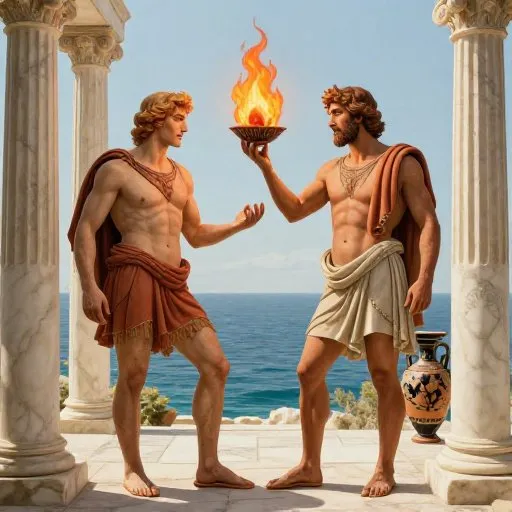
You know about Prometheus. If you don't, the short version is this: he stole fire from the gods and gave it to humans and Zeus chained him to a mountain and had an eagle eat his liver every day for thirty thousand years. That story ends, more or less, with Heracles shooting the eagle.
This story is what happened in between. This story is what Zeus did about the people who now had fire.
He couldn't chain them all to mountains. Too many mountains required. And besides, the problem wasn't that humans had fire. The problem was that they had received a gift, and receiving gifts from someone means you are in a relationship with that someone, and Zeus did not want Prometheus and humanity to be in a relationship. He wanted humanity to understand, clearly and permanently, that gifts from the wrong sources come with consequences, and that the consequences land on everyone, not just the one who stole the fire.
He needed a different tool.
He called a meeting. The gods and the god-adjacent craftsmen. Hephaestus, the great smith. Athena, goddess of wisdom and crafts. Aphrodite, goddess of love and desire. Hermes, divine messenger. Ares, Graces, Hours, and others depending on which source you read. Hesiod, in Works and Days, written around 700 BCE, lists them. Zeus told them what he wanted. He wanted them to build a woman.
Not just any woman. A specific kind of woman, designed from the ground up for a purpose.
Hephaestus mixed earth with water and shaped her form. He gave her a human voice. Athena dressed her and taught her weaving. Aphrodite gave her grace and desire and the kind of beauty that makes people stop thinking clearly. The Graces gave her jewelry. The Hours gave her a crown of flowers. Hermes gave her a mind that was quick and curious. He also gave her, Hesiod says pointedly, a nature that was "shameless" and a heart that was "full of wile." Hesiod was not on her side. We will come back to Hesiod.
They named her Pandora. Every gift. Pan: all. Dora: gifts. She was a gift from every god.
She was also a weapon. Zeus had built a weapon and named it Every Gift and he was going to hand her to someone who had been specifically told not to accept gifts from Zeus.
Prometheus had a brother. Epimetheus. Afterthought. The one who gave all the survival traits to the animals before he got to humans and left nothing for them. He was not, to put it gently, the best planner.
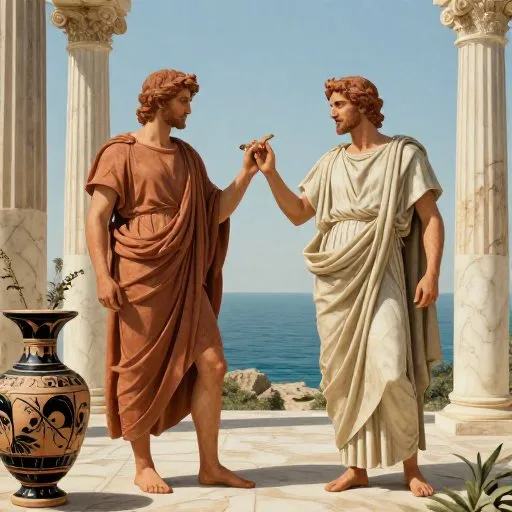
Prometheus had warned him. Explicitly. Do not accept gifts from Zeus. Whatever Zeus sends, send it back. If Zeus hands you something wonderful, it is because the wonderful thing is going to destroy you, and Zeus is counting on you accepting it before you figure that out.
Epimetheus had agreed. He understood the logic. He had committed to this principle.
Then Pandora arrived.
She was the most beautiful thing he had ever seen. She had the grace of Aphrodite and the intelligence of Athena and the voice of someone who had been specifically designed to be impossible to refuse. And Epimetheus, the man whose name was Afterthought, the man who had agreed to refuse all gifts from Zeus, accepted her.
There is a version of this where you feel some sympathy for Epimetheus. He was a Titan of average capability given an impossible task, warned against something that arrived as the most appealing possible version of itself. You cannot design a woman to be irresistible and then blame the man who found her irresistible. That argument exists.
Hesiod does not make that argument. Hesiod describes Pandora with barely concealed contempt, blames her for what came next, and uses her origin to explain why women in general are a burden that men must bear. This is 700 BCE writing and it reflects 700 BCE attitudes with painful clarity. We are telling the story, not endorsing the framing.
Pandora came with a container.
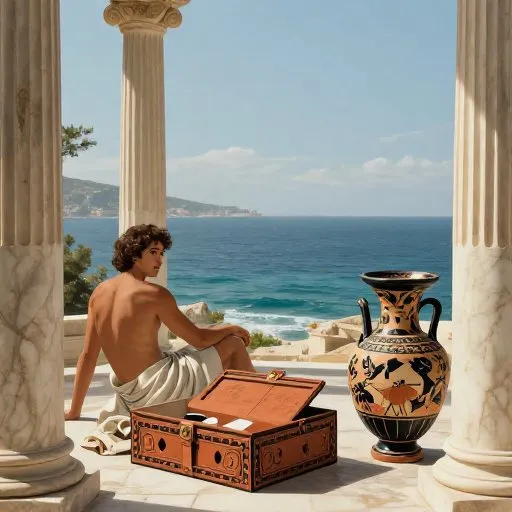
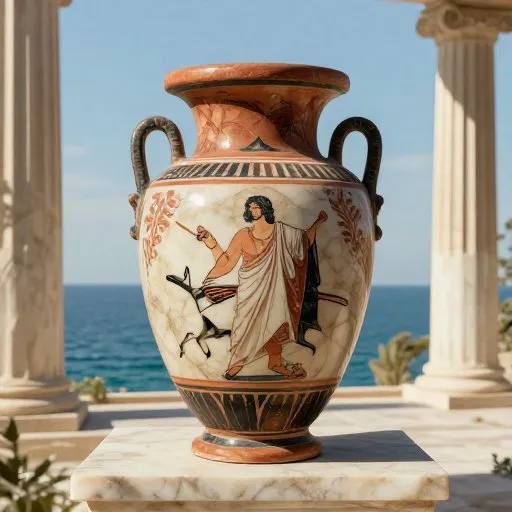
This is the point where the mistranslation enters the story and never leaves: it was a large storage jar. A pithos. Not a box. Erasmus of Rotterdam, the Renaissance scholar, translated Hesiod in 1508 and rendered "pithos" as "pyxis," which means a small box. The word "Pandora's box" entered every European language and never came out. It has been the box for five hundred years. The jar was probably big enough for a person to stand in. Hesiod says it contained every evil and every disease and every suffering that was going to happen to humanity.
It had a lid.
Before Pandora, life was different. Hesiod describes the time before as a kind of original ease. No sickness. No hard labor. Food appeared. The world was generous. Humans lived without suffering and died peacefully and then the good things accumulated elsewhere, among the gods, without diminishment.
Think about what it means that Hesiod is telling you this in the past tense.
The jar held everything that would replace that ease. Disease, in all its forms. Old age. Pain. Madness. Grief. Strife. The thousand specific miseries that make a human life hard. All of it compressed into a container, sealed, sitting in the house of the man who had just married the woman Zeus had built to be the delivery vehicle for it.
Why did she open it?
The sources are not helpful here. Hesiod says she did. He does not explain motivation. In some later versions, Epimetheus opened it, which removes Pandora from the action but doesn't explain anything better. In others, she was simply curious. Curiosity as the engine of catastrophe is an ancient story pattern: the forbidden room, the thing you must not look at, the door you cannot open. The prohibition creates the urge. You tell someone not to open something and the sealed container becomes the only thing in the room.
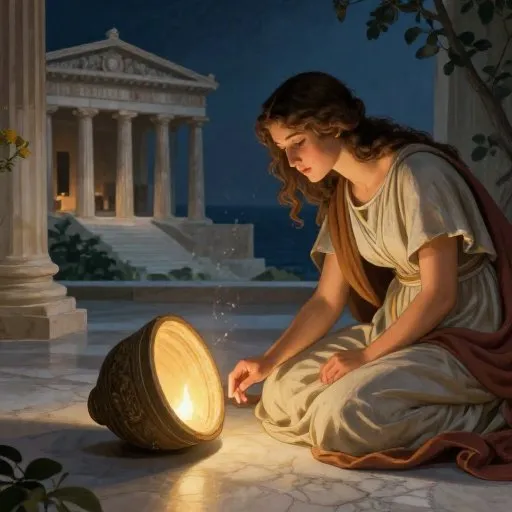
She lifted the lid.
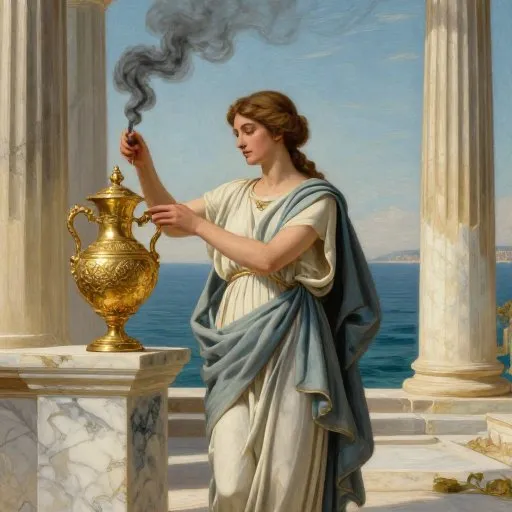
The contents left. All of them. Every evil, every disease, every grief that would ever affect humanity poured out into the world in a moment. There was no taking it back. You cannot put smoke back in a jar. The world that had existed a moment before, the world of ease and health and painlessness, that world was over.
She slammed the lid shut.
One thing was still inside.
The thing that remained was Elpis. The Greek word is usually translated as Hope.
This is where the myth becomes a philosophical argument that has been running for roughly two thousand seven hundred years and shows no sign of resolution, so let's lay it out properly.
Argument one: Hope stayed in the jar, which means Hope did not escape into the world with all the evils. This is good. Hope is a comfort, a resource, something that helps humans survive suffering. It remains available, contained and accessible, when everything else has turned terrible. The jar, in this reading, is the place Hope lives, and Pandora slamming the lid kept Hope safe. The myth is explaining why humans can endure terrible things: because Hope is still there, in the jar, and they can reach in and find it.
Argument two: Hope stayed in the jar with all the evils, which means Hope is an evil. It is a cruel thing, not a kind one. It is the lie that keeps you suffering through things that might otherwise teach you to stop. False expectation. The thing that makes you think tomorrow will be better when tomorrow is going to be exactly the same. If Hesiod put Elpis in a jar with diseases and madness and grief, maybe he thought it belonged there. Maybe Hope, in his understanding, was the most dangerous thing in the container, the one that makes all the others workable.
Argument three: Elpis stayed inside the sealed jar, which means humans don't have access to it. All the evils escaped and roam the world freely. But Hope, sealed in the jar, is out of reach. This is the bleakest reading. The world got suffering and did not get the thing that makes suffering survivable.
Hesiod himself wrote both versions in different texts and the versions are not reconcilable. He may not have known which he meant. The ambiguity may be the point.
Think about that. The Greeks built a myth specifically designed to not resolve. The most important question in the myth, the one everything else turns on, has no settled answer, and they preserved the uncertainty deliberately, across centuries of copying manuscripts, because they thought the unresolved question was more honest than a clean conclusion.
That is not mythology as fairy tale. That is mythology as philosophy. They were not writing children's stories. They were writing the hardest possible version of the question: when everything is bad, what do you do with hope?
Humanity got on with things.
That is the literal continuation of the story. The evils left the jar and entered the world and humans, who now had fire thanks to Prometheus, had to live in a world that also had disease and grief and hard labor and every other thing that had been sealed in Pasiphae's storage. They cooked their food and built their shelters and got sick and old and buried their dead and kept going.
Prometheus was still on his mountain. He would stay there for the duration of the thirty thousand years, liver and eagle and the same morning repeating, while humanity used his gift to build everything he'd imagined they would. The cities. The writing. The medicine, which helped with some of what the jar released, not all of it. The astronomy, which gave them a way to feel slightly less small under the sky that had taken away their original ease.
Epimetheus and Pandora, in the versions where this is recorded, had a daughter named Pyrrha. Pyrrha married Deucalion, the son of Prometheus. When Zeus eventually decided to flood the earth and start over, Deucalion and Pyrrha survived in a chest. They were the new beginning. The man named Afterthought and the woman Zeus made as a punishment produced the line that continued everything.
Greek mythology is full of this. The punishments produce the survivals. The catastrophes make the people who outlast them. Pandora's jar released everything terrible into the world, and the world that came after was worse than what came before, and it was also, somehow, the world that made Homer and Sappho and Thucydides and the Parthenon and the concept of democracy and tragedy as a theatrical form and philosophy as a discipline. The world after the jar. Built from the wreckage and whatever was in the container that didn't leave.
Whether that remaining thing is a comfort or a cruelty is the question.
The jar is still sealed. Elpis is still inside it.
That's the whole myth, reduced to its smallest form: something terrible happened, and one thing survived it, and whether that surviving thing is good news or bad news is something you have to work out yourself, because the people who first told the story couldn't agree, and two thousand seven hundred years of thinking about it hasn't settled it, and you are now the latest person to sit with a sealed jar and a question and no clean answer.
Welcome to Greek mythology. This is what it has always been for.