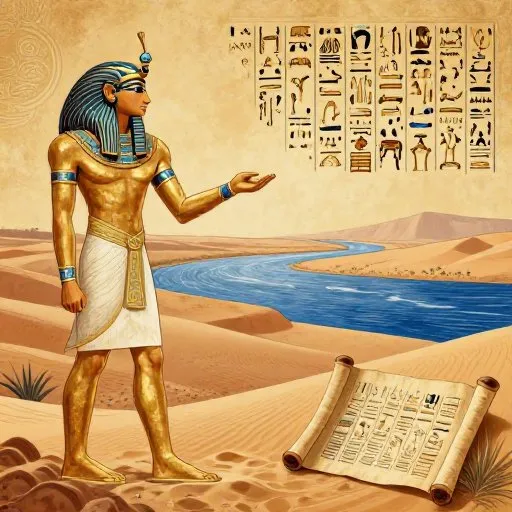
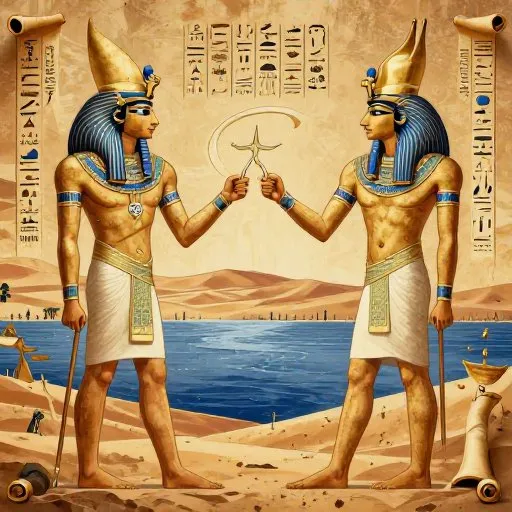
The Egyptian myth of Osiris and Set: jealousy, a custom-fitted coffin, a body cut into 14 pieces, and the wife who put it all back together. The full story.
Mythwink
His brother measured him for a coffin. He thought it was a party game.
Osiris was the first king of Egypt. And he was, by every account, extremely good at it.
This is where the trouble started.
He taught the Egyptians agriculture. He gave them law. He taught them the proper ways to honor the gods, which in ancient Egypt was practically a full-time occupation by itself. Before Osiris, according to the priests of Heliopolis, humans were eating each other. After Osiris, they were farming wheat and governing themselves with something resembling order. His wife Isis stood beside him, brilliant and devoted, and between the two of them they turned a civilization out of chaos.
His brother Set watched all of this and was not pleased.
Set was not, to be clear, a minor figure. He was the god of storms, of the desert, of chaos itself. He commanded real power. He had defeated the great serpent Apophis in defense of the sun god Ra. He was not weak. He was not stupid. He simply looked at Osiris ruling the fertile land of Egypt, beloved by his people and his wife, celebrated across the earth, and he decided that he wanted all of that instead, and that wanting it badly enough was a sufficient reason to take it.
The Egyptians had a word for this kind of disorder. They called it isfet: chaos, injustice, the force that opposes Ma'at, which is the principle of rightness and truth that holds the universe together. Set was, in this particular story, a walking definition of isfet. He did not have a grievance that anyone could defend. He just wanted what his brother had.
He built a chest.
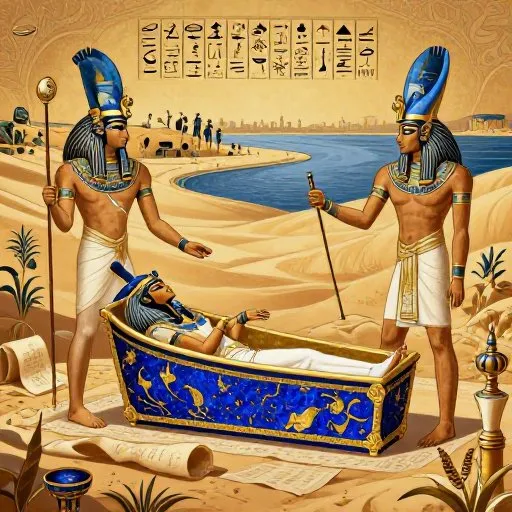
Not just any chest. He had craftsmen measure Osiris secretly, at some point during family gatherings or perhaps while Osiris slept. He had them build a chest to fit Osiris and Osiris alone. It was exquisite. Gilded and beautiful and precisely, specifically, exactly the size of one person.
Then he threw a party.
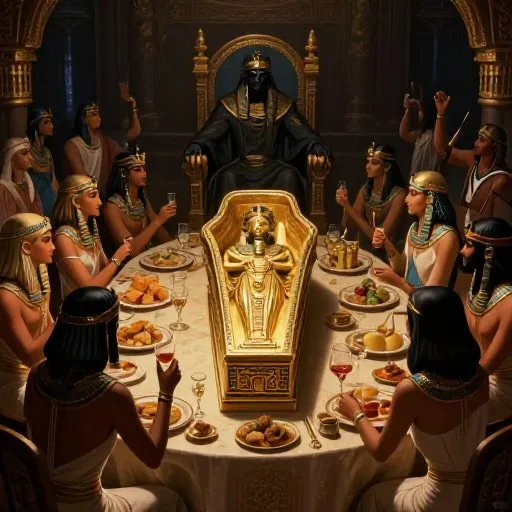
The feast was magnificent. This is worth noting. Set understood that a plan this audacious requires presentation. There was food and wine and music. Seventy-two conspirators attended. Set had spent considerable effort assembling a crew. Seventy-two people who had decided, for their own reasons, that the current arrangement of Egyptian power was not to their liking. A coup requires coordination. Set was thorough.
At some point during the evening, attendants brought in the chest.
Everyone admired it. It was genuinely beautiful. And Set, with the easy confidence of someone who has practiced this moment, proposed a game. Whoever fit perfectly inside the chest could keep it. Step right in. See if it fits.
Think about this for a moment. Seventy-two people tried. One by one they climbed in. Too tall. Too short. Too wide. Each person clambered out, and everyone laughed, and the next person tried. This went on for some time. The Egyptians were having the game explained to them and agreeing it was a fun idea, which tells you something about either the quality of the wine or the social pressure of having seventy-three people watching you be a good sport.
Osiris stepped in.
Of course he did. He was the host. He was the king. He was, if the sources are to be believed, a gracious and genuinely good-natured person. The game sounded harmless. The chest was beautiful. He lay down inside it.
Seventy-two men slammed the lid shut simultaneously. They sealed it with molten lead. They carried it to the Nile.
They threw it in.
Osiris was inside. Alive or dead at this point, the sources disagree. It does not make much practical difference. He was in a sealed chest in a river, and Set was standing on the bank watching it float away, and that was the end of Osiris being king of Egypt.
Set took the throne. The fertile land of Egypt, the kingdom his brother had built, passed to the god of chaos and storms. And somewhere in the palace, Isis found out what had happened to her husband.
Isis was not going to accept this.
She cut off her hair as a sign of mourning. She put on rough clothes. And she began to search. This is the part of the story that the ancient Egyptians told with genuine reverence, because what followed was not a goddess throwing divine power at a problem. It was a wife looking everywhere she could think of, for as long as it took, refusing to quit.
The chest had floated north. Out of the Nile delta, into the Mediterranean, and eventually to the coast of Byblos in what is now Lebanon. This was a real city. Archaeologists have found it. The Egyptians traded with it for millennia. The Phoenicians who lived there cultivated timber, which Egypt with its flat desert landscape desperately needed. The mythological and the historical were not separate for ancient Egyptians. They existed in the same story.
The chest had washed ashore at Byblos and come to rest against a tamarisk tree. And the tree, in the manner of living things that find themselves near something significant, had simply grown around it. By the time Isis followed the trail to Byblos, the chest containing her husband was encased inside the trunk of a fully grown tamarisk. The king of Byblos, admiring the tree's remarkable size and fragrance, had cut it down and used it as a column in his palace.
Osiris was in a column. Holding up a ceiling. In Phoenicia.
Isis talked her way into the palace, which she did by sitting near a well and performing small kindnesses for the queen's servants until the queen invited her in as a nurse for the royal children. She tended the children. She gained trust. She revealed herself as a goddess and asked for the column, and the king of Byblos, to his considerable credit, said yes.
She split the wood. She found the chest. She opened it.
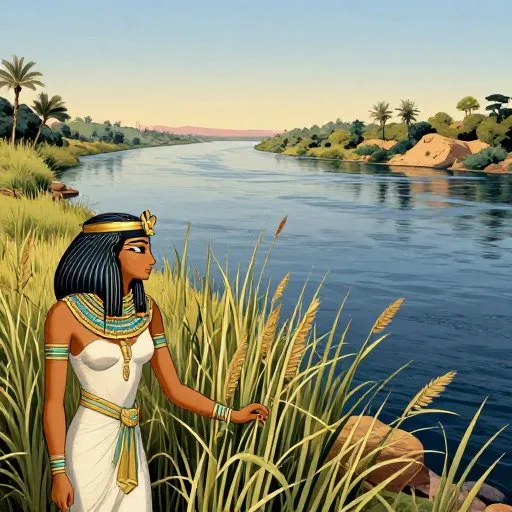
She brought the body back to Egypt. She hid it in the marshes of the Nile delta, in the thick papyrus reeds where Set was unlikely to look.
And then Set went hunting.
He found it. Of course he found it. This was his territory. Set, the god of the desert, the god of chaotic places, was hunting in the wild edges of Egypt where he had always been most powerful. He found the body of his brother hidden in the reeds by night, and what he did next was the act of a man who understood that a dead body is not always a permanent solution.
He cut it into fourteen pieces. He scattered them across Egypt.
The Egyptians, to varying accounts, said fourteen or sixteen. The number changes depending on the source and the era. But the intention was clear. You cannot reassemble what you cannot find. You cannot resurrect what you cannot reach. Set distributed the pieces of his brother across the length and breadth of the country, into the Nile, into the desert, into places that would take years to search. It was a practical measure. Set was, underneath everything, practical.
Isis gathered them all.
This took a very long time. The Egyptians built temples at every location where she found a piece, which is part of why the myth has so many sacred sites attached to it. The temples were not invented for the myth. The myth, in some places, may have grown to explain why a temple was already there. Religion and story feed each other in Egypt in ways that are genuinely difficult to separate.
She found thirteen pieces. There was one she could not find. Osiris had been thrown into the Nile at some point, and a fish had eaten it. The sources name the fish differently. An oxyrhynchus, a Nile perch, a catfish. The Egyptians of several cities near the Nile never ate their local fish because of this story. That is how real this was to them. It was not a fish in a fairy tale. It was the fish that had eaten part of their god, and you did not eat that fish, and your children did not eat it, and their children did not eat it.
Thirteen pieces. She had thirteen.
She made a replacement for the missing piece out of gold. She reassembled her husband. She wrapped him in linen, said the spells that the Book of the Dead would later record, and called him back.
Osiris returned.
He was alive enough. He was not the same. He could not rule the living land of Egypt, the Black Land of the Nile flood, the kingdom he had built. He was something different now. He was the first death and the first resurrection, and what he ruled from that point on was everything that comes after.
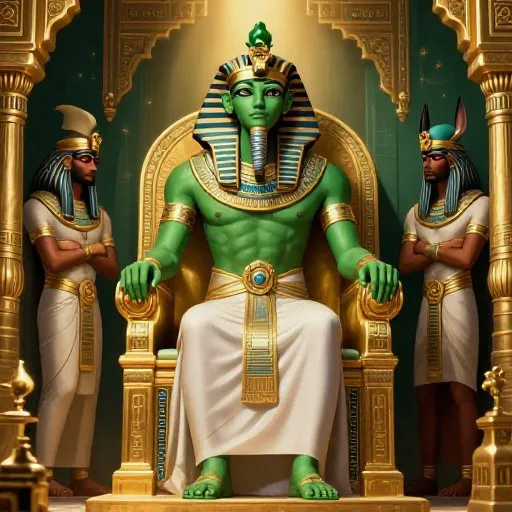
He became king of the Duat, the Egyptian underworld. He sat in the Hall of Two Truths, robed in white, holding the crook and flail of kingship, his skin green with the color of renewal and growing things and the Nile's annual gift of new life. Every person who died in Egypt, for the next three thousand years, would eventually stand before him. Every soul. Pharaoh and farmer and scribe and soldier. They would all come to Osiris in the end.
Isis bore his child. The boy's name was Horus. Raised in hiding, protected from Set, trained for the singular purpose of taking back what belonged to his father's line. When Horus grew, he fought Set in a long and vicious war that the Egyptians described in considerable detail, involving lost eyes, severed limbs, tribunals of gods arguing about who had the better claim, and a great deal of behavior that reflects poorly on everyone involved.
Horus won. He always wins, in the end. He became king of the living. Osiris remained king of the dead. Set was banished.
The Egyptian cosmos had a proper structure. Ma'at, the principle of rightness and truth, was restored. The universe breathed again.
But it had taken Isis searching the entire world with her hair cut short and her grief too large to set down, finding thirteen of fourteen pieces and refusing to stop there, calling her husband back from a darkness no one was supposed to return from. It did not happen because the gods willed it. It happened because one person would not accept that it was over.
The Egyptians told this story for three thousand years. They built temples at every place she searched. They refused to eat the fish that had eaten part of their god. They wrapped their dead in linen and said the spells and trusted that what happened to Osiris could happen to them too.
That is not a small thing to believe. That is not a comfortable thing to need. But they believed it, and they needed it, and every year when the Nile flooded and the black silt came in and the dead land turned green again, they had evidence.