The Greek myth of Orpheus, whose music charmed the underworld into giving back his dead wife. He almost made it. The full story, told properly.
Mythwink
Orpheus and Eurydice
He made Hades cry. Then he looked back anyway.
The Greek myth of Orpheus, whose music charmed the underworld into giving back his dead wife. He almost made it. The full story, told properly.
Mythwink
He made Hades cry. Then he looked back anyway.
There is a question you could ask about Orpheus that sounds simple and isn't. The question is: how good was he?
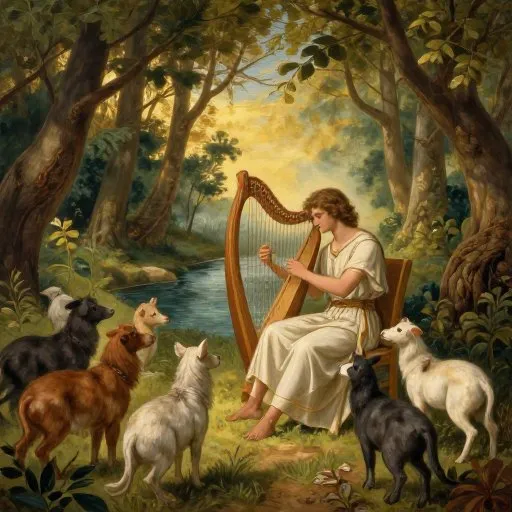
Not "pretty good." Not "the best in his city" or "the best in Greece." We're talking about the man who, according to every ancient source that mentions him, could play the lyre so well that rivers changed direction to come closer. Trees uprooted themselves and walked toward the sound. Wild animals lay down next to each other and stopped being predators for the duration of the song. Rocks moved. Rocks.
He was the son of Calliope, the Muse of epic poetry, which explains a great deal. His father, depending on which source you prefer, was either Apollo, the actual god of music, or a Thracian king named Oeagrus. If it's Apollo, then Orpheus was a demigod who inherited an immortal talent. If it's Oeagrus, then a mortal man and a divine woman produced a child who outplayed every god at their own game. Either way, the music wasn't metaphor. It was force. Physical, measurable, undeniable. Pindar mentions him in the fifth century BCE. Apollonius of Rhodes describes him aboard the Argo, where Jason took him specifically to drown out the Sirens. Not because he was good company. Because his music could neutralize theirs.
And this man, this specific man with this specific talent, married Eurydice.
She was a nymph. The sources don't tell us much about her, which is its own problem and we'll get to it. They were married. By all accounts they were happy in the way that people in myths are happy before something goes horribly wrong, which is to say: briefly, and completely.
The wedding itself was a bad sign. Hymen, the god of marriage ceremonies, was supposed to carry a torch at the procession. The torch smoked. It wouldn't burn clean. In Greek mythology, a smoking torch at your wedding is not a quirky detail. It is the universe sending you a letter and the letter says: this is not going to end well. Nobody in any ancient myth seems to have known what to do with information like this. You can know a thing is coming and still not be able to stop it.
Eurydice walked into a meadow on her wedding day. The sources split here: Virgil, writing in the first century BCE in his Georgics, says she was fleeing Aristaeus, a minor god of beekeeping and agriculture who would not leave her alone. Ovid, in the Metamorphoses, is vaguer. She was simply there, in the grass, and then she was not.
A snake bit her. She died.
On her wedding day. The woman Orpheus had just married walked into a field of flowers and stepped on a snake and died. That is not poetry. That is the kind of thing that happens and breaks people permanently. Orpheus had the greatest musical gift in the history of the world, and it was completely useless for this.
A lot of people lost people in ancient Greece. Virtually all of them mourned and then got on with things, because that was the alternative available to mortals. You grieve, and you continue, and eventually the grief gets smaller. It doesn't leave. It just takes up less room.
Orpheus did not do that.
What he did instead was walk to the entrance of the underworld.
Now stop. Before you read past that sentence, sit with it. The underworld in Greek mythology was not a metaphor or a concept. It was a physical place. It had geography. It had rivers. The Styx, which you had to cross. The Acheron, the River of Woe. The Phlegethon, which burned. It had administrators. Hades and his queen Persephone ruled it from a palace. Charon the ferryman charged a coin for passage and left you stranded on the far bank if you couldn't pay. The shades of the dead wandered the Asphodel Meadows, which was the Greek afterlife's general waiting room, because the Greeks imagined death as an enormous bureaucracy that processed people into various departments based on their merits and sins.
Living people did not go there. That was the whole point. The dead went to the underworld. The living went about their lives until it was their turn. Crossing that boundary while breathing was not a theological debate. It was an actual violation of how existence worked.
Orpheus walked to the entrance anyway. Some ancient sources place it near Taenarum in southern Greece, a cave at the tip of the Mani peninsula. You can still go there. He went in, found Charon, and played.
Charon had been ferrying the dead across the Styx since before humans existed. He had heard every argument for why this particular dead person should be returned, why this particular case was special, why just this once the rules shouldn't apply. He had said no to all of them. He had said no to kings and heroes and people who believed they were important enough to matter. His entire existence was the enforcement of the boundary between living and dead.
He put Orpheus in his boat. That's it. He just did it. The music, Virgil writes, made the oars stop. Made the river slow. Made Charon, who had never done anything but take people one direction, take someone the other way.
Orpheus kept playing.
The three-headed dog Cerberus, who guarded the exit so no shade could escape, lay down when he heard it. All three heads. The Furies, whose specific job was to torment the guilty, stopped. The wheel of Ixion, spinning eternally as punishment for his crimes, stopped spinning. The boulder of Sisyphus, which rolled back down the hill every time he reached the top and had been doing that forever, stopped rolling long enough for Sisyphus to sit down on it. You understand what this means. Music that could make Sisyphus take a break.
He reached the palace of Hades.
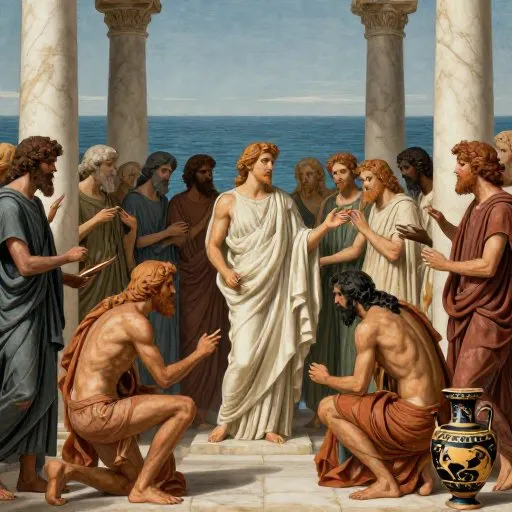
The shades of the dead gathered around him as he played. In Virgil's account they came in enormous numbers: great heroes, little children, old men, young women, everyone who had ever died and arrived here. They couldn't feel much anymore. That was part of what death took. But they could feel this.
Hades and Persephone sat on their thrones and listened.
Think about what it means that Hades was moved by this. He was the god of death. He presided over the end of everything. Every creature that had ever existed, mortal or otherwise, ended up in his kingdom eventually. He ran, by any measure, the most comprehensive operation in the cosmos. He was not known for sentimentality. He did not do exceptions. The whole structure of the Greek afterlife depended on the fact that what came in did not go out.
Ovid says Hades wept. Actually wept. And Persephone wept. And the Furies, the three spirits of vengeance and punishment, were crying. The judges of the dead put down their work. No one was keeping records.
Then Orpheus stopped playing and stated his case.
He did not pretend Eurydice had lived a full life cut tragically short. She hadn't. She was a new bride who had died on her wedding day from a snake bite in a meadow. The years she had not yet lived were real and specific and they had been taken. He laid all of it out. The marriage. The meadow. The missing years. He told them that he had not come to steal her. He had come to ask. And if they refused, he told them he would stay. He had no interest in returning to a world that had her in it for half a day and then didn't.
Persephone was the one who said yes. The sources are consistent on this. She was moved by it in a way her husband was, but she was the one who acted. She had spent time in the world above before Hades took her. She understood what it was to be separated from someone. She had her own relationship with grief.
Hades set one condition. Eurydice would follow Orpheus back to the world of the living. She would walk behind him. He must not look back at her until they both reached the light. Not until they were fully in the upper world. He could not turn around to check if she was there. He could not look over his shoulder. He had to trust that she was following and walk.
One condition. Don't look back.
Orpheus agreed. Hermes led Eurydice to him. And they began the climb.
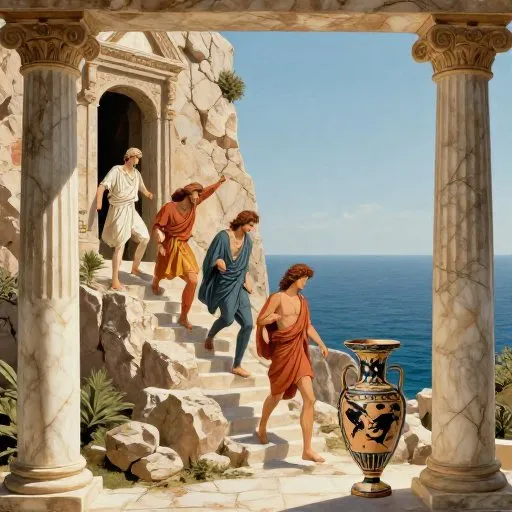
It was a long climb. The sources don't give us exact distances, but the entrance to the underworld was deep, and the path back to the living world was dark, and the only sound was his footsteps and hers, somewhere behind him in the dark.
He couldn't hear her. That's the part Virgil emphasizes. The shades of the dead have no weight. They leave no footprints. They make no sound. Eurydice was behind him, the sources say, following, returned to him by the rulers of the underworld themselves. But she walked like a ghost because she was a ghost, and the path was dark, and he couldn't hear her.
He played as he walked. He kept playing. Some accounts say the music was meant to guide her, or to keep Hades from changing his mind. Others say he played because playing was the only thing that kept him moving forward instead of turning around. It may have been both.
Think about what this required. He had gone into death to get her back. He had made Hades cry. He had gotten everything he came for. She was right there, a few steps behind him, alive again or close enough to alive to be returned to the world. The only thing standing between Orpheus and Eurydice and a life together was a walk in the dark and a rule about not looking back.
He was close to the top. Virgil places the moment just as the light was visible. Just as the entrance appeared. Just as the upper world, with its air and its daylight and its living things, was right there within reach.
He looked back.
Nobody knows why. The sources don't explain it and they don't pretend to. Virgil calls it furor: madness, panic, frenzy. A sudden desperate need to confirm she was actually there. Three thousand years of readers have offered their theories. He doubted the gods. He needed to see her face. He loved her too much to trust. He loved her too much to wait one more second.
She was there. He saw her. She met his eyes.
And then she was gone.
Not dramatically. Not with a speech or a cry. Ovid says she reached toward him. She said only this: "Farewell." A faint word. Already fading. Then the darkness took her back.
He tried to follow. He reached for her. He tried to cross back into the underworld for a second time. Charon wouldn't take him. The gates were closed. The condition had been clear and he hadn't kept it, and there are no second chances at second chances. He sat on the riverbank for seven days, playing, not eating, not moving. Charon let him mourn. The ferryman was not cruel. He was just the boundary, and the boundary held.
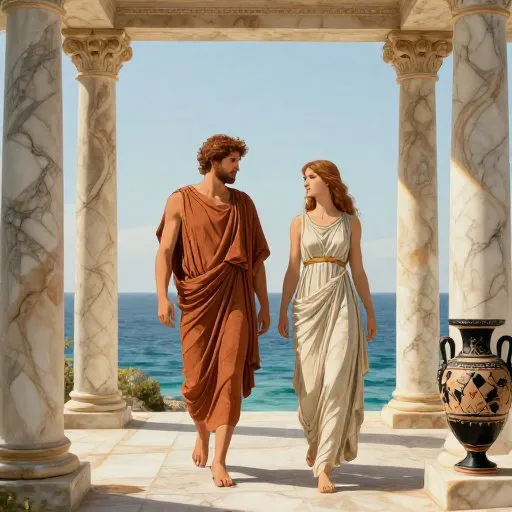
Orpheus walked back to the world above. Eurydice was gone for the second and final time, and no music he could play was going to change that. He had used that card. He had gone to the underworld and charmed death itself and come back with her and then, with light visible, with daylight right there, he had looked back.
He wandered Thrace. Months. Maybe years. He played. Trees walked toward him. Rivers turned. None of it helped with anything.
He refused to have anything to do with other women. The ancient sources are pointed about this. He had loved Eurydice and she was gone and that was the end of his interest in that subject. This offended the Maenads, the women who followed Dionysus in ecstatic, frenzy-filled worship. Whether they were genuinely insulted or simply in one of their ritual states when they encountered him, the result was the same.
They tore him apart. Literally. Sparagmos is the Greek term. It is the ritual dismemberment associated with Dionysiac worship, and in several ancient sources it is exactly what happened to Orpheus. A group of Maenads attacked him and tore his body to pieces. Ovid describes them throwing stones and branches, and the music from his lyre made the stones stop mid-flight, too beautiful to be used as weapons, until the screaming of the Maenads finally drowned out the sound. When the music couldn't reach them, the stones could.
His head and his lyre were thrown into the river Hebrus.
And here is the part that nobody made up, because nobody could have made it up: the head kept singing. Floating down the river, separated from the body that had made the music for a lifetime, it kept singing. Ovid records it. Virgil records it. The lyre floated alongside, still playing. The river banks answered back. The current carried both of them out to sea.
The head washed ashore on the island of Lesbos, where it was said to give prophecies for centuries after. The lyre was placed by the Muses among the stars. You can still see it: the constellation Lyra, the one with Vega at its brightest point, is the lyre of Orpheus.
And Eurydice, in the underworld, waited. The shades of the dead eventually arrive at the Asphodel Meadows, and they wander, and they find each other. Ovid ends the story there. He tells it simply. Orpheus descended to the underworld a second time. Not by force this time. Not with music and bargaining. Just by dying, the way everyone eventually does. And this time he could look back all he wanted.
He turned around and she was there.
Get on the list before the myths do.
New retellings from world mythology, gods behaving badly included. This list is just starting, so nothing has gone out yet, only a place in line.
Nothing has been sent from this list yet. You'll be among the first to hear once new myths start going out, and you can leave anytime.