← All Stories

The Norse myth of Odin's self-sacrifice on Yggdrasil to learn the runes, and the eye he traded for a drink of wisdom. Why knowledge cost a god everything.

Odin and the World Tree

Mythwink

Odin and the World Tree

He hung himself from a tree for nine days. He already owned the tree. That's how badly he wanted to know things.

1The God Who Couldn't Leave Things Alone

Chapter 1: The God Who Couldn't Leave Things Alone

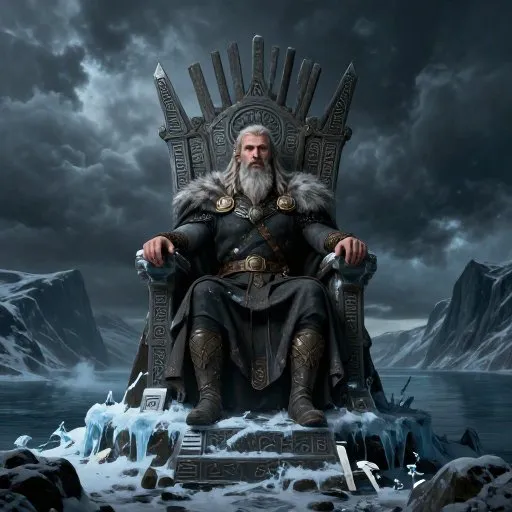
Odin was the king of the Norse gods. He had a throne called Hlidskjalf that sat so high he could see into every corner of every world from it. He had two ravens: Huginn and Muninn, Thought and Memory, who flew across the nine worlds every day and returned to his shoulders at evening to report everything they had seen. He had eight-legged horse named Sleipnir who could travel faster than any other animal in existence. He had spear. He had warriors. He had a hall where half of the slain came to prepare for the last battle.

By any reasonable measure, he was equipped.

And yet.

The thing about Odin that separates him from the other Norse gods is not his power. Thor was stronger. Tyr was more just. Freyr was more beloved. What separated Odin was the hunger. The need to understand things. Not just to be powerful, but to know. He was not satisfied with strength. He was not satisfied with command. He wanted to know the structure of the world beneath the world. The secrets underneath the secrets.

He paid for them. Specifically, repeatedly, and at tremendous personal cost.

The runes were not just an alphabet. The Norse did not think of them that way. Runes were understood as forces. As things that existed before they were written, that writing allowed humans and gods to access. Each rune was a principle: protection, travel, victory, inversion, loss. To know the runes was not to know a writing system. It was to understand the grammar of the universe. How things worked. What could be changed. What couldn't.

Odin wanted this knowledge. And the runes, according to the Havamal, the great poem of wisdom in the Poetic Edda, did not simply belong to anyone. They had to be won. The method required to win them was specific, painful, and definitionally absurd.

He had to sacrifice himself. To himself. On the World Tree.

2The World Tree

Chapter 2: The World Tree

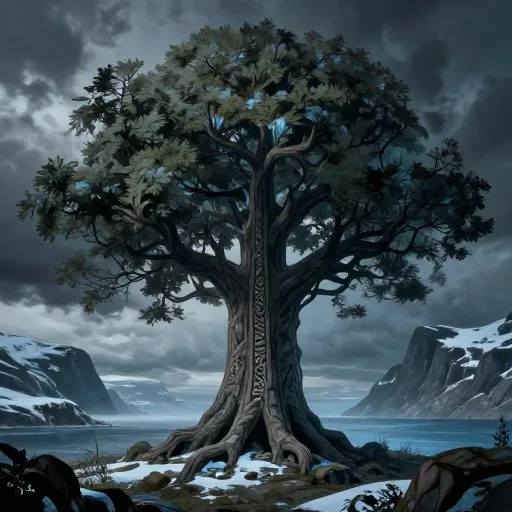
Yggdrasil is not just a large tree. Let's be clear about the scale here.

It is the structure that connects the nine worlds. Its three roots reach into Asgard, the realm of the gods; into Jotunheim, the realm of the giants; and into Niflheim, the realm of the dead. Below the root in Asgard is the Well of Urd, where the three Norns, the weavers of fate, sit and carve the destinies of all beings into the tree's bark. Below the root in Jotunheim is the Well of Mimir, where wisdom itself is stored. Below the root in Niflheim is the spring Hvergelmir, source of all rivers.

In its branches lives an eagle so large that a hawk sits between its eyes. A squirrel named Ratatoskr runs up and down the trunk carrying messages, and all the messages are insults, because the eagle and the serpent Nidhogg at the base of the tree hate each other, and Ratatoskr has made a career out of making it worse. Four stags run through the branches eating the leaves. Below the roots, Nidhogg gnaws at them from underneath. The tree is simultaneously providing structure to the entire universe and being destroyed by everything that lives in it.

This is Yggdrasil's situation on a normal day.

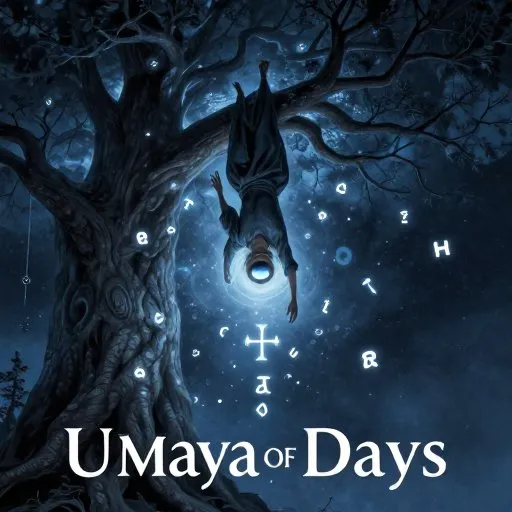
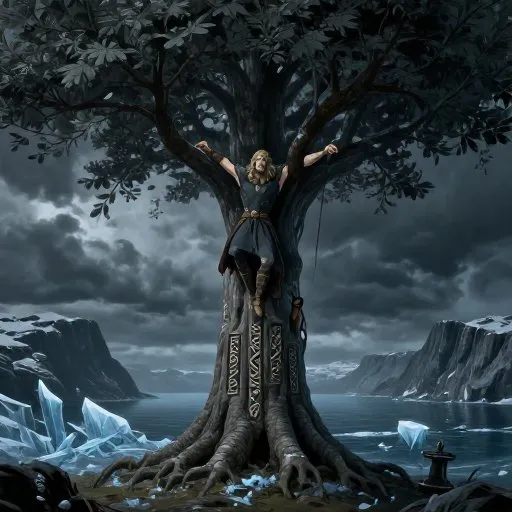
Odin approached this tree. According to the Havamal, he wounded himself with his own spear. Then he hung from the tree. Nine days. Nine nights. He did not eat. He did not drink. He hung there in pain, sacrificed, as he says in the poem, "to myself." A sacrifice to himself, on a tree he owned, in a realm he ruled. This is genuinely one of the stranger theological constructions in any mythology, and the Norse produced it without apparent embarrassment.

On the ninth night, he looked down. He saw the runes in the darkness below. And the runes, recognizing the sacrifice, revealed themselves.

He screamed. He fell. And when he rose, he had them.

3What the Runes Were Worth

Chapter 3: What the Runes Were Worth

The Havamal lists what Odin gained. Not abstractly. Specifically.

He learned eighteen rune charms. The Havamal names each one and describes its function. One heals the sick. One defeats enemies in battle. One frees prisoners from their chains. One stops an arrow in flight. One controls weather at sea. One revives the hanged. One makes a wise man love you. One puts out fire. One calms the sea in a storm.

Read that list and understand what it means for Odin to have these. He could revive the hanged, which is information that arrives with particular irony given where he learned it. He could stop arrows mid-flight. He could calm storms. This was not the collection of an academic. This was a toolkit for intervention. For changing outcomes that would otherwise be fixed.

And yet. The runes didn't tell him everything. The Voluspa shows the limits. Odin still rides to consult the dead volva, the seeress, to understand the future. He still trades an eye for Mimir's wisdom. He still sends his ravens every day because there are always things he doesn't know yet. He got enormous power from the World Tree and what it gave him was, apparently, the understanding of how much more there was to know.

This is the specific quality the Norse gave Odin. Not omniscience. Not omnipotence. A relentless, consuming drive toward understanding that was never satisfied by what he already had. The Havamal, which is essentially a book of Odin's advice on how to live, is full of this quality. Observe. Ask questions. Don't be foolish enough to think you've learned enough. Keep looking. The poem was attributed to a god who had hung on a tree for nine days to understand things and was still not finished.

The runes spread. According to the Havamal, Odin gave them to gods and to humans. This is what he did with the knowledge he bled for. He distributed it. The Norse parallel to the Prometheus story is not exact, but it is there.

4The Eye in the Well

Chapter 4: The Eye in the Well

Before the World Tree, there was the eye.

Mimir's Well sat beneath the root of Yggdrasil that reached into Jotunheim. Mimir was a being of enormous wisdom. Some sources describe him as a god. Some as a giant. Some as something between. What was clear was that the water in his well, drawn up from beneath the roots of the World Tree, contained wisdom in a form you could drink.

Odin came to the well and asked for a drink.

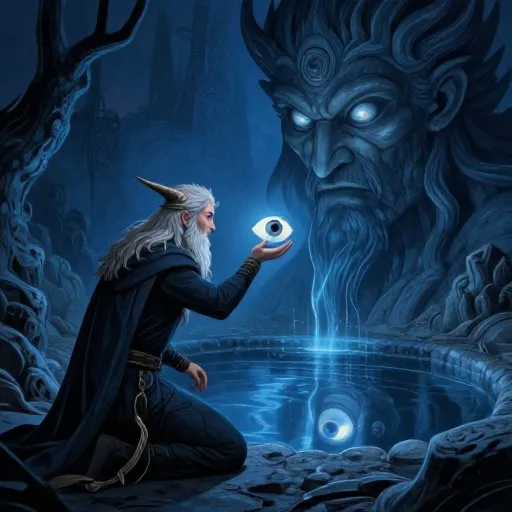
Mimir said yes. The price was an eye.

Odin pulled out his own eye and dropped it into the well. He drank. He left with one eye and whatever wisdom a drink from the deepest source of wisdom in the universe provides. The eye stayed in the well. It's still there, if you believe the sources. Odin's eye, at the bottom of Mimir's Well, seeing everything the water sees.

This is a trade that the Poetic Edda treats as simply true. Here is what happened. Here is the cost. Here is what he got. The Norse did not workshop the moral of this story. They presented the exchange and trusted the reader.

What Odin got from Mimir's well is not specified in detail, the same way the runes gained from the World Tree are specified. What changes is his posture toward the future. After the well, after the World Tree, Odin stops being a god who simply rules and becomes a god who watches. He sends his ravens every day. He consults the dead. He walks among humans in disguise as a wandering old man with one eye and a wide-brimmed hat, asking questions, testing people, listening. A king who gave up half his vision to see better than anyone.

The one-eyed wanderer is how humans most often encounter Odin in Norse mythology. The throne and the ravens and the hall of the slain are real. But the figure who shows up in the stories, in the Saga of the Volsungs and the Eddic poems and the tales, is an old man on a road. Asking things. Watching what people do when they think nobody important is watching.

The eye in the well is why.

5Thought and Memory

Chapter 5: Thought and Memory

His ravens left every morning at dawn.

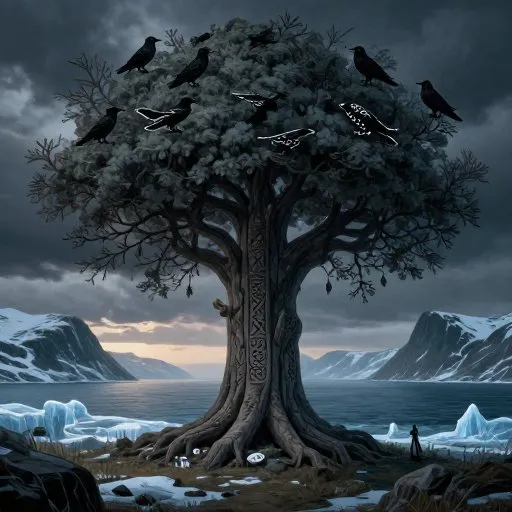
Huginn and Muninn. Thought and Memory. The Prose Edda describes them flying across the entire world every day and returning to Odin's shoulders to tell him what they had seen and heard. Every morning he sent them out. Every evening they came back. This was not occasional. It was daily. For the entire history of the world, Odin's relationship with information was a morning ritual involving two birds.

The Havamal contains a line that stops you if you read it carefully. Odin says he fears more for Muninn than for Huginn. More for Memory than for Thought.

Think about what that means coming from a god who hung himself for nine nights and traded an eye for wisdom. The thing he is most afraid of losing is not the capacity to think. It's the capacity to remember. Everything he has sacrificed, every price he has paid, every piece of himself he has put in a well or on a tree, is only worth anything if it can be held. Memory is how you keep what you've bought. Without it, all the thought in the world is just motion.

Odin had given up more than most beings could imagine, and what he was most afraid of was forgetting it.

Here is the picture the Norse built, across the Havamal and the Eddas and the poems: a king who rules from the highest seat in the universe, but never trusts the view from the throne. Who sends birds to confirm what his eyes can see. Who walked in disguise among the people he ruled because he understood that power does not automatically give you knowledge of the things happening under it. Who sacrificed an eye to see further and nine nights of agony to understand the structure of things, and who still sent his ravens out every morning because yesterday's information was already old.

The Norse did not make their highest god a comfortable one. They did not make him serene or satisfied or all-knowing. They made him worried. Hungry. Always working. The Allfather is not sitting in eternal contentment at the top of creation. He is up early, watching his birds leave, hoping they come back with something new, knowing that what's coming at the end of everything can only be faced if he understands it in time.

He never quite did. The Voluspa makes that clear. Odin goes to the Well of Mimir one last time at the start of Ragnarok, for final counsel, and what he learns there is private. He comes back and says nothing about it. The ravens come home. He goes to the field.

He knew everything the runes could tell him, and everything Mimir's water could show him, and everything Huginn and Muninn had seen in every corner of every world. And it was not enough to change what was coming. That was what the eye was for. To see clearly, even when what you see is something you cannot fix.
Mythology Notes