← All Stories

The Chinese myth of Nuwa, the serpent goddess who created humans from clay and held the sky together. Chinese myth told straight, with all the strange details intact.

Nuwa Creates Humanity

Mythwink

Nuwa Creates Humanity

She made humanity by hand, got tired, and used a rope. Then she fixed the sky.

1The World Before People

Chapter 1: The World Before People

The world was finished, and it was empty.

Mountains stood. Rivers ran. Forests grew dense across the plains and up the hillsides. Fish moved through the water. Birds crossed the sky. Animals wandered the land, each one in its territory, each one doing what animals do: eating, moving, sleeping, doing it again. The natural order was intact.

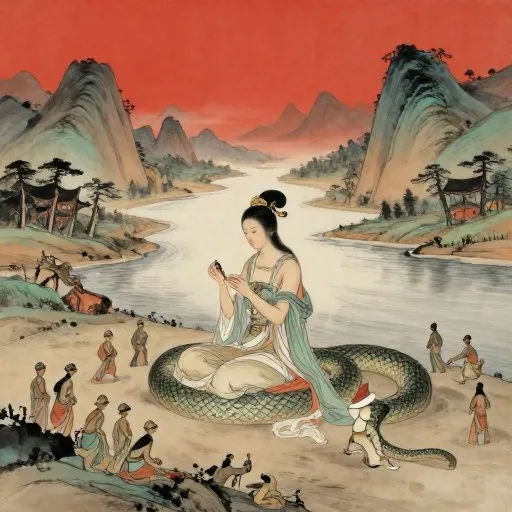
Nuwa walked through it. She had a human head and torso and the long, scaled body of a serpent from the waist down, and she moved through the new world the way you move through a house after you've finished arranging the furniture. Everything where it's supposed to be. Everything working. Everything correct.

And nothing to talk to.

The Shan Hai Jing and the Huainanzi, and a number of Han dynasty texts, are careful about why Nuwa made humans. They say she was lonely. Not in a small way. In the way that a world with nothing that can look back at you and recognize you is lonely, which is a specific and total kind of aloneness that animals in their territories and fish in their rivers and birds in their sky do not address at all.

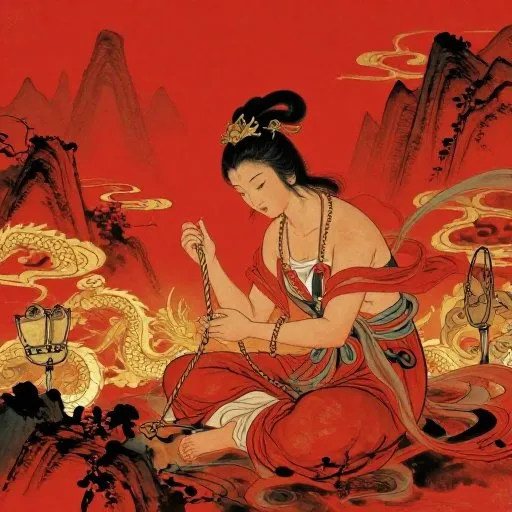
She sat down by a river. Yellow river-clay, the heavy kind, the kind that holds its shape. She picked some up. She started working.

She shaped feet first, then legs, then the torso, then the arms, then the head. She pressed the features into the face carefully: the curve of the eye socket, the ridge of the nose, the line of the mouth. She set the figure down and breathed life into it, or called down the spirit of heaven and earth into it, depending on which source you're reading. It stood up.

It walked. It made sound. It looked at her, and she looked at it, and the specific aloneness she had been carrying around since the beginning of the world got smaller.

She made another. Then another. She sat by the river and made humans by hand, one at a time, with care.

This is the origin of the noble class, in the tradition. The ones Nuwa made carefully and slowly, pressing each detail deliberately: these became the aristocracy, the people of high rank. Which is either a satisfying cosmological explanation for social hierarchy, or the most honest thing any myth has ever said about how the ruling class sees itself.
2The Rope

Chapter 2: The Rope

She made humans by hand for a long time. Long enough that her arms got tired. Long enough that the process, which had been meaningful and careful, started to feel like a quota.

She had, depending on the version, already made hundreds or thousands of humans by hand. And the world was large. The world was very large. At the rate she was going, it would take longer than she had patience for.

She found a long rope. Or a vine: the sources use different words and translators make different choices. She dipped it in the river mud. She pulled it up, heavy with clay, and swung it. The clay flung off in all directions: thick drops, thin drops, big pieces and small, landing where they landed.

Each one became a person. The flung-clay people were not less real than the hand-made ones. They walked and talked and built things and had children and became the populations of the world. They simply weren't made with the same deliberate care.

This is why, the texts explain, there are nobles and commoners. The hand-made ones and the rope-made ones.

Think about the honesty of that. Some other mythological tradition might have said humans were made equal, or made in the image of something divine, or made with cosmic purpose for each individual soul. The Chinese cosmological tradition looked at the actual distribution of human outcomes, the gap between the ones who seem to have everything and the ones scrambling for their share, and said: yes, we see that, that is real, and here is a story that acknowledges it happened from the beginning rather than pretending otherwise.

Whether that story made things better or worse for the rope-made people is a question that mythology does not answer. History has some views on it.

Nuwa finished. The world had people. They spread out across the land. They looked up at the sky. The sky looked back down at them. For a while, everything held.

3The Sky Breaks

Chapter 3: The Sky Breaks

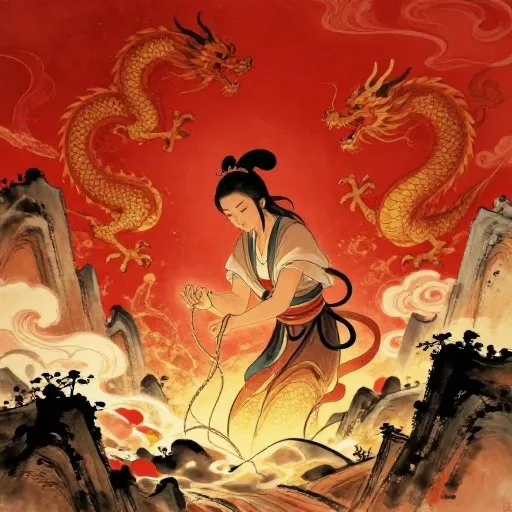
The sky broke.

Not metaphorically. Not as a poetic way of describing bad weather or cultural collapse. The sky broke. According to the Huainanzi, a catastrophe struck: the four pillars that held up the corners of heaven were damaged, the dome of the sky cracked, great gaps opened. Fire came down from the sky where it should not be. Water flooded up from the earth where it had no business going. The floods were vast. The fires spread. Animals that had lived in order became wild and dangerous. Great birds with claws. Enormous serpents. Things that had been contained were not contained anymore.

The sources don't agree on what caused it. In one version, a battle between two divine figures, the water god Gonggong and the fire god Zhurong, ended badly when Gonggong lost and smashed his head in rage against the Mount Buzhou, one of the pillars of heaven. The pillar broke. The sky tilted. That is why, the text adds quietly, the sky and all its stars tilt to the northwest, and the rivers of China flow east to the sea. Because a god lost a fight and was a sore loser about it, and the sky has been slightly crooked ever since.

Nuwa looked at the burning, flooding, cracking world. The people she had made by hand and by rope. The animals she had walked among when the world was new and empty.

She went to work.

4The Five Stones

Chapter 4: The Five Stones

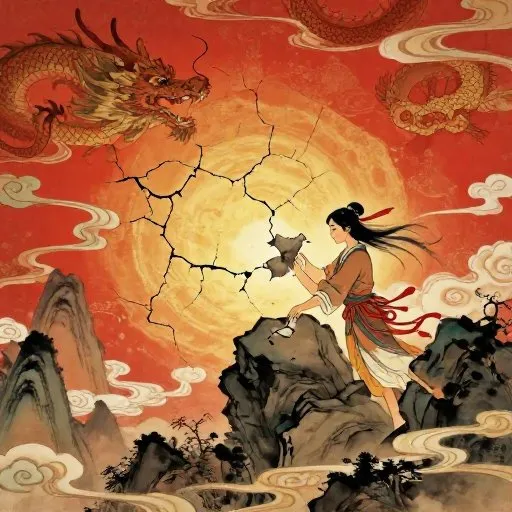
She needed to patch the sky. A sky is a large surface area, and the cracks were many. She gathered five-colored stones: red, yellow, blue, white, and black, corresponding to the five elements and the five directions. She built a kiln. She smelted the stones and worked them until she had the material she needed: five-colored plaster, celestial mortar, the substance that could seal the gaps in heaven.

She filled the cracks. The fire that had been falling stopped. The places where the sky had opened up sealed over. This part is described in the Huainanzi in plain terms, without ceremony: she smelted the stones, she filled the breaks, she was thorough.

But the sky still tilted. The pillars were damaged or gone. She needed new ones.

She found a giant turtle. The sources call it ao, the great sea turtle, a creature of immense size. She killed it. She cut off its four legs. She used them as pillars to prop up the four corners of the sky.

This is in the text. She fixed the broken infrastructure of the universe with turtle legs.

There is a detail in the Shan Hai Jing about the Black Dragon that was also ravaging the earth during this catastrophe, one of the wild things let loose when the sky broke. She killed it too. This is mentioned the way you mention fixing a gutter while you're already up on the roof. While she was at it.

She gathered the reeds from the riverbanks, burned them to ash, and used the ash to stop the floods: a detail that has intrigued scholars of early Chinese hydraulic technology, who note that ash from burned vegetation was actually used historically to help control water. The myth remembers the technique.

When she was finished, the sky held. Not quite the same as before: it still tilted northwest, the rivers still ran east, the turtle's legs weren't perfect replacements for whatever the original pillars were. But the sky held. The fires went out. The water receded. The people she had made were still there.

5What She Left Behind

Chapter 5: What She Left Behind

There are no temples to Nuwa in the archaeological record from the earliest periods, the way there are temples to male deities from the same eras. This has interested scholars. The Shan Hai Jing names her. The Huainanzi tells her story. But the formal religious infrastructure around her is later, or inconsistent, or built on top of older folk worship practices that didn't leave the same kind of traces.

She is, depending on the text, both creator and repairer. She makes and she mends. She is lonely before humans exist, and she solves that by making something that can look back at her. When the thing she made is threatened, she saves it, without ceremony, with stone and ash and turtle legs, because it needed to be done.

She had a consort in some versions: Fuxi, the culture hero, depicted like her as a half-human, half-serpent figure. Han dynasty tomb art shows them intertwined, their serpent tails wound together, holding the tools of civilization: the compass and the set-square, the instruments of measurement and order. Nuwa and Fuxi as the paired origins of humanity: she provides the people, he provides the tools they use to organize themselves.

Whether she and Fuxi were originally separate figures who got merged by later traditions, or always paired, is a question that scholars of early Chinese religion are still working through. The iconography is beautiful regardless. Two serpent-bodied figures, wound together, holding a compass and a ruler, surrounded by the humans they made and the sky she stitched back together.

What the myth keeps insisting on, across every version and every source, is this: she did not abandon what she made. The sky broke and she fixed it. The world flooded and she stopped it. The dragon threatened and she ended it. There was no divine committee. No waiting for permission. She was there, and the problem was there, and she handled it.

The Mid-Autumn Festival has mooncakes. The Qixi Festival has magpie bridges. The story of Nuwa has no annual holiday, no specific food, no set celebration. Just the bones of the world she held together. The sky that still tilts slightly northwest. The rivers that still run east. The evidence, still visible, of what she did.

Mythology Notes