The Polynesian myth of Maui, the demigod who lassoed the sun and beat it into slowing down. The full story, with the real Pacific history behind it.
Mythwink
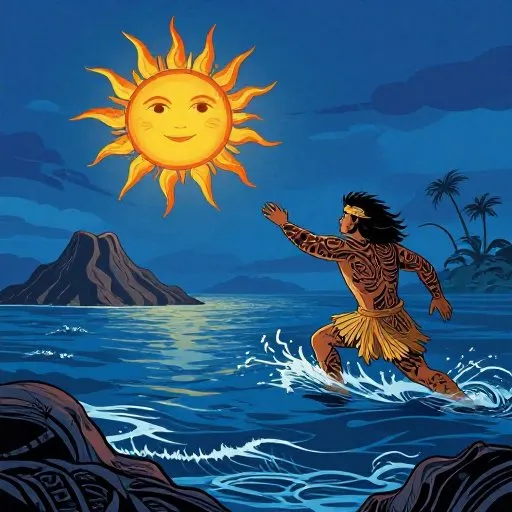
The sun had been sprinting across the sky since the beginning of time. Maui had rope and a problem with that.
The sun crossed the sky too fast.
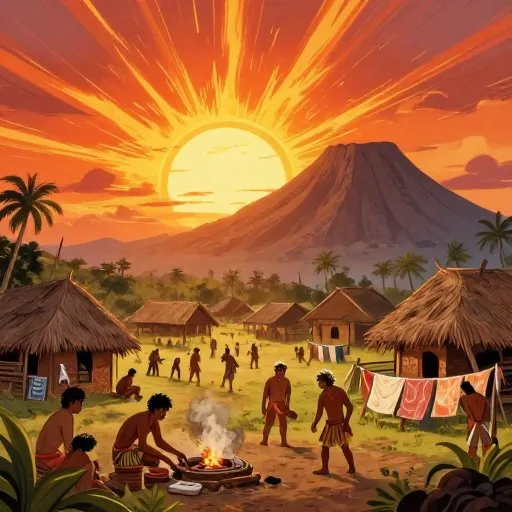
Not a little too fast. Catastrophically fast. Up before you could prepare for it, gone before you could use it. Fishermen hauled nets in half-light. Farmers worked in shadows. Tapa cloth, the bark cloth that Polynesian communities had spent days pounding and preparing, spread out to dry in the morning and was still wet when the afternoon vanished. The sun rose, sprinted across the sky as if it had somewhere better to be, and disappeared. Every day. Since the beginning.
Nobody had done anything about this. When something has always been a certain way, people stop treating it as a problem. It becomes the weather. It becomes Tuesday. You complain about it and then you adapt and then eventually you stop complaining.
Maui was not built for that final step.
He was a demigod, half divine through his father, and he had a specific way of looking at the world that created a lot of problems for everyone around him and, occasionally, solved problems that nobody else had thought to address. He did not see systems. He saw flaws in systems. The sun was not a constant of existence to him. The sun was a thing that was behaving badly, and a thing that is behaving badly can be corrected.
His mother Hina mentioned the tapa cloth. She had been trying to dry a length of it for days. Every morning she spread it on the warm rocks. Every afternoon the sun was gone before it finished. She said it the way a person mentions something they have given up on.
Maui heard it as a complaint that required a solution. He went to find rope.
Not just any rope. The sun, presumably, had been grabbed at before.
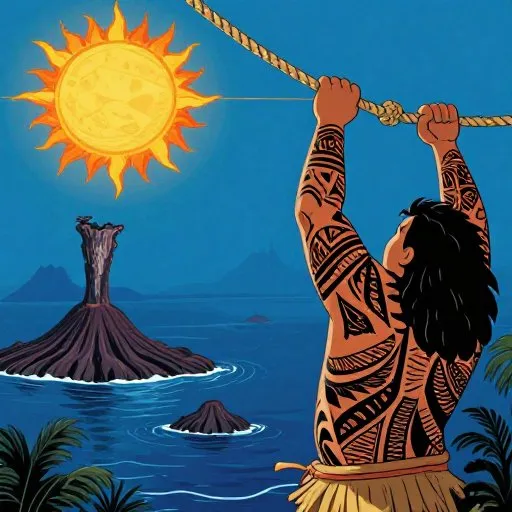
Maui cut his own hair and braided it with twisted flax and whatever else came to hand that was strong enough not to break immediately. Different versions of this story describe different materials. The Hawaiian telling, recorded by scholar Martha Beckwith in the 20th century, mentions the hair of the sun's rays themselves being used to bind it. The New Zealand Maori traditions describe a mixture of materials including flax, the hair of ancestors, and in some accounts the braided strands of the goddess Mahuika's hair. Sixteen ropes. That is the number most versions agree on. Sixteen ropes, laid across the path where the sun would emerge.
Then he went to visit his grandmother.
She lived near the place where the sun came up. This is not a metaphor for extreme old age. She actually lived near the eastern horizon, at the lip of the world, cooking bananas over a fire in a place where the ground held heat even in the dark and the light arrived sideways before dawn. Her name, in the Maori traditions, was Muri-ranga-whenua. She had a jawbone. Not her own jawbone: the jawbone of an ancestor, the kind of artifact that in Polynesian tradition was both a weapon and a sacred object carrying the power of the dead.
Maui explained what he was going to do. She gave him the jawbone. She told him not to come back to complain about what happened if it went wrong.
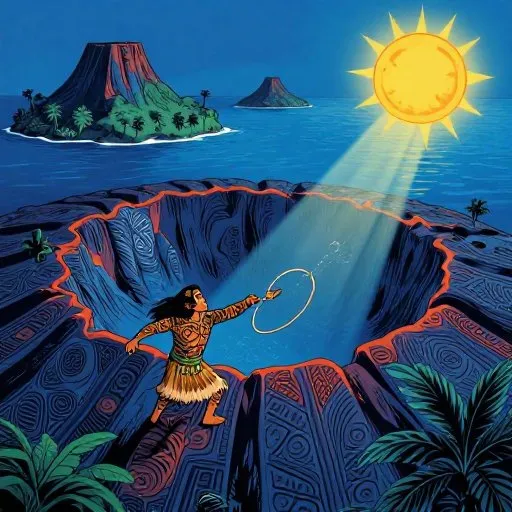
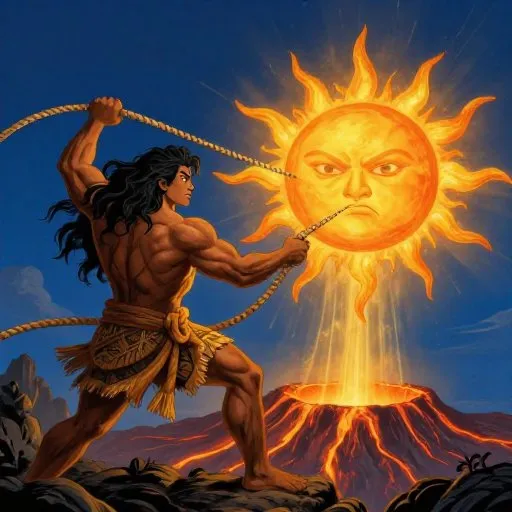
He braided the last of the ropes. He placed them in loops across the sun's path at the eastern crater. He positioned his brothers behind him, and they stood in the dark waiting with the particular alertness of people who have been conscripted into something they do not fully believe in. Maui held the jawbone. He watched the horizon.
The thing about waiting for the sun to rise is that you have never seen it come up slowly before. You do not know what the moment before it is actually looks like until you are waiting to ambush it.
The first ray came over the rim of the crater and Maui threw his loop.
It caught.
He threw another. It caught. His brothers threw their ropes and eight more of the sun's legs were tangled before the sun had a chance to understand what was happening to it. The sun had been running this route since before humans existed. It had never been stopped. It took a moment to register that it was stopped.
Then the roaring started.
The sun pulled. The ropes burned. Maui's brothers dug in their heels and the crater shook and the eastern sky went white with heat. The sun expressed, loudly and at length, its objection to this entire situation. It was not accustomed to being told no. It was not accustomed to being told anything. It had a schedule, a path, a very long history of doing exactly what it wanted, and there was a man at the other end of these ropes.
Maui hit it with the jawbone.
He hit it again. Not in frustration. Methodically. The sun, which had planned to simply burn through the ropes and continue its morning, was encountering new information: the ropes were not breaking, the man was not letting go, and the hitting was ongoing.
The sun had never negotiated before. It was about to learn that negotiation is what you call it when the alternative is being hit again.
Maui told the sun what was going to happen.
More time. A slower crossing. Long enough for crops to grow, for cloth to dry, for fish to be caught and cleaned and cooked in daylight, for people to actually accomplish something between sunrise and sunset. The sun argued. The sun had been crossing the sky at this speed since the beginning. The sun had a whole cosmological schedule to maintain. The sun had never been asked to consider anyone else's plans.
Maui hit it again.
The agreement took the shape all agreements take when one party is free and the other party is tied up and being beaten: the second party decides that stopping the pain matters more than winning the argument. The sun would slow down. For half the year, it would walk. The other half, it could run. That is why summer days stretch long and winter days end before you are ready for them. The sun was not happy about any of it. It agreed anyway.
Maui let go of the ropes. The sun moved on across the sky.
Slower than it had ever moved before. His brothers stood on the crater rim catching their breath, watching. They had never seen the light do this: move like it had somewhere to be, but no particular urgency about getting there. The shadows stretched out long across the ground. The morning opened up into something that actually had room in it.
His mother spread out her tapa cloth. By midday it was dry.
That is it. That is the payoff. Not a divine transformation or a kingdom restored. A piece of cloth that dried properly for the first time. The story always comes back to this. It was always about the cloth.
People tell the other Maui stories after this one.
There are quite a few of them. He fished entire islands up from the ocean floor with a magical fishhook. He slowed fire down so humans could use it. He tried to win immortality for all people by crawling through the body of Hine-nui-te-po, the goddess of death, while she slept. His companions laughed at the sight and woke her. She crushed him. Maui died, and because he failed, all humans remain mortal. That story ends quietly and without redemption and the Maori tradition tells it straight.
But this is the one people come back to. Not because it is the biggest. Not because it is the saddest. Because it is the most recognizable.
He saw something that was wrong. Not catastrophically wrong. Not world-ending wrong. Just: wrong. The day is too short. People cannot finish what they start. His mother is standing over cloth she cannot dry because the sun cannot be bothered to take its time. That is the entire problem.
So he made rope. He got up early. He put his brothers to work even though they thought the plan was insane. He climbed the mountain and hit the problem until it changed.
Maui is one of the most widely shared figures in Polynesian mythology, appearing across Hawaii, New Zealand, Samoa, Tonga, the Cook Islands, and throughout the Pacific, with the core elements of his stories remaining consistent across thousands of miles of ocean. Scholars who study oral tradition are interested in this kind of stability. When a story travels that far and holds its shape that well, it means the story is doing something important.
The sun story is usually the first Maui story children learn.
It is easy to understand why. It does not require a god or a hero of unusual size or power. It requires someone who notices something is wrong and decides to do something about it instead of adapting. It requires rope and preparation and the willingness to hold on when the thing you are fighting is much larger than you are.
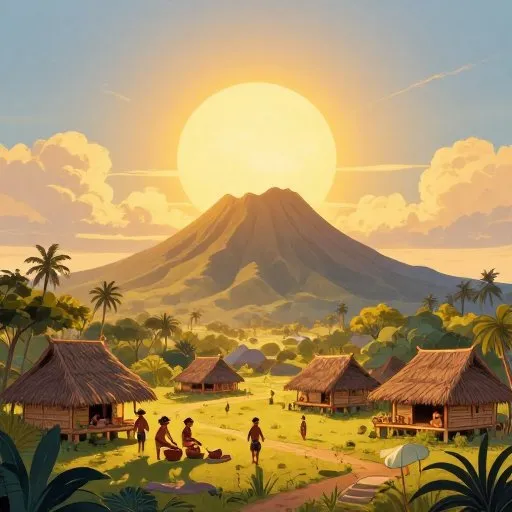
The mountain is still there. In Hawaii, Haleakala, on the island that bears his name, means House of the Sun. The name came from this story. From a man who went up in the dark with sixteen ropes and waited for dawn.