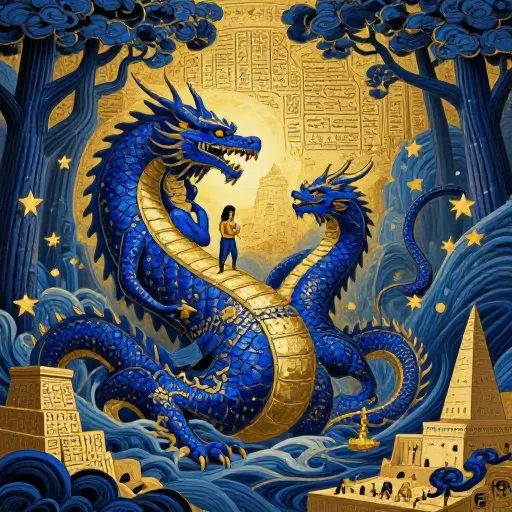
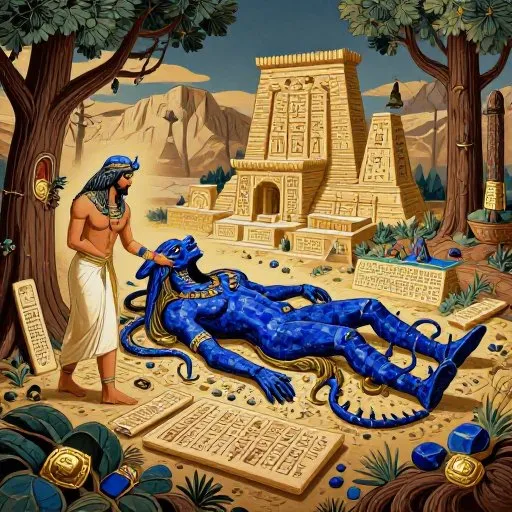
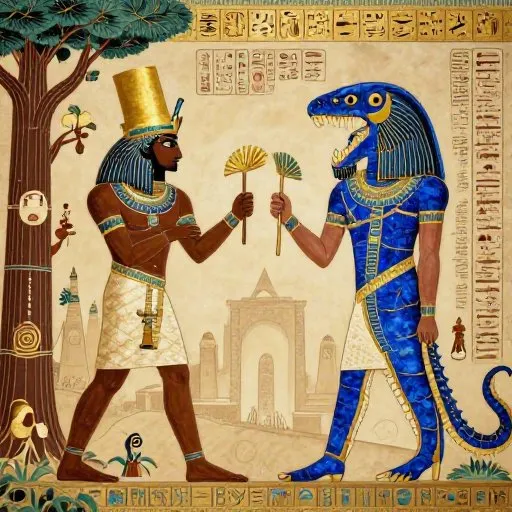
Tiamat, the Babylonian sea dragon, was the world before the world existed. Marduk killed her and built the sky and earth from her body. Mesopotamian myth, told properly.
Mythwink
Before there was a world, there was a sea dragon. Then a young god made her into one.
Before the sky. Before the earth. Before the gods.
There was water.
Two kinds of water, actually. Apsu was the fresh water, the underground springs and rivers, the sweet water that feeds wells and irrigates fields. Tiamat was the salt water: the sea, the ocean, the dark water at the edge of everything. They were not gods in the way that later gods were gods. They were the substance of existence itself. Before anything had a name, before the sky had been separated from the earth, when nothing had been determined or fixed: there was Apsu, and there was Tiamat, and where their waters mingled, things began to happen.
The gods emerged from that mingling. First Lahmu and Lahamu, then Anshar and Kishar, then Anu. And from Anu came Nudimmud, who was Ea, the god of wisdom and the deep waters. Generation by generation, the universe was filling with noise.
The gods gathered. They made a racket. They danced. They were young and large and enthusiastic and they had no idea what they were doing to the ones who had come before them.
Apsu couldn't sleep. The noise was unrelenting. He went to Tiamat and said: I cannot rest during the day, I cannot sleep at night. Let us destroy them.
Tiamat said no. She had made these gods. She had carried them in her waters. She was, by some readings, their mother, or something very close to it. She was furious at Apsu's suggestion and told him so.
Apsu didn't listen. He went to his advisor Mummu and they made their plan anyway.
Ea heard about it. Ea, who was the god of wisdom and who was always, in any Mesopotamian story, the first one to understand what was actually happening. He cast a sleep spell on Apsu. He killed him. Then he built his home over Apsu's body: the abzu, the deep freshwater realm, the underwater sanctuary where Ea lived and thought and made things.
He killed his own ancestor to protect himself and then built his house on the corpse. This was practical. The Babylonians were, in many ways, practical.
And then Tiamat was alone. And she noticed what had happened to Apsu. And she changed her mind about destroying the younger gods.
Tiamat was patient for a while. Then she was not.
She gathered allies. Not gods, exactly. She made new things. The serpent. The dragon. The hairy hero. The great demon. The savage dog. The scorpion man. The mighty storm. The fish man. The bull man. She made eleven of them, eleven new creatures, terrible and overwhelming. She armed them with weapons that no god had faced before.
She needed a champion. She chose Kingu. He was one of the divine beings in her service, and she elevated him above all the others. She gave him the Tablet of Destinies. This was significant. The Tablet of Destinies was the object that conferred supreme authority in the cosmos. Whoever held it held power over all things. Tiamat hung it on Kingu's chest and declared him her commander, her supreme weapon, the new Apsu in her life.
Her army moved.
The gods heard about it and reacted the way gods in Mesopotamian mythology almost always initially react: with paralysis. Anshar sent Ea. Ea went and encountered the army and came back. Anu went and came back. The problem was simple and terrible. Tiamat was not an opponent. She was the ocean. She was the substance from which the world was made. She had made monsters that no existing weapon could harm. Nobody in the assembly of the gods knew what to do about an enemy who was, in a meaningful sense, older than the concept of fighting.
The assembly sat in grief. They sat in silence. They could not figure out a solution.
Then a young god stood up.
Marduk was Ea's son. He was, by the Enuma Elish's account, extraordinary even by divine standards. Born from Ea and the goddess Damkina, he had four eyes and four ears. When he moved his lips, fire came out. His stature was enormous, his bearing magnificent. He was tall. The text dwells on his height. The Babylonians had a specific relationship with tall kings that they translated into theology.
Marduk said: if I defeat Tiamat, I want to be king.
Not a small ask. He wanted supreme power. He wanted to be higher than every other god, in command of the Tablet of Destinies when it was recovered, with the final word on every decision, the authority to set destinies as he saw fit. He would fight the unkillable monster, but he wanted to be paid for it.
The gods looked around at each other. They looked at their options. Then they poured beer, sat down in a formal feast, and agreed.
Marduk prepared.
He made a net to encircle Tiamat. He made winds: the north wind and the south wind, the east wind and the west wind. He made the whirlwind, the tornado, the four-wind. He raised the flood-storm and the evil wind, the wind without equal. He put them all in the net. He took his main weapon: the flood-storm, the great weapon, a spear. He also took lightning. He made a new weapon that had not existed before, the imhullu, a wind so strong it could not be described easily. And he loaded all of this onto his chariot.
His chariot was pulled by four horses named Destroyer, Pitiless, Trampler, and Swift. The text names them. Someone in Babylon thought it was important that you knew those were the horses.
He rode out to meet Tiamat.
When Tiamat saw him coming, she did not run. She called him out. She screamed at him. She accused the gods of killing Apsu, of being treacherous, of treating her poorly. She was not wrong about most of it. But Marduk didn't engage with the substance of the complaint. He was there for a fight.
He challenged her to single combat.
And then Tiamat did the thing that every enormous, ancient, terrifying opponent does in mythology at the exact moment you don't want it to: she screamed. She opened her mouth. She was going to swallow him whole.
Marduk released the evil wind, the one that couldn't be described, into her open mouth.
The wind held her jaws open. She could not close them. She could not swallow him. She could not breathe. Her belly distended with the pressure. He drove the spear in through her open mouth. He cut through her heart.
He stood on her body. He cut the arteries of her blood and let the north wind carry it away to unseen places. The gods saw what had happened and came forward, bringing Kingu in chains. Marduk took the Tablet of Destinies from Kingu's chest and fastened it on his own.
He stood over the body of the oldest thing in existence. And he decided to make something from it.
Marduk looked at the body of Tiamat and he thought about construction.
He split her in two, like a fish for drying.
Half of her he set overhead: the sky. He stretched the other half beneath him: the earth. Then he walked through what he had made and started engineering it.
From her eyes he caused the Euphrates and the Tigris to flow. Her tail he bent up into the sky and fastened to the Milky Way. From her breasts he made the mountains. Her spittle he made into clouds. The winds in her body he set to be the weather.
This is the Enuma Elish's cosmology: the world was built from a body. The rivers ran from a goddess's face. The mountains were her chest. The clouds were her spit. When it rained in Babylon, it was Tiamat's moisture falling from Tiamat's sky onto Tiamat's earth.
This was not metaphor to the Babylonians. Or rather, it was and it wasn't. The Enuma Elish was recited in its entirety, all seven tablets of it, at the New Year festival every year in Babylon. The king participated in ritual enactments of Marduk's victory. It was the founding story of the world and the founding story of the city and the founding story of kingship all at once, and it was renewed annually, which is how myths stay alive.
Marduk then made the months. He assigned three stars to each month. He made the moon. He told the moon how to behave: wax for half the month, wane for the other half, so that the night sky could be used to track time. He was building a world with an operating system. Everything assigned. Everything tracked.
And then the gods said to Marduk: we need someone to do the work. The maintenance. The irrigation. The temples. The offerings.
Marduk said: I know. I'll make humans. He had a specific plan for that too.
Kingu was brought before Marduk.
Kingu, who had been Tiamat's champion, who had carried the Tablet of Destinies on his chest, who had commanded her army of monsters. He was the one who had started what finished with a sea dragon split in half and made into geography. Marduk cut the veins of his blood.
From the blood of Kingu, humans were made.
The Babylonian creation story did not begin with dust or clay. It began with the blood of a defeated god. Humans were made from the substance of a combatant in the worst war before time began. And their purpose was stated clearly: they would do the work of the gods. They would build the temples, plant the fields, perform the rituals, bring the offerings. The gods could rest.
The gods were pleased. They built Babylon. Not as a metaphor. As a city. The great city of Esagila, the temple-tower of Marduk, the structure that later became famous in other people's stories as a tower built toward heaven. The gods built it first, in the Enuma Elish, as a gift to Marduk, as their residence when they came down from the sky. They measured it. They baked its bricks for a full year. They set the top at the height of Apsu.
Then the great gods sat down at the feast. They ate bread and drank wine. They decreed the fifty names of Marduk. Fifty names, each one describing another attribute of his power. The text lists all fifty. The ceremony of naming was the ceremony of power, in Babylonian thought. To name the fifty names of Marduk was to recite the architecture of the universe and the authority of the city at the same time.
At the New Year festival in Babylon, the priests did exactly that. Every year. The creation happened again. Marduk killed Tiamat again. The world was remade again. Babylon, which sat at the center of the world Marduk had made, was confirmed again as the place where the rivers ran and the sky held and the earth held shape.
The Enuma Elish is a creation story that is also a political document. The elevation of Marduk above all other gods coincided with the elevation of Babylon above all other cities. When Babylon was powerful, Marduk was supreme. When the city fell to Assyrian conquest, the Assyrian version sometimes substituted their own god Ashur for Marduk in the same story with surprisingly few other changes.
The myth was a tool. It told you who was in charge of the universe by telling you who was in charge of the city. And it renewed that claim every single year, in public, in the street, in the presence of the king, who performed his own ritual submission to Marduk in the Esagila temple and received back the divine authorization to rule.
Tiamat is still there. She is the sky above Babylon and the earth below it. She is the Tigris and the Euphrates running from her eyes. She is the weather and the mountains and the dark water at the edge of everything.
She lost the fight. She didn't disappear.
The world is what became of her. That is either a defeat or the most permanent kind of victory, depending on how you look at it.