The Hindu myth of Krishna and Kaliya: a massive poisonous serpent poisons the Yamuna River, and a young Krishna jumps in alone to deal with it. By dancing on his heads.
Mythwink
The river was poisoned. A child jumped in. The snake had no idea what was about to happen.
The Yamuna River ran through Vrindavan, and the stretch around Kaliya's pool was dead.
Not metaphorically dead. Actually dead. The Bhagavata Purana describes it precisely: the water was black with venom. Birds flying over it fell from the sky. Cattle that drank from the banks died on the spot. Grass and trees on the shore had turned brown and bare. Fish floated on the surface. The water itself had become something that ended anything that touched it.
Kaliya was a naga, a serpent being. Not a snake in the ordinary sense. A naga in Hindu cosmology is a semi-divine entity, powerful, ancient, capable of taking multiple forms. Kaliya had a hundred and ten heads in some versions of the story, five in others, with the larger number reserved for moments of full manifestation. He had lived in the Yamuna for a long time. He was old. He was enormous. His poison was not incidental to his nature. It was his nature.
He had moved to the Yamuna from the ocean because Garuda, the divine eagle and mount of Vishnu, had been hunting nagas. Garuda was one of the few things in existence that could kill Kaliya. There was a standing arrangement at a particular bend in the Yamuna: Garuda would not go there. A sage named Saubhari had made an agreement that protected the location. So Kaliya went where he was safe.
He poisoned the river because that's what Kaliya did. He didn't make a calculation about it. He didn't target Vrindavan specifically. He was a massive poisonous serpent in a river and the river became poisonous. The cattle died. The birds fell. The people of Vrindavan watched their water source become a death zone.
Something had to be done about this.
The something turned out to be a child.
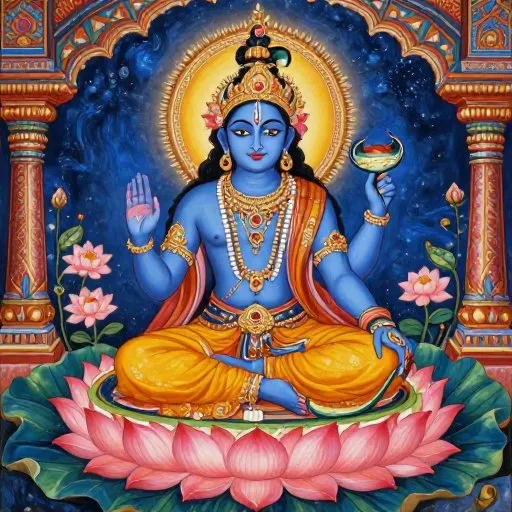
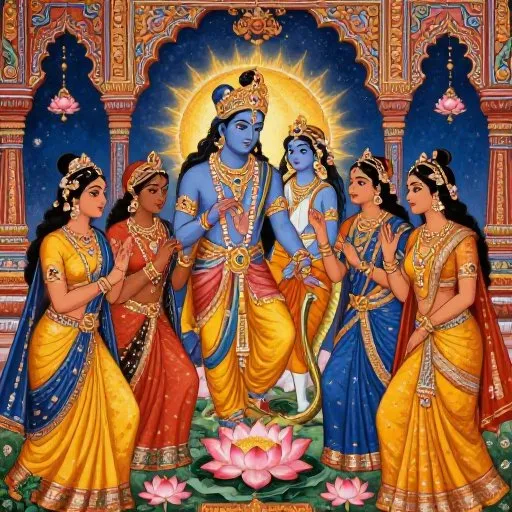
Krishna was tending cattle with the other boys of Vrindavan. He was young. The Bhagavata Purana doesn't settle on an exact age for this story, but he was a child. Visually, if you look at the paintings: a small boy, dark blue skin, yellow clothes, peacock feather in his hair.
This was, depending on how you count, not his first impossible situation. He had already killed the demoness Putana, who had tried to poison him with her breast milk and discovered that you cannot poison the avatar of Vishnu this way. He had destroyed a dust demon, a whirlwind demon, a calf demon. He had lifted the mountain Govardhana on his little finger for seven days to shelter the village from Indra's storm. He had been doing this since infancy.
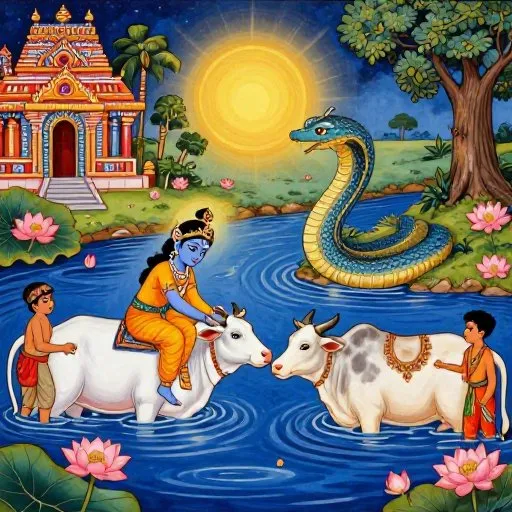
But the boys with him didn't necessarily know the full accounting of what Krishna was. Or they knew it in the way you know something intellectually that you haven't fully absorbed. So when Krishna climbed a tree on the bank of the poisonous river and they told him not to jump in, their concern was genuine. They were looking at poisoned water and a friend with no apparent plan.
He jumped.
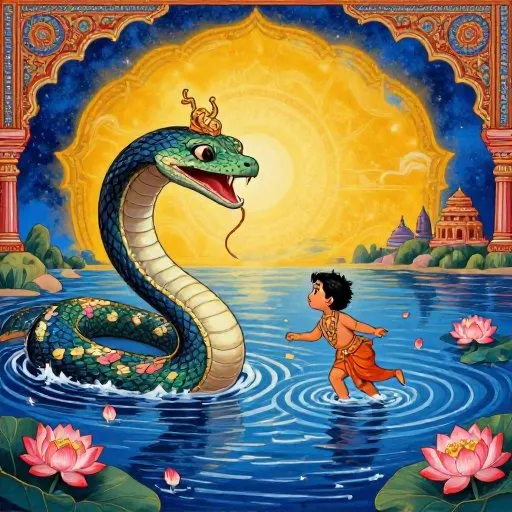
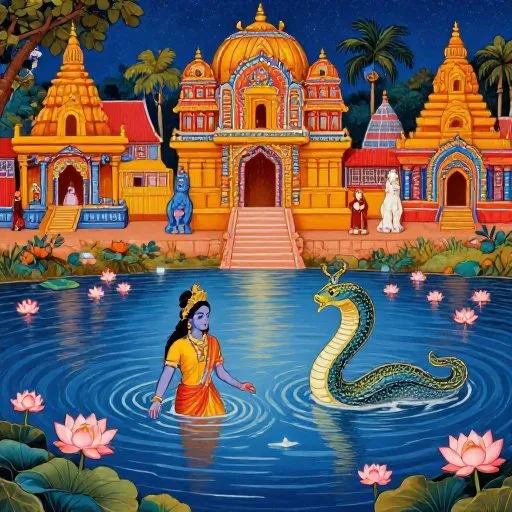
He jumped into the water where the cattle had died and the birds had fallen from the sky, and he landed in Kaliya's pool and started swimming. The texts describe the pool as dark, thick with venom, the current disturbed by the serpent's coils.
Kaliya felt him.
What happened next is depicted in paintings all across South Asia, Central Asia, and wherever the Krishna tradition traveled. It is one of the most painted scenes in Hindu art. If you've seen an image of a small dark-skinned child dancing on the heads of a serpent whose hoods are spreading wide, this is the moment.
Kaliya came up from the depths and wrapped around Krishna. The Bhagavata Purana says he bit him, wrapped his coils tight, squeezed with the full force of a creature that had been alive in rivers since before Vrindavan existed. The boys on the shore fell to the ground in terror. The news spread to the village. Yashoda, Krishna's mother, came running. Everyone who loved him, and in Vrindavan that was essentially everyone, came to the bank.
They found him under the water, and then they found him not under the water, because Krishna expanded.
This is one of the things Krishna can do. He is Vishnu's avatar, and Vishnu is one of the three supreme deities of the Hindu tradition, and one of the things available to him is expansion. He became too large for Kaliya's coils to hold. The serpent had to release him.
Krishna stood on the water. Then he stood on Kaliya's hoods.
He danced.
The texts are specific about this. Krishna danced on Kaliya's heads. His feet struck each hood in sequence. The Bhagavata Purana describes Kaliya's crests being crushed, his venom draining from him with each impact of the dance, his body being pressed down into the water and released and pressed again. This was not a gentle dance. It was victory expressed as art, which is very much a Krishna way of doing things.
Kaliya's wives were watching.
The nagapatnis, the serpent women, came forward. They prostrated themselves in front of Krishna while he was still dancing on their husband's heads. The logic of the situation was clear: Kaliya was losing. More than losing. He was being pressed into submission by a child who should not have been able to enter the river much less survive it, and the dance showed no sign of stopping.
The Bhagavata Purana records their prayer. They called him the Lord. They said: who else would receive our devotion? Who else could absorb this serpent's venom without harm? They recognized what Kaliya had not, or had not admitted: they were not looking at a boy. They were looking at something that had decided to look like a boy for reasons that were not entirely visible from where they were standing.
They asked for Kaliya's life.
Krishna stopped.
He stood on the central hood and looked at Kaliya. Kaliya, for his part, was finished. The arrogance was gone. Whatever Kaliya was when he arrived at this river, when he claimed this pool, when he poisoned the water that the village depended on, he was not that now. He lay still.
Krishna had a few things to say.
He told Kaliya to leave the Yamuna. Go to the ocean. Return to where he came from. Garuda would not harm him: the mark of Krishna's feet on his hoods would be enough to protect him. Garuda, who serves Vishnu, would recognize the mark and know that Kaliya was under a different kind of protection now.
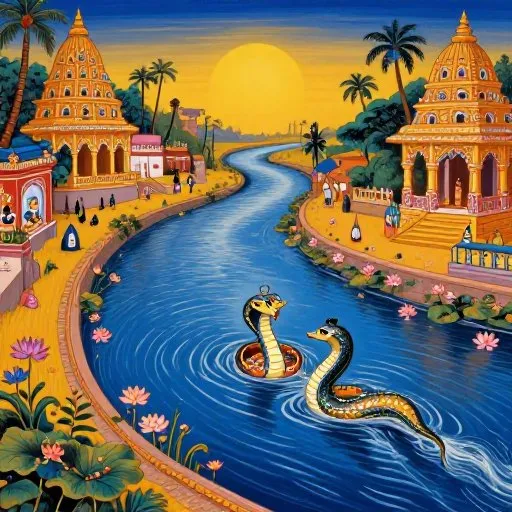
Kaliya agreed. The serpent who had made the Yamuna into a dead zone left the river, left Vrindavan, went south to the ocean with his wives. The river cleared. The water moved clean again. The fish returned. The banks greened.
The village had been standing on the banks the whole time. When Krishna came out of the river, the adults who had feared him dead and the boys who had watched him jump now watched him walk out of the water that had been killing cattle an hour ago, dry his feet on the bank, and look entirely untroubled.
Yashoda held him. Parents in these stories often hold their children after the impossible things happen, because the impossible things don't change the fact that the child is the child.
The Bhagavata Purana uses this story to make a theological point that is consistent with everything else in the Krishna tradition: the world's problems are not solved by matching force with force. Kaliya was not killed. He was danced into recognition. He was pressed into understanding what he was dealing with and what that meant for his choices. Krishna gave him an exit and a protection and let him go.
This matters in the tradition because Krishna is not primarily a god of destruction. He is a god of love, of play, of music, of the kind of joy that is also a form of power. The flute is his instrument. The dance is his mode. He defeated one of the most dangerous beings in the Yamuna not by the logic of combat but by the logic of art, which was unstoppable in ways that combat wasn't.
The pool where Kaliya lived is called Kaliya Ghund. It's on the Yamuna in Vrindavan, which is a real city in Uttar Pradesh. Pilgrims go there. They remember the river being cleaned, the serpent leaving, the boy dancing on the hoods while the village held its breath on the bank.
What they are remembering, underneath the story, is something simple. The most poisonous thing in the river met something more powerful, and the river was cleaned. Not through destruction. Through a dance.
That is a specific kind of hope. The kind that is harder to argue with than the other kind.