← All Stories

The Japanese myth of Izanagi descending to Yomi, the underworld, to find his dead wife Izanami. The origin of death, birth, and the reason you do not look at things you cannot un-see.

Izanagi in the Underworld

Mythwink

Izanagi in the Underworld

He was told not to look. He looked. That is why you die.

1The World They Made Together

Chapter 1: The World They Made Together

Izanagi and Izanami made Japan.

Not as a metaphor. Literally. They stood on the floating bridge of heaven, the bridge that connected the sky world to the unformed brine below, and they stirred the ocean with a jeweled spear. When they lifted the spear, the drops that fell from the tip thickened and accumulated and became the first island. Then the next. Then all the rest. They came down to the islands and made them their home. They built a pillar of heaven, walked around it in opposite directions, met in the middle, and from their meeting came gods. Wind. Sea. Trees. Mountains. More islands. The whole structure of a world that had not existed before they started.

They were partners in this. The Kojiki, the oldest book of Japanese mythology, is precise about it: they created together, they spoke together, they made the decision to descend together. Izanami is not a secondary figure in this story. She is half of it.

Then came Kagutsuchi. The fire god.

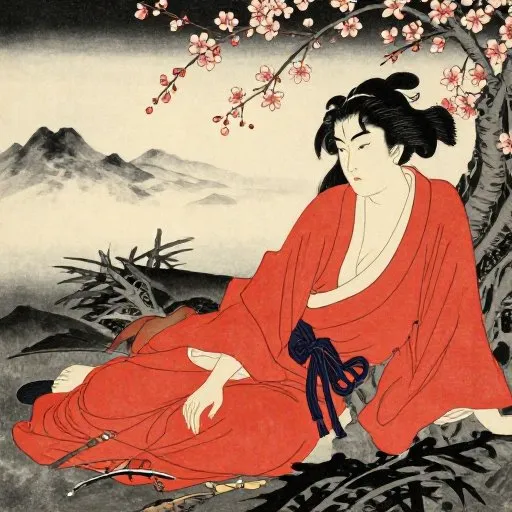
Izanami gave birth to Kagutsuchi, and the fire took her. Not the way a sickness takes someone, not quickly, but the way fire actually works: slowly consuming the thing it burns, transforming it as it goes. Izanagi held her while it happened and could not stop any of it. He watched her die.

When she was gone he wept until his tears became gods, because in those days everything came from strong feelings if the feelings were large enough. He took his sword in his grief and killed the fire god, and from the blood and the pieces of Kagutsuchi came more gods: fourteen of them in Snorri's catalog, birth from destruction, the world growing precisely because something terrible had happened.

Then Izanami went to Yomi. The land beneath. The realm of roots and endings.

Izanagi knew where she was. He waited. He told himself he had accepted it. He had not. He went down.

2You Must Not Light a Torch

Chapter 2: You Must Not Light a Torch

The path to Yomi goes down and keeps going.

The Kojiki does not describe the path in detail, which is its own kind of description. When a text that catalogs every island and every god and every transformation decides not to describe something, it is telling you something about the nature of that thing. The path to Yomi is not described. It goes down. The light from the surface world fades and then is gone, and what replaces it is not darkness exactly but the absence of the category of light itself.

He found the gates: great sealed doors somewhere below, and beyond them, her voice.

She was there. She said she was glad he had come. She was sorry, she said. She would speak with the gods of Yomi about permission to leave with him. He must wait outside. He must not come in. And above all, above everything, he must not light a torch.

He agreed to these terms.

He stood outside the gates of the underworld and he waited.

He waited for what the Kojiki measures only as a very long time. Sounds came from behind the doors. They stopped. They did not become her voice again. The silence on the other side grew the kind of texture that silence develops when it has been there long enough.

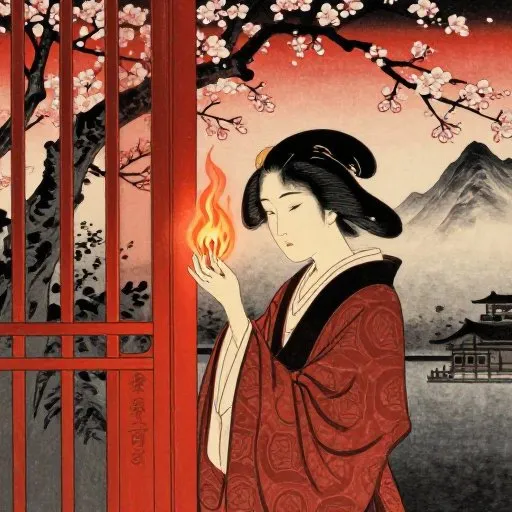
He reached up and pulled a tooth from the comb in his hair. He lit it.

You already know he should not have done this. The myth tells you before he does it. The chapter heading tells you. He knew too. That is not the same as not doing it.

3What the Light Showed

Chapter 3: What the Light Showed

She was very close to the gate. The small flame caught her face.

She was not the person he had stood beside on the floating bridge of heaven. The Kojiki is specific about what she was: her body was filled with maggots. Eight gods of thunder had taken up residence inside her. The Kojiki names them: Thunder-in-the-Chest. Thunder-in-the-Belly. Thunder-in-the-Head. Thunder-in-the-Back, Thunder-in-the-Genitals, Thunder-in-the-Left-Hand, Thunder-in-the-Right-Hand, and Thunder-in-the-Foot. Eight thunder gods in a rotting body. The text names every single one. The Kojiki was not a document that looked away from difficult material.

This was Izanami. She was still her shape. Everything inside the shape had become Yomi.

Izanagi ran.

He did not try to speak to her. He did not reach for her. He turned and ran up the path toward the surface at the speed of a god who has just discovered for the first time that something in creation can genuinely terrify him. Behind him, through the gate, he heard her voice change into something that was not voice. He heard pursuit. She was angry in the way that the dead become angry when the living look at what they have become. He had promised not to look. He had looked. And now she was coming.

4The Chase

Chapter 4: The Chase

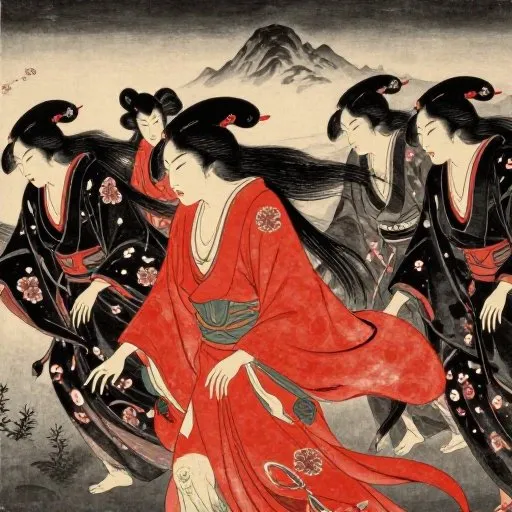
She sent the Shikome first. The hideous women of Yomi, creatures of the underworld, fast in the dark the way things born in darkness are fast. Eight of them, behind him on the path.

Izanagi ran and reached into his hair and threw his black headdress behind him. It became a bunch of grapes. The Shikome stopped to eat them. Even the dead are hungry. He gained ground. He threw his comb and it became a stand of bamboo shoots and they stopped again. He kept running.

Then Izanami herself came. Not sending others now. Coming herself, with the eight thunder gods inside her.

He reached the peach trees that grow at the border between Yomi and the living world. He grabbed peaches and threw them and the thunder gods retreated, because peaches are a protection against the dead, which is why you know to leave them at graves. He reached the entrance to Yomi, the place where the underworld opens toward the sky.

He rolled a boulder across the mouth. A boulder so heavy the Kojiki says it would take a thousand people to move. He stood on the living side of it, breathing.

Then he heard her voice through the rock. She said: I will kill a thousand people every day.

He said: I will cause fifteen hundred to be born.

That is the origin of death and birth in the Shinto tradition. Two gods on opposite sides of a boulder, negotiating the population of the world. She would kill one thousand each day. He would bring fifteen hundred new lives into being. The numbers have held since the first morning of the world. More are born than die. The world gets larger, very slowly, because of a promise made through a sealed stone at the entrance to the underworld.

They both kept their word.

5What Washed Off in the River

Chapter 5: What Washed Off in the River

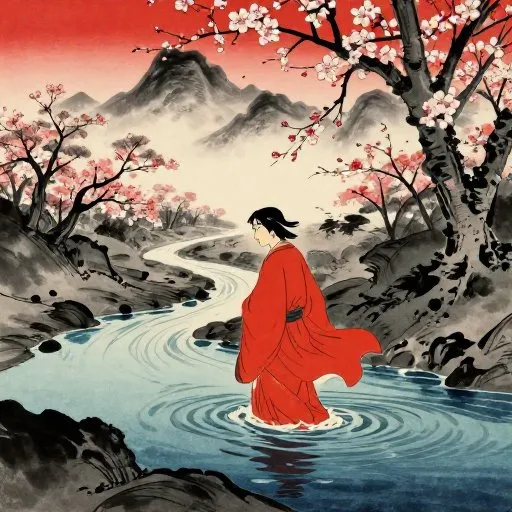
On the way back to the surface, he found a river and he went into it.

He needed to be clean. Not clean the way you wash dust off your hands. He needed to remove Yomi from himself: the dark, the smell, the sight he had seen and could not put back. The pollution of the underworld realm, what the Shinto tradition calls kegare, the impurity that comes from contact with death. He went into the river and he began to wash himself, and the Kojiki records, methodically, what was born from each act of cleaning.

From the clothes he removed: more minor gods. From the washing: more gods. The pollution of Yomi falling away into the river and becoming things as it left him, because everything came from strong feelings if the feelings were large enough.

He cleaned his left eye. From it came Amaterasu, goddess of the sun.

He cleaned his right eye. From it came Tsukuyomi, god of the moon.

He cleaned his nose. From it came Susanoo, god of storms.

He had gone down to Yomi to bring back one person and he had failed. He had come back alone. But he came back with the sun and the moon and the storms, born from the act of washing off his failure in a river.

The Kojiki does not say what Izanagi did after that. It moves on immediately to the adventures of his children. Amaterasu hiding in a cave and pulling the sun from the sky. Susanoo rampaging and being exiled. Tsukuyomi killing the food goddess and being banished by Amaterasu to the opposite side of the sky, which is why the sun and moon never appear together. Izanagi is not mentioned again. The story moves to the next generation without looking back.

He is said to have retired to a small, quiet palace. Hidden away. He had stirred the ocean until it became an island, walked into the land of the dead, run from his wife through absolute darkness, sealed the entrance to the underworld with a boulder, and washed the sun into existence from his left eye.

If anyone had earned quiet, it was him.
Mythology Notes