← All Stories

The Egyptian myth of Isis tricking Ra into revealing his secret true name. How a clay serpent, a patient goddess, and a god's own drool rewrote the balance of power in ancient Egypt.

Isis and the Secret Name

Mythwink

Isis and the Secret Name

Ra had a thousand names. Isis wanted the one he used when nobody else was listening.

1The God Who Made Everything and Then Got Old

Chapter 1: The God Who Made Everything and Then Got Old

Ra was the oldest thing there was, and he had made everything, and he knew it.

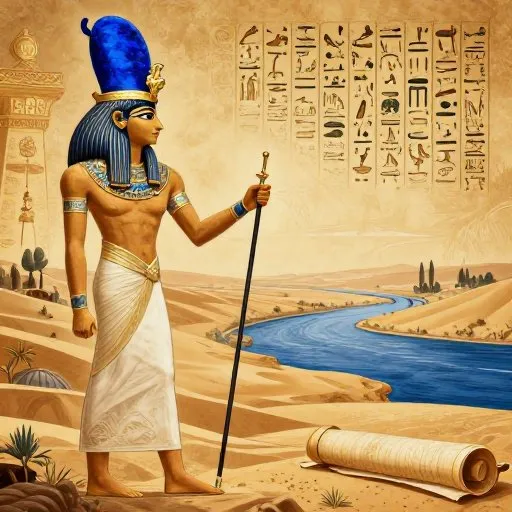
He had spoken the world into being before there was a world to stand in. Before Ra there was nothing, not even darkness, because darkness is a thing and there were no things. After Ra there was everything: the sky, the river, the black soil of the Nile, the people walking its banks, the animals in the grass, the monsters in the water. He had made all of it. Every morning he crossed the sky in his solar boat, and every night he descended into the Duat, the underworld, and fought his way through twelve hours of darkness and serpents and chaos, and every morning he came back out the other side. He had been doing this since the first morning. He would do it until the last.

He had a name for each stage of the crossing. Khepri in the morning, the scarab beetle rolling the sun up from behind the horizon. Ra at noon, blazing and direct. Atum in the evening, the old man settling into the west. These were his working names. The names priests spoke and he answered to. They were powerful. But they were not the name.

In ancient Egypt, every person, every god, every thing had a true name. A secret name. The ren. It was one of the five parts of the soul, as real and as vital as the body itself. Know someone's true name and you did not have their attention. You had them. Their power, their obedience, their full and complete self. A god's true name was the word at the root of everything they were. Ra's true name was the word at the root of the world.

He guarded it absolutely.

It never occurred to him that someone might find another way in.

2Patient as the Nile

Chapter 2: Patient as the Nile

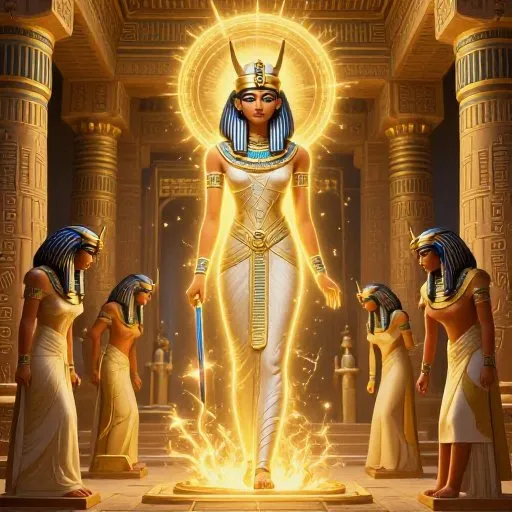
Isis was the goddess of magic and the keeper of secrets, which meant she understood the value of watching carefully before acting.

She was brilliant in the way that does not announce itself. While other gods were being impressive, she was paying attention, which is a different kind of impressive entirely. She had learned everything she knew by gathering information nobody else thought was worth gathering. She watched Ra on his daily crossing. She watched him every day, for days on end. She was waiting for the right information.

What she noticed was this: Ra was old now, the way immortals are sometimes old. His mouth had grown slack. When he walked the earth in his ancient form, spit fell from his lips into the dust. Sacred spit from the god who had spoken the world into being. The same divine substance that had been the raw material of creation, landing in the dirt of the Nile path every morning.

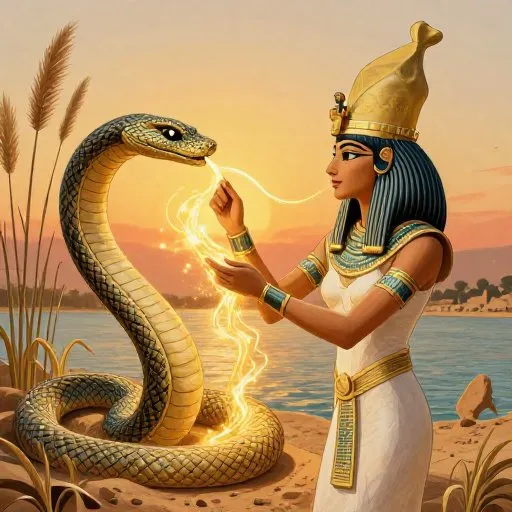
She collected it. Patient days with a small clay vessel. Sacred drool from the oldest thing in existence, mixed with the black earth of the Nile, worked together with her fingers and her words until the mixture had a shape: a serpent, small as a forearm, but with a specific and carefully designed purpose.

Think about what she had built. A weapon made partially from Ra himself. She had taken pieces of him, literally pieces of his body, and shaped them into something that could hurt him. When it bit him, the venom would be, in a sense, his own. Which meant only something made from him could undo it. Which meant only the person who made the serpent held the cure.

Which was Isis.

She placed it on the path where Ra walked each morning. He had used the same path for ten thousand years without varying his route.

Routine is its own kind of blindness.

3The Bite

Chapter 3: The Bite

Ra walked right into it.

The serpent bit him and died in the same moment. Its entire purpose was the bite and it had done the bite, and that was the end of its existence. Ra stopped walking. He made a sound none of the gods who traveled with him had heard before: something between a cry and the tearing of cloth. Above Egypt, the sun wobbled in the sky in a way that made every person on earth look up with the sudden knowledge that something had gone wrong with the world.

He called the gods to him. He stood in the path with his legs shaking, still magnificent, the sun disc burning on his brow, the most powerful being in existence, and he could not stop trembling. The venom was already moving through him. Fire and cold at once. His limbs were going distant, the way a sound goes distant when you walk away from it.

He described what had happened. He had been bitten by something. He did not know what. He had not seen it. The thing was already gone. He recited his names, all of them, the way you recite your credentials when you are trying to establish that you are too important for this to be happening to you. "I am Khepri in the morning and Ra at noon and Atum in the evening." He listed everything he was. The venom kept moving.

Isis came with the others. She examined the wound with the careful professionalism of someone who had designed exactly this wound. She looked up at him with great sympathy on her face. She said she could help. She was skilled in these matters. But she would need his name. His real name. Not Khepri, not Ra, not Atum. The name beneath those names.

Ra said those were his names.

She said she understood. But the venom was a special kind. It required a truer key to address it. Without the true name, she could do nothing. Her hands, regretfully, were tied. She had been practicing the expression on her face for quite some time.

4Every Name Except the One

Chapter 4: Every Name Except the One

He tried to give her other names first.

Lord of the Horizon. Creator of Heaven and Earth. He Who Illuminates the Two Lands. The Hidden One. The Old One. Each name was real and each name was powerful and each time Isis shook her head, gently, with great sorrow for his predicament. The venom moved deeper. His hands shook. The sun overhead was doing something that made the priests in the temples look at each other.

Here is what Ra knew, standing in that path: she had done this. He understood that from the beginning. A venom no natural creature could make, placed on his exact path, with a healer ready on the scene who required exactly one thing he had never given anyone. He knew. He had been Ra long enough to know a trap when he was standing inside it.

It did not matter that he knew. The venom was real. The pain was real. The names he could offer were not the name she needed.

She waited. Patience was her first gift, the one that made every other gift work. She had wanted this for a very long time. She held that knowledge carefully, not letting it move in her face.

Then Ra told her the name.

The Turin Papyrus of Magic records the moment this way: the name moved from his heart through his eyes into her heart. Not spoken aloud, because the true name is too real to survive open air. It passed directly between them, god to goddess, the root of everything that existed, and when it arrived in her it settled there the way a key settles in a lock.

She recognized it. She healed him. Completely, the venom drawn out carefully and entirely, exactly as she had always planned to do. Ra stood upright and the sun steadied and Egypt went back to its morning.

He looked at her across the bright air and understood with complete clarity what had just happened.

There was nothing he could do about it.
5What Isis Did With It

Chapter 5: What Isis Did With It

She never misused it. This is worth saying clearly.

She had the secret name of the god who made the world. The most powerful word in existence. And she used it with the precision of someone who understood exactly what it was worth. Carefully. Deliberately. Only when nothing else would do.

When Set murdered her husband Osiris and scattered the pieces across Egypt, she used the name. She gathered every piece, reassembled him, and spoke to him from across the line between living and dead. She brought him back long enough. When their son Horus was still an infant hidden in the marshes and the poisons of Egypt's enemies came for him, she used the name to save him. When she needed to walk through sealed gates into the hall of the dead to argue for the living, she used the name.

Each time, precisely. No excess.

The Egyptians built her temples across Egypt. Then they built more. By the time of the New Kingdom, around 1500 BCE, she had become one of the most widely worshipped goddesses in the ancient world. When Roman soldiers arrived in Egypt, they found her and they brought her back with them. Her temples went up in Rome. Then in Britain, in Germany, in the Rhineland, in the ports of the Mediterranean. Her following traveled with trade routes and legions to the edges of the known world.

Her worship continued without pause from ancient Egypt into the early Christian era. Scholars have noted that certain depictions of Mary holding the infant Jesus carry the same visual grammar as ancient Egyptian images of Isis nursing the infant Horus. The figure of a mother holding a divine child is very old. Isis was part of how it became the image it became.

The other gods had power. They had strength and craft and fire and thunder and armies. Isis had the name underneath all the other names.

When you have that, you outlast everyone.

Mythology Notes