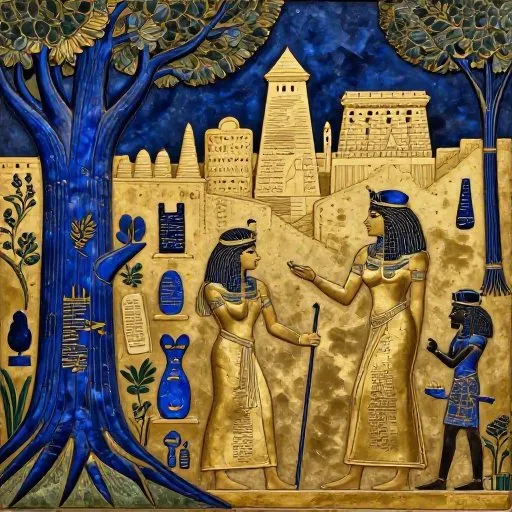
Inanna, Sumerian goddess of love and war, descended into the underworld and got killed. The world above stopped working. Then it got personal. Sumerian myth, told properly.
Mythwink
The goddess of everything walked into hell on purpose and it went about as well as you'd expect.
Let's establish what Inanna was, before we get to what she did.
Inanna was the Sumerian goddess of love, war, beauty, desire, fertility, and political power. That is not a typo. One goddess. All of those things. The Sumerians did not see these as contradictions. They had looked at the world and noticed that love and war were deeply related, that desire and destruction tended to show up together, that the most powerful forces in human experience were not gentle or tidy. So they made one goddess and gave her the whole portfolio.
She had temples across the ancient Near East. She had hymns. She had the oldest named author in human history writing about her: a high priestess named Enheduanna, who composed her praises around 2300 BCE, and whose name we still know, which is remarkable. Most writers from any period of history are anonymous. Enheduanna is not. She wrote about Inanna.
Inanna had a collection of divine powers called the "me," the rules and attributes of civilization: kingship, scribal arts, descent to the underworld, ascent from the underworld, the art of lovemaking, the art of music, flood, the kindling of fire. She carried all of it. She had fought for some of it, stolen a bit of the rest.
She also had a sister. Ereshkigal, queen of the Great Below. Ruler of the land of no return. The underworld, in Sumerian cosmology, was the domain of the dead, a dark, dusty place where the dead ate clay and wore feathered garments. Ereshkigal ran it. They were sisters who apparently did not see each other much, which, given the distance involved, is understandable.
Inanna decided to go visit.
Why. This is the question scholars have been arguing about for a century. The text does not give a clean reason. Inanna says she set her ear to the Great Below. She heard it. She felt it calling. Some read this as ambition: she wanted to conquer death's realm the way she'd acquired everything else. Some read it as grief: a Sumerian king had recently died, and there are fragments suggesting she was mourning. Some read it as the story's own internal logic, which required the goddess of everything to lose everything, to be stripped down to nothing, in order for something to be understood.
She prepared. She told her servant Ninshubur exactly what to do if she didn't return in three days. Go to the gods. Beg. Do not let them ignore you. Beat on the door. Dress in mourning. Don't stop.
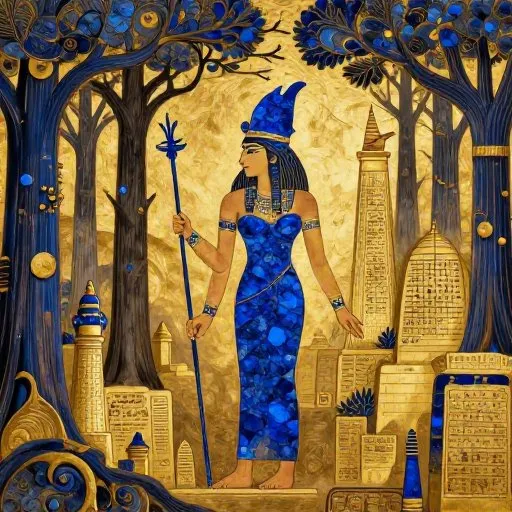
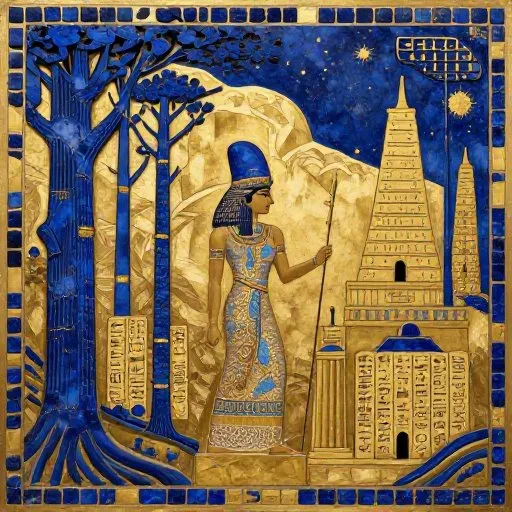
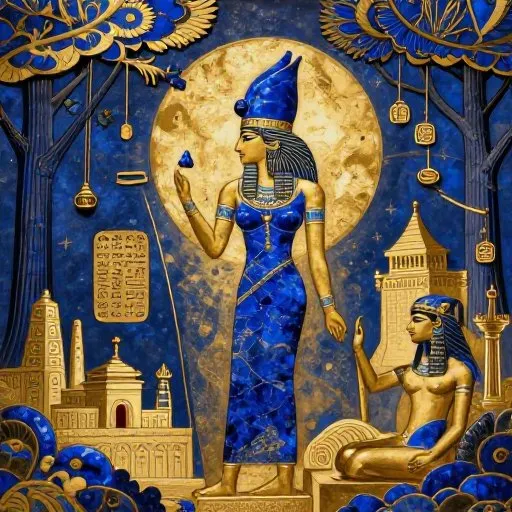
Then she dressed herself. She put on all seven of her divine attributes. The shugurra crown on her head. Lapis lazuli beads at her neck. The double strand of beads on her chest. The golden ring. The lapis lazuli measuring rod and line. The royal robe. All seven. All the symbols of who she was and what she had.
She walked to the gate of the underworld. And she knocked.
Neti was the gatekeeper of the underworld. He heard the knocking. He went to Ereshkigal and told her: there is a woman at the gate. She is claiming to be your sister. She is asking to come in.
Ereshkigal slapped her thigh. She bit her lip. She thought.
Then she told Neti: let her in. One gate at a time. And at each gate, take something.
This is the rule of the underworld. You enter it the way everyone enters it: with nothing.
Inanna walked through the first gate. Neti stopped her. He took the shugurra crown from her head. Inanna asked why. He said: the ways of the underworld are perfect. Do not question them. She went through.
At the second gate, the lapis lazuli beads from her neck.
At the third gate, the double strand from her chest.
At the fourth gate, the breastplate they called "come, man, come."
At the fifth gate, the golden ring.
At the sixth gate, the lapis lazuli measuring rod and line.
At the seventh gate, the royal robe.
Seven gates. Seven pieces of everything she was. Each one taken from her with the same answer when she asked why: the ways of the underworld are perfect. Do not question them.
She arrived in the throne room naked and bowed low.
Ereshkigal was sitting on her throne. The seven judges of the underworld were sitting with her. They looked at Inanna and did what the judges of the underworld do.
Ereshkigal fastened the eye of death upon her. She spoke the word of wrath. She uttered the cry of guilt.
And Inanna was killed. Her body was hung on a hook on the wall.
The greatest goddess in the Sumerian pantheon. Goddess of love, war, beauty, political power, desire. The owner of more divine me than anyone. Hung on a hook. Naked. Dead.
The text is not grim about it. It is matter-of-fact. She went in, and this is what the underworld does. The ways of the underworld are perfect.
Three days and three nights passed.
Ninshubur waited. On the third day she began mourning. She beat the drum in the assembly places. She circled the houses of the gods, tore her eyes, tore her nose, tore her ears, the formal gestures of Sumerian grief, the physical performance of a world that had gone wrong.
She went to Enlil. She prostrated herself. She told him Inanna was gone.
Enlil said: Inanna had too much ambition. She wanted the Great Below. This is what she got. I will not help.
She went to Nanna, the moon god. He said the same thing.
She went to Enki. God of wisdom, god of the sweet underground waters, the god who, more often than not, was the one who found the workaround. She told him: if Inanna dies, if she stays on that hook, then nothing works. Nothing grows. Animals won't breed. Grain won't sprout. And specifically, specifically, the bull will not mount the cow. Which was not a symbolic observation. It was a practical one. The Sumerians were agricultural. The bull and the cow mattered.
Enki looked at this and understood it the way he usually understood things: as a problem with a solution, if you were willing to be clever about it.
He took dirt from under his fingernail. From this dirt he fashioned two small beings. The kurgarra and the galatur. They had no sex, no desire, no mortal needs. They could slip through the gates of the underworld like flies, slipping through cracks, unnoticed.
He gave the kurgarra the food of life. He gave the galatur the water of life. He told them to find Ereshkigal. She would be moaning. Moaning like a woman in labor. Moaning like the waters of a leaking vessel. And they should moan back. Whatever she says, agree with her. When she offers them gifts, say: we only want the body on the hook.
The kurgarra and galatur slipped into the underworld. And they found exactly what Enki said they would find. Ereshkigal, on her throne, in agony. The queen of the dead, groaning. Some scholars read this as grief for the dead she was obligated to receive. Some read it as the underworld itself feeling the absence of Inanna. Some read it as isolation. Ereshkigal, in all her power, alone in the dark, and nobody ever stayed.
The small beings moaned with her. She mourned. They mourned. She cursed her own body. They cursed with her.
She offered them gifts. A river of water. Fields of grain. They said: we want only the corpse on the wall.
She gave it to them.
They sprinkled the food and water of life on Inanna sixty times. And Inanna rose.
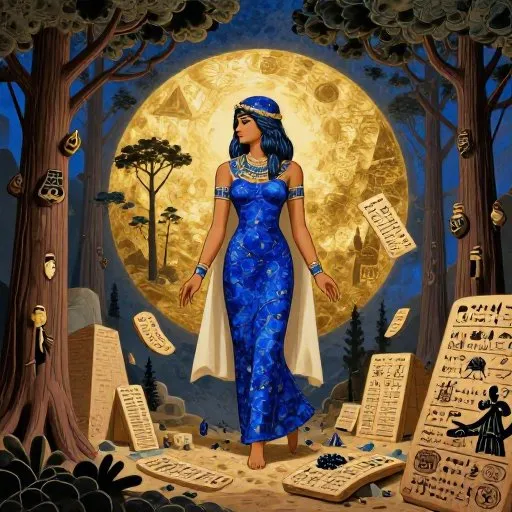
The trouble with coming back from the dead is what it costs.
The Anunnaki, the judges of the underworld, called out after Inanna as she walked toward the gates. Nobody, they said, ascends from the underworld for free. Send a substitute. If you want to go above, someone has to stay below.
The demons of the underworld, the galla, came with her. They were her escorts, which is to say they were her debt collectors. They walked beside her through the seven gates. At each gate, her items were returned to her. The crown. The beads. The rod. The robe. Everything back, one gate at a time. But the galla stayed beside her. When she reached the upper world, they would need someone.
They walked with her to Umma, where her servant Shara was. Shara saw Inanna and fell at her feet, weeping, in mourning clothes, in dust. The galla wanted to take Shara.
Inanna said no. Not him.
They walked to another city. The servant there had also been mourning. Inanna protected him too.
They walked to Uruk. To the great apple tree where Inanna's husband Dumuzi sat.
Dumuzi was not in mourning.
He was not in dust or ashes. He was not weeping or tearing his eyes. He was not wearing coarse garments and performing the expected gestures of a husband whose wife had gone to the land of the dead and not come back. He was sitting on his throne in his best clothes.
The text does not explain what he was thinking. It doesn't need to. Inanna looked at him, sitting there, comfortable, clean, dressed, fine. While she had been hanging on a hook.
She fastened the eye of death upon him. The same look Ereshkigal had fastened on her. She handed him to the galla.
She said: take him.
Dumuzi fled. He prayed. He was turned into a snake or a gazelle, depending on the version. He ran. He hid with his sister Geshtinanna, who offered to take his place for half the year. There are Sumerian tablets that describe his sister weeping while he is in the underworld. There are tablets of Inanna weeping. Even Ereshkigal wept. Everyone, eventually, wept for Dumuzi.
Except the text does not record Dumuzi weeping for Inanna. He had his chance. He sat on the throne instead.
He spent half of every year in the underworld. His sister spent the other half. The seasons began. The world turned. The grain grew when Dumuzi was above and died back when he descended. This is one of the oldest recorded explanations for why winter happens. Because a husband was too comfortable while his wife was dead, and she remembered.
The Descent of Inanna was written down around 1900 BCE. Probably older than that as a told story. It is one of the oldest recorded narratives on earth.
Scholars have been reading it for a century and a half and they still argue about what it means. The seasonal interpretation is there: Dumuzi in the underworld, the crops failing, his return bringing renewal. The ritual interpretation is there: Sumerian sacred marriage rites connected Inanna and Dumuzi in ways that shaped their city's fertility and prosperity. The feminist interpretation is very much there and has produced a significant body of scholarship. The grief interpretation, Inanna entering death to understand it from the inside, is compelling and difficult to disprove.
None of these readings cancel the others. That's actually the mark of a story that was worked on by serious people over a long time. It holds all of them.
What stays with you is the image of the seven gates.
Every gate taking something. Every gate making her less. And the rule at every gate that she could not argue with, could not charm, could not fight: the ways of the underworld are perfect. Do not question them. The most powerful goddess in the ancient world, stripped of every symbol of her power, one by one, with perfect patience, until she was nothing. And even then: hung on a hook.
The story does not suggest this was unfair. It suggests this was the price. The underworld takes everything from everyone eventually. Inanna just went early, and on purpose, and came back. Most people do not.
Most people just go through the gates and do not return.
There is a reason this story survived four thousand years. It is not because it is cheerful. It is because it is honest about what the dark is like, what it demands, what it takes from you piece by piece, and what it might be possible to recover if someone loves you enough to moan with you in the dark until you remember you're allowed to stop.
Inanna came back. She came back changed, harder, knowing something she hadn't known before. She was still the goddess of love and war. She was also, now, the goddess who had been on the hook. Those are not the same thing.
They could have been. They were supposed to be different parts of the portfolio. After the descent, they were the same.