← All Stories

The Hindu myth of Ganesha: how Parvati made a son from turmeric paste, Shiva cut off his head without asking, and why the replacement was an elephant. The full story.

How Ganesha Got His Head

Mythwink

How Ganesha Got His Head

Shiva came home to find a stranger guarding his door. One decision later, the stranger had an elephant's head.

1The Problem with Being Married to a God

Chapter 1: The Problem with Being Married to a God

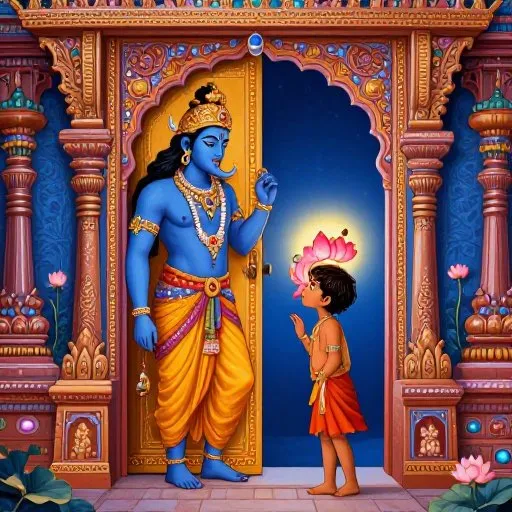
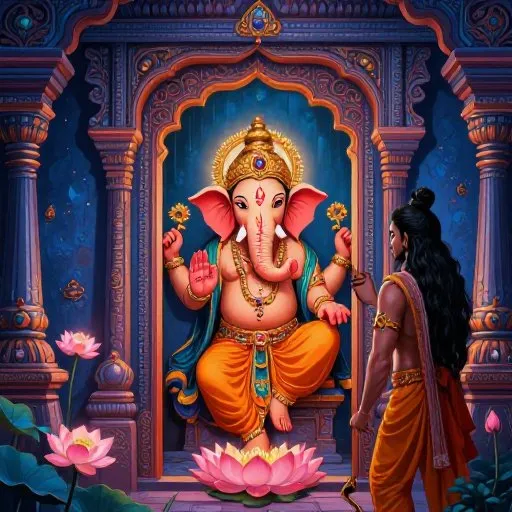
Parvati needed a door.

Not a physical door. She had plenty of those. She was the wife of Shiva, one of the three most important gods in the Hindu tradition, and they lived on Mount Kailash, which is a real mountain in the Himalayas at 22,000 feet and which the texts describe as simultaneously a mountain and a kind of cosmic center point. She had everything a goddess could want in material terms.

What she didn't have was privacy. When your husband is Shiva, one of the defining characteristics of the universe, and his attendants, the ganas, are wandering the mountain at all hours, and anyone who has a divine problem feels comfortable knocking, you begin to see why a woman might want someone standing at her door who would actually turn people away when asked.

Shiva's attendants would not turn people away from Parvati because they served Shiva. Not her. This distinction mattered. She wanted someone who served her. Someone whose loyalty was to her first.

The texts record different materials. The Shiva Purana says turmeric paste, which Parvati had been using to bathe herself. The Skanda Purana says clay from the Ganges. The Brahma Vaivarta Purana says she breathed life into him herself. Every major telling agrees on the essential point: she made him. Not born. Made. With her hands, from material she had on or near her body, shaped into the form of a boy and brought to life by her own power.

She held him and told him: you are my son. You belong to no one else. Stand at the door and let no one in while I bathe. No one. No exceptions.

The boy stood at the door.

His name was Ganesha. Though at this point in the story, he doesn't have that name yet. That comes later. That comes after the problem.

2Shiva Comes Home

Chapter 2: Shiva Comes Home

Shiva returned to Kailash to find a boy standing in front of his door.

Not one of his ganas. Not anyone he recognized. A child, apparently, though built with the kind of stillness that suggested he was not going to move regardless of who was asking. Shiva looked at the boy. The boy looked at Shiva. And the boy said: you cannot pass.

Think about this for a moment. A boy made of turmeric paste, hours old, standing in front of Shiva. Destroyer of worlds. The god of the cosmic dance of creation and dissolution, the god whose third eye burns everything it opens on, whose matted hair holds the Ganges river. One of the three supreme deities of the Hindu tradition, in some schools of thought the supreme deity, the one who everything else dances around.

You cannot pass.

Shiva told his attendants to move the child. The child did not move. He fought off every attendant Shiva sent because Parvati had made him well, had built into him exactly what she needed: the absolute unwillingness to yield on this single point. The ganas couldn't shift him.

Shiva dealt with the situation himself.

The texts are direct about what happened next. He cut off the boy's head. With his trident, or with his sword, depending on the version. He did not know who the boy was. He did not ask. A stranger was blocking his door and refusing to move and his attendants couldn't handle it, and Shiva, who is cosmic dissolution, handled it the way cosmic dissolution handles things.

The head fell.

Parvati came to the door.

3The Weight of What Just Happened

Chapter 3: The Weight of What Just Happened

Parvati looked at her son. Her son that she had made that morning, given life, given purpose, sent to do the one thing she needed done.

The accounts that deal with this moment don't soften it. Parvati's grief was not gentle. The Shiva Purana describes her as ready to destroy everything. Every world. Every god. All of creation. She had asked for one thing. Privacy. One morning. And her son, her first and only child, had been killed by her own husband who had not even thought to ask.

Shiva understood immediately that he had made a catastrophic error. The ganas who had failed to move the boy had perhaps given him a hint that this was not an ordinary situation. Parvati's reaction confirmed the rest. He looked at his wife and saw clearly, probably for the first time, that he was looking at someone fully capable of ending everything he had ever made if he didn't fix this.

He told her: I will fix this.

He sent his attendants out immediately. The instructions were: go north. Find any living creature sleeping with its head pointed north, and bring the head back. North was auspicious. An animal sleeping that way was an animal in a state of sacred ease. The details vary by text. Some say the first animal they found was an elephant. Some say it was specifically a single-tusked elephant, an elephant whose tusk had been broken, which connects to Ganesha's iconography of one full tusk and one broken one.

They found an elephant. They returned with the head.

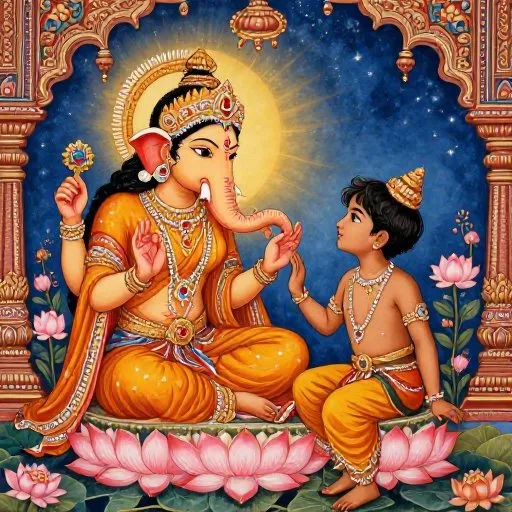
Shiva placed it on the boy. He breathed life back into him. The child who had been made of turmeric paste and a mother's intention was now alive again, healed, with the head of an elephant.

4The God of Beginnings

Chapter 4: The God of Beginnings

Here is what's interesting about what happened next.

Shiva could have treated this as an unfortunate incident that ended reasonably well. He didn't. He looked at his wife's son, his son by adoption at minimum and by acknowledgment in every practical sense, with his elephant head and his bright eyes and his absolute commitment to guarding whatever door he was placed in front of, and he declared something.

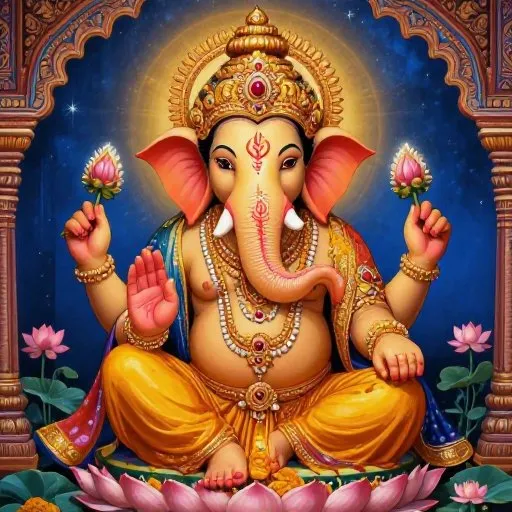
Ganesha would be worshipped first. Before any other deity. Before any undertaking, any journey, any ceremony, any prayer to any god, Ganesha gets addressed first. The remover of obstacles would be invoked before the obstacles are encountered. Before you plant, before you build, before you marry, before you travel, before you begin any business or any art, you call on Ganesha. All of existence lines up behind him.

This is not a small thing. In a tradition with hundreds of millions of deities, being the one everyone addresses first is a position of extraordinary centrality. Shiva gave his son this position. Whether it was an act of restitution, a recognition of the boy's nature, or both, the texts don't settle.

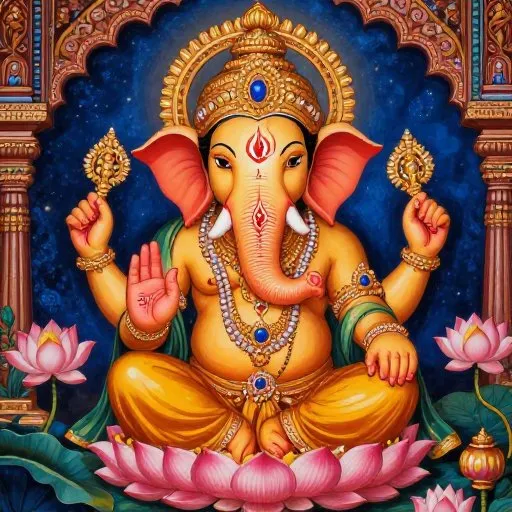
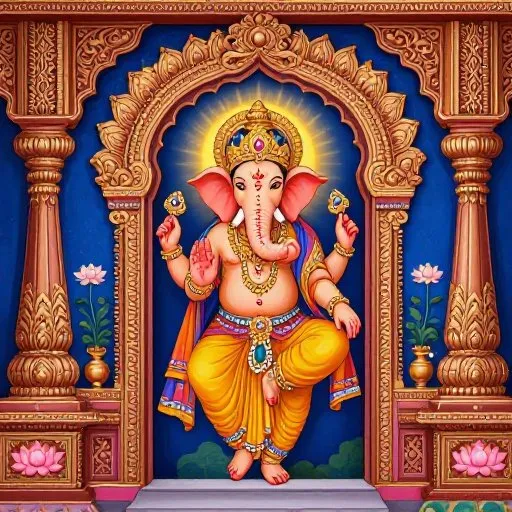
Ganesha's iconography is dense with meaning. The elephant head represents wisdom, because elephants remember everything and navigate with purpose. The large ears listen to all prayers. The small eyes focus on detail. The large belly accommodates all experience. His vehicle is a small mouse, which represents the ego: the largest, most powerful divine mind in existence rides on top of the smallest, most scurrying, most reactive impulse, and steers it.

One of his four hands holds a laddoo, a sweet. He is frequently eating one. The god of wisdom eats sweets and looks entirely comfortable doing so. This tells you something about what the tradition values. Knowledge is not grim. Insight does not require misery. The remover of obstacles enjoys himself.

5Why the Most Worshipped God in Hinduism Was Made of Turmeric Paste

Chapter 5: Why the Most Worshipped God in Hinduism Was Made of Turmeric Paste

Ganesha is now the most widely worshipped deity in Hinduism. Not universally agreed as the greatest power, because Hinduism is vast and complex and different schools hold different gods supreme. But in terms of daily invocation, in terms of how many people say his name in the morning before they begin their day, in terms of how many thresholds he guards, it's Ganesha.

He guards thresholds because he was made to guard one. His origin is his purpose. Parvati made him to stand at a door, and he has been standing at doors ever since. Doorways, beginnings, first days of work, the moment before you say the difficult thing, the morning of the new project. Every threshold you cross, in a tradition with a billion living practitioners, goes through him.

He has his broken tusk because of a story. The Mahabharata needed to be written down. Vyasa was dictating it. It needed to happen without stopping, because stopping would break the composition. Ganesha agreed to transcribe it but required that Vyasa never pause. One of his pens broke. He snapped off his own tusk and used it to keep writing. He did not stop. 200,000 lines. He kept going.

The Mahabharata exists. Ganesha has one full tusk.

Ganesh Chaturthi, the festival celebrating his birthday, is one of the largest festivals in the world. In Maharashtra alone, millions of clay Ganesha idols are made in the months before the festival, worshipped for one to ten days, and then immersed in the sea or a river. The clay returns to the water. The god returns to everywhere he came from. And next year, someone makes him again.

From clay. Or turmeric paste. Or whatever the hands can find.

The making is the point. Parvati understood that. She needed something, and she made it with her hands, and it became something bigger than she intended, as made things often do.
Mythology Notes