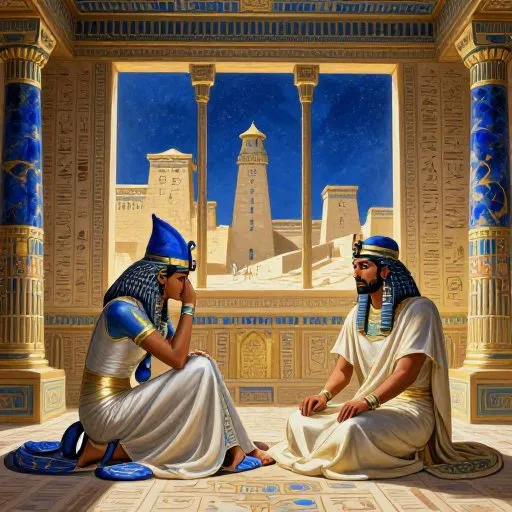
The Epic of Gilgamesh is 4,000 years old and it's about ego, grief, and the one friend who could beat you up. Mesopotamian myth, told properly.
Mythwink
The world's oldest story is about two men who were terrible for each other and completely inseparable.
Gilgamesh was two-thirds divine and one-third human, and it showed in all the wrong directions.
He was king of Uruk, one of the first great cities in human history. Uruk had walls. Massive walls, in fact, built from fired brick, stretching for nine kilometers around the city, still partially standing today after four thousand years. Gilgamesh built them. He built the temples. He built the whole city. He was genuinely extraordinary, and he knew it, which is where the trouble started.
Being two-thirds god meant he had strength, beauty, and energy that no ordinary man could match. Being one-third human meant he had appetites no god could fully contain. He was not cruel in the way tyrants are cruel because they don't care. He was cruel in the way that people with too much power and not enough opposition are cruel: thoughtlessly, confidently, without anyone in his life willing or able to say stop.
He worked his subjects to exhaustion on his building projects. He exercised a right no bridegroom of Uruk welcomed. The people of the city, ground down and terrified, did the only thing they could. They prayed. They went to the gods and said: please do something about our king.
The gods heard them. This was not uncommon. What was uncommon was what they decided to do about it.
They did not remove Gilgamesh. They did not curtail his power. They did not send a messenger with a list of grievances. They created a person who could physically fight him to a standstill. The gods of Mesopotamia looked at an out-of-control king and said: what this situation needs is an equal.
His name was Enkidu. And he arrived, as equals sometimes do, from completely outside the world Gilgamesh knew.
The goddess Aruru formed Enkidu from clay, the same material the Mesopotamians believed humans were originally made from. She pinched him off and threw him onto the steppe. He was covered in hair. He ran with animals. He ate grass. He pulled animals from hunters' traps and broke the traps apart because he didn't know what a trap was for. He had no language, no city, no concept of cooked food. He was everything Gilgamesh was not: wild, unkempt, uncurated, not remotely interested in being impressive.
Uruk's hunters brought reports to the palace. Something was out there, a man-shaped thing, and he was wrecking their livelihoods. Gilgamesh, who by most accounts was never bored by the prospect of conflict, sent someone out to find him.
He sent a woman named Shamhat. And her approach, whatever you think about the particulars, worked. Enkidu spent several days in her company and then followed her back toward the city. Toward fire. Toward bread. Toward a world he had never been part of.
On his way in, he learned to eat cooked food and drink beer. He drank seven jugs of beer, which the text records matter-of-factly, and felt his heart grow light and his face shine. He washed himself and put on a garment. He looked like a man.
He was ready, in other words, to meet Gilgamesh. Gilgamesh was not ready for him.
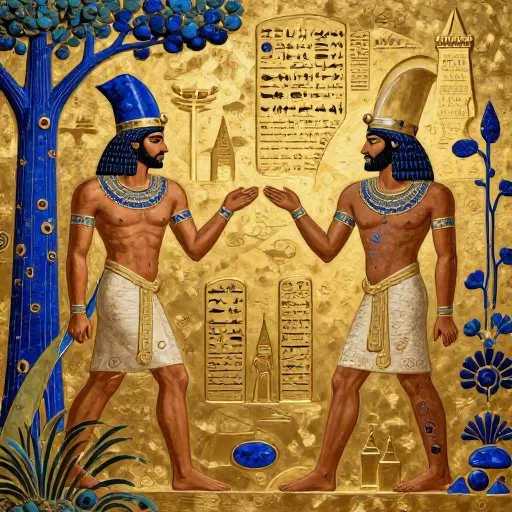
The city of Uruk had heard about Enkidu before he arrived. Word traveled fast in a walled city, and a wild man who wrestled hunters and drank seven jugs of beer in a single sitting was the kind of news that got around. By the time Enkidu walked through the gate, people had opinions.
Some people saw a savior. Someone who might finally be able to check Gilgamesh. Someone at least worth watching.
Gilgamesh had a dream. Two of them, actually. His mother, the goddess Ninsun, interpreted both: a man would come to Uruk, someone Gilgamesh would love like a wife, like a brother. Someone who would complete him.
Gilgamesh, being Gilgamesh, did not process this information the way most people would. He did not wait, or open his arms, or extend a welcome. He walked into the street and tried to go into a house he had no right entering. And Enkidu was standing there. Blocking the door. Two men who were two-thirds or fully extraordinary, each looking at the other, knowing.
They fought.
The tablet describes it with the controlled intensity of something the writer had watched in their mind a thousand times. They grappled in the street like young bulls. They shattered the doorpost. The walls shook. And eventually, after real struggle, Gilgamesh won. He threw Enkidu. Pinned him.
Then something unusual happened.
Gilgamesh released him.
Not to be merciful. Not strategically. He just let go. He stepped back. And Enkidu, on the ground, looked up at the king who had beaten him, and said: "There is not another like you in all the world."
That was it. That was the whole fight. The reason Enkidu was created, the intervention of the gods, the prayer of the people of Uruk, the entire divine plan: it ended with both of them on their feet, bruised, breathing hard, and completely and entirely friends.
This is how the oldest surviving work of literature begins its central relationship. Not with tenderness. Not with a shared meal. With two men nearly killing each other in a doorway until they had each convinced the other that the fight was worth it. Uruk watched from the sides of the street. The walls stood around them, thick and fired and very permanent.
Gilgamesh had found the thing his life was missing. He just had a broken door now as well.
Here is the problem with best friends when one of them is a restless, two-thirds-divine king with too much energy: they need a project.
Gilgamesh announced he wanted to go to the Cedar Forest.
This was not a camping trip. The Cedar Forest was in what is now Lebanon, impossibly far from Uruk by any standard of the ancient world. It was guarded by a monster called Humbaba, who the god Enlil had appointed specifically to terrify anyone who got close. Humbaba had a roar like a flood, a mouth that was fire, and breath that was death. Enlil had stationed him there to protect the cedar trees because cedar was sacred and rare and not for the likes of humans. Humbaba was not a problem that had arisen. He was the solution to a problem. Enlil wanted the forest left alone, and Humbaba was how that preference was enforced.
Gilgamesh wanted to go there anyway, cut down the trees, and kill the guardian. For glory.
Enkidu, who had lived on the steppe and knew what things like Humbaba were, told him this was a terrible idea. The elders of Uruk agreed. Everyone agreed. This was a unanimous community of informed opinion telling Gilgamesh that the Cedar Forest was not a reasonable destination.
Gilgamesh went anyway. Enkidu came with him because that was the other problem with this particular friendship: he couldn't let Gilgamesh go alone.
They made weapons. They walked the long road north and west. Enkidu knew the path from his time in the wild. The journey took, depending on the source, somewhere between several days and twenty days of hard travel, the kind of travel that required the sun god Shamash to give Gilgamesh dreams at night to keep his courage up. Real courage, it turns out, still needs maintenance.
They reached the Cedar Forest. Humbaba came out.
The battle was real and terrifying and the tablets are damaged enough that scholars are still arguing about exactly how it went. What is clear: Gilgamesh prevailed. Shamash helped, sending great winds against Humbaba from all eight directions. Humbaba was caught, pinned, begging. He offered Gilgamesh anything. He offered him timber rights. He offered him his service. He made a reasonable case for his own continued existence.
Enkidu told Gilgamesh to kill him before he could make any more reasonable cases.
They cut off Humbaba's head. They cut down the cedars. They built a great door from the timber and sent it downriver to the temples of Uruk. Enlil was furious. But Enlil was not, at that precise moment, standing in front of them.
Gilgamesh and Enkidu floated home on the river with the timber, victorious, and the world above them had absolutely no idea what they had just set in motion.
When Gilgamesh returned to Uruk, he cleaned himself up. He put on his finest clothes and his crown. And the goddess Ishtar saw him.
Ishtar was the goddess of love and war, which is either the most natural combination imaginable or a warning you should have taken seriously. She decided she wanted Gilgamesh. She asked him to marry her.
Gilgamesh said no.
He said more than no. He listed her previous partners, men and creatures she had loved and then discarded or destroyed. The gardener she had turned into a spider. The horse she had condemned to the bit and spur. The shepherd she had turned into a wolf. He called her a fire that goes out, a pitch that doesn't hold, sandals that hurt the feet. He asked, and I am not paraphrasing, what she had given any of her lovers except grief.
This was accurate. It was also unwise.
Ishtar went to her father Anu, the sky god, and demanded the Bull of Heaven. The Bull of Heaven was a divine animal so powerful that each snort opened a pit in the earth. Anu tried to warn her. He said if he sent the Bull of Heaven down, there would be seven years of famine. Ishtar said she'd already prepared for that. Send it anyway.
The Bull came down and opened pits in Uruk's streets and hundreds of men fell in. On its third snort it opened a pit under Enkidu. Enkidu grabbed it by the horns. He called to Gilgamesh. They killed it together. Gilgamesh's spear between the shoulders. Done.
Ishtar stood on the walls of Uruk and screamed. Enkidu tore off the Bull's thigh and threw it at her.
This was, by any standard, an escalation.
The gods met. Someone had to die. Humbaba: dead, the guardian of a sacred forest killed for sport and timber. The Bull of Heaven: dead, sent by a goddess, killed by two men who thought the consequences would keep not finding them. The gods decided: Enkidu.
He got sick. In the ancient way that people get sick when it isn't quite a disease. He lay in bed, fading. He dreamed of the underworld. He cursed the people who had brought him to civilization, then took the curses back. Shamash told him that Gilgamesh would honor him forever, would dress in mourning, would weep for him. That the city would grieve.
Enkidu died. The text doesn't flinch from it. He was there, and then he was not. Twelve days he lingered, and then he was gone.
Gilgamesh held the body. He would not let it go. He kept vigil over it until a maggot fell from the nose. That is what the tablet says. A maggot fell from the nose, and that was when Gilgamesh finally understood that Enkidu was not coming back.
He wept. He wept so hard and for so long that the descriptions of his grief become their own kind of monument. The man who had feared nothing, who had insulted a goddess, who had killed a forest guardian and the Bull of Heaven: he sat on the ground and wept for his friend until his throat hurt.
Then he got up and started looking for a way to cheat death. Not for Enkidu. It was too late for that. For himself.
Gilgamesh abandoned his city. He put on animal skins, which is worth noting: the king who had dismissed Enkidu's wildness, who had listed himself as superior to the untamed man of the steppe, dressed himself like the wild thing Enkidu had been. He walked out into the wilderness looking for Utnapishtim, the one man in all of history who had not died.
Utnapishtim had survived the great flood. The gods had granted him immortality afterward. He lived at the edge of the world, beyond the waters of death, in a place no living person could reach by any ordinary method. Gilgamesh reached it anyway. The sources describe the journey with the slightly dazed respect of someone writing about a thing that shouldn't have been possible. He crossed the scorpion-mountains. He crossed the Waters of Death, using a special pole that could not touch the water. He arrived.
And Utnapishtim looked at him. This king in animal skins, wrung out with grief and fear, and said: where are you rushing?
Gilgamesh told him. Enkidu died. I don't want to die. Tell me how you became immortal.
Utnapishtim told him about the flood. He told him the whole story. Then he looked at this exhausted, desperate king and told him the truth: the gods don't give immortality twice. It was a one-time thing. They were appalled by their own decision, if you want to know the truth. It will not happen again.
But there was one thing. A plant. It grew at the bottom of the sea. It wouldn't make him immortal, but it would make him young again. A second chance at the years he'd spent. Gilgamesh tied stones to his feet and dove to the bottom and brought the plant up with his hands, tearing them on its thorns.
He started back to Uruk. He was not going to eat the plant himself, he decided. He was going to bring it home and test it on the elders first. Share it around. He was becoming, for the first time, someone who thought about other people.
He stopped to bathe in a cool pool. He set the plant on the bank.
A snake smelled its fragrance and ate it. As the snake slipped back into the water it shed its skin, which is how the Mesopotamians explained why snakes can renew themselves and humans cannot. The plant was gone. Gilgamesh sat down on the bank and wept again. He had come so far. He had survived so much. And a snake ate the answer while he was washing his face.
He went home.
And here is where the story ends, and it ends in a way that has surprised people for four thousand years. Gilgamesh arrived back in Uruk. He looked up at the walls. His walls. The great fired-brick walls, nine kilometers, still standing. And the narrator of the tablet says to look at them. To see the brickwork. To walk the perimeter. To go inside and read the lapis lazuli tablet that Gilgamesh himself inscribed with the story of everything he had done.
That's the ending. The man who wanted to live forever comes home and finds the walls he built still standing. The city is still there. The story is still there. He is still there, in the telling.
The Epic of Gilgamesh understood something about mortality that most people spend their whole lives not wanting to admit: it ends. Everything ends. But the walls he built are still there in the ground in Iraq right now, four thousand years later. And we're still telling his story. That's not nothing. That might be everything.