← All Stories

The Korean founding myth of Dangun Wanggeom, the bear who became human, the god who came down from Mount Taebaek, and the kingdom that began in 2333 BCE.

Dangun and the Bear

Mythwink

Dangun and the Bear

A bear sat in a cave for one hundred days and became a woman. Her son founded Korea.

1A Son Comes Down from Heaven

Chapter 1: A Son Comes Down from Heaven

Hwanin was the Lord of Heaven. His son Hwanung wanted to come to earth.

More specifically, Hwanung looked down at the mountains and the rivers and the human world and wanted to be in it. Not to visit. To govern it. To be present in the world of people and trees and rain rather than the world of heaven, which, depending on the day, apparently had less to recommend it than a particular mountain in what is now the Korean peninsula.

Hwanin looked down at his son and saw that the desire was genuine. He gave Hwanung three sacred seals that conferred the authority to rule, and he sent him down to Mount Taebaek. If you've ever stood on Mount Taebaek, in what is now Gangwon Province in South Korea, and looked out over the ridge country, you understand why a heavenly being might choose it. The mountain has presence. It earns its place in the story.

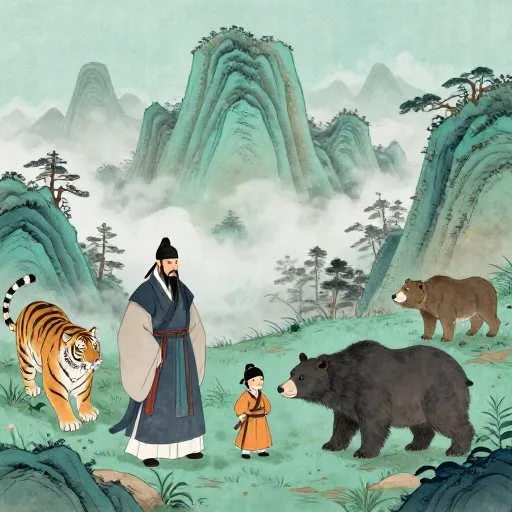
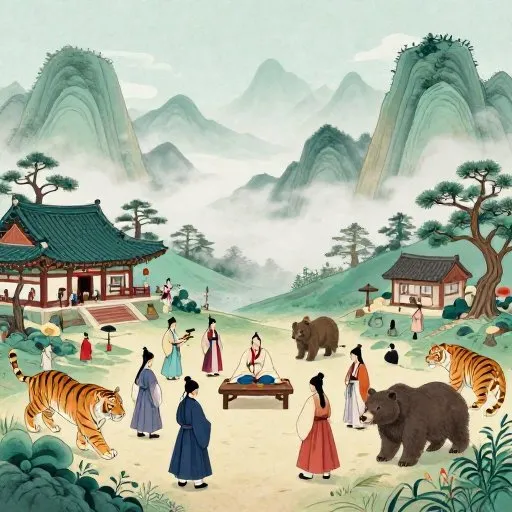
Hwanung descended under a sandalwood tree at the summit. He brought three thousand companions. Among them were the ministers of Wind, Rain, and Cloud, the forces that govern crops, food, disease, punishment, good and evil, and the full range of human affairs that need governing. He established a sacred city there. He called it Sinsi, the City of God. He taught agriculture. He taught medicine. He laid down laws.

This is the Samguk Yusa, the "Memorabilia of the Three Kingdoms," compiled by the Buddhist monk Iryeon in the thirteenth century CE. It's the primary source for the Dangun narrative. Iryeon was drawing on older records, some of which no longer exist. The story he preserved is the one that became the foundation of Korean national identity, the story told on October 3rd each year at Gaecheonjeol, National Foundation Day.

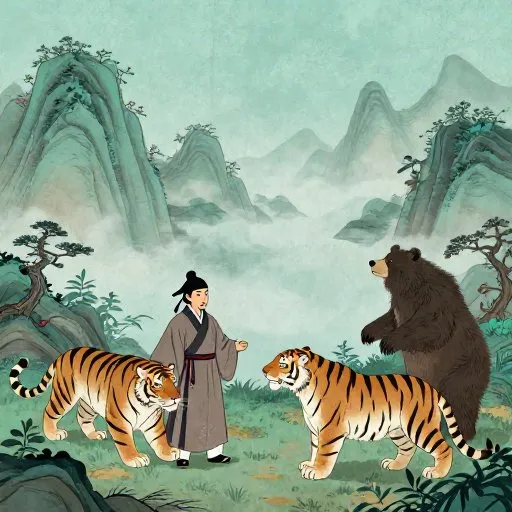
A bear and a tiger found out that a divine being was living on the mountain.

They went to ask him something.
2The Challenge

Chapter 2: The Challenge

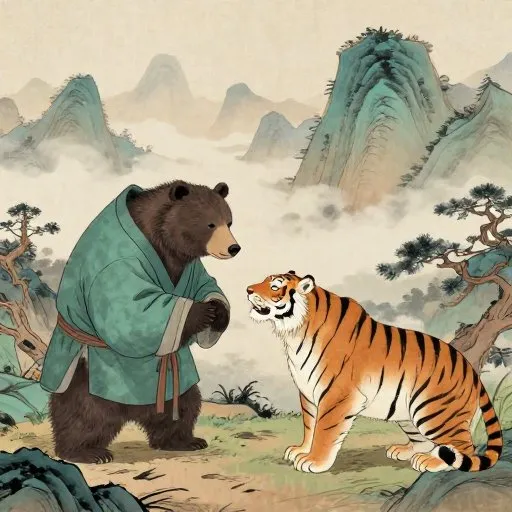
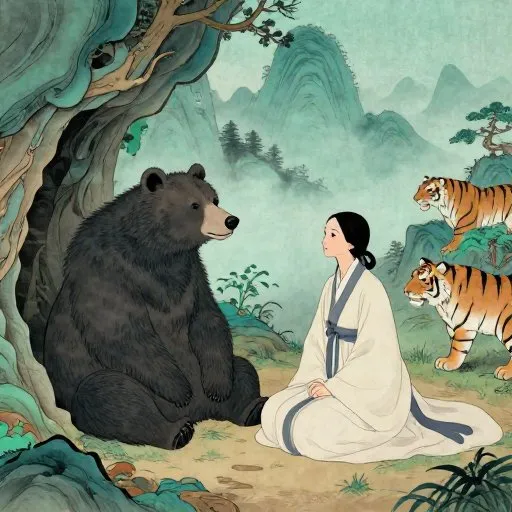
The bear and the tiger prayed to Hwanung. What they wanted was extraordinary. They wanted to become human.

Not human-like. Not to be treated as humans. To actually transform. To walk on two legs, to think as humans think, to become what humans are.

And Hwanung said yes. Sort of.

He gave them a bundle of mugwort and twenty cloves of garlic. He told them to eat only this for one hundred days. He told them to stay out of sunlight for that time. To remain in a cave. To do this together.

Now. If you want to think about what this actually asks of a bear and a tiger, consider the specifics. A bear in the wild eats approximately 20,000 calories a day preparing for hibernation. A tiger is an apex predator whose entire biology is built around hunting and meat. Asking either of these animals to survive on garlic and mugwort in a dark cave for one hundred days is not a mild request. It is a request designed to separate out whoever really means it from whoever thought they meant it.

The garlic and mugwort are not arbitrary either. Mugwort, Artemisia species, has been used in Korean medicine for thousands of years. It's still used today, in moxibustion, as a digestive aid, in cooking. Garlic is so central to Korean cuisine that modern Koreans consume more garlic per capita than virtually any other population on earth. These are not random ingredients Hwanung selected from a heavenly pantry. These are the foundational plants of Korean culinary and medicinal life, and the story puts them at the beginning of everything.

The bear and the tiger went into the cave together.

3The Tiger Leaves

Chapter 3: The Tiger Leaves

Three weeks.

That's approximately how long the tiger lasted. Different versions give different timelines. What they agree on is that the tiger could not do it. Could not stay in the dark. Could not exist on garlic and mugwort. Could not hold the shape of its desire against the pressure of its nature.

The tiger left the cave.

Think about what that means in the story. The tiger is not a villain. The tiger is not punished. The tiger simply couldn't do the thing that was required, and so the tiger remained a tiger. There is no cruelty in it. There is only the reality that some transformations require something that not everything has. The tiger had the desire. It didn't have the endurance.

The bear stayed.

Day after day in the dark. Garlic and mugwort. The sound of the mountain outside. The light that was not permitted. The hunger that must have been enormous and constant. One hundred days is not a short time to hold yourself in a state of becoming, in a state of intention so focused that you forgo everything your body knows in favor of something it has never been.

On the twenty-first day, according to the Samguk Yusa, the bear became a woman.

Not after one hundred days. Twenty-one. This is the detail that surprises people. The full hundred days was the offer. Twenty-one days was what it actually took. As if the transformation wasn't waiting for a fixed deadline but for a threshold of sincerity, a moment when the commitment had been demonstrated beyond what doubt could measure.

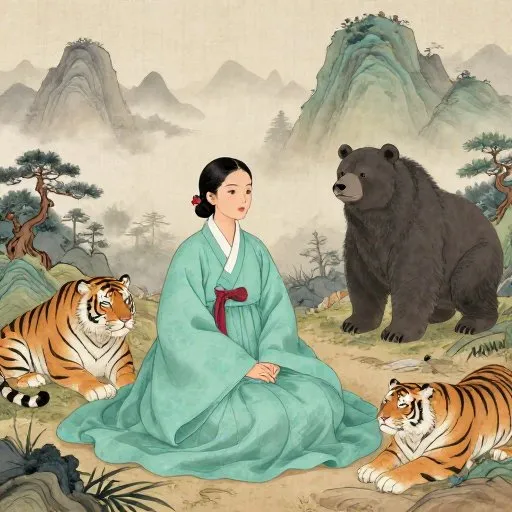
The bear became a woman. She was called Ungnyeo. Bear Woman.

4The Woman Who Wanted More

Chapter 4: The Woman Who Wanted More

Ungnyeo sat in the transformed state and found that she had a new desire.

She wanted a child.

She prayed under the sandalwood tree, the same tree where Hwanung had first descended. She prayed for a child.

Hwanung heard her.

The accounts vary here in ways that are worth acknowledging. In some versions Hwanung temporarily takes human form to be with Ungnyeo. In some the union is handled more briefly and less specifically. The Samguk Yusa is not always detailed about these transitions. What is clear in all versions is that Ungnyeo became pregnant, and what she carried was going to matter.

Her son was born.

His name was Dangun Wanggeom. The first syllable, Dan, relates to sandalwood or birch, the tree under which so much of this story has happened. Wanggeom means ruler, or king. Dangun Wanggeom: the king of the sandalwood.

He founded a kingdom. He called it Gojoseon, Old Joseon, sometimes translated as Land of the Morning Calm, a name that later dynasties would also claim as their own. The traditional date of founding, drawn from the Samguk Yusa, is 2333 BCE. This is the date celebrated on Gaecheonjeol every October 3rd. Whether it is literally historical, whether a historical Dangun existed who corresponds to the mythological figure, is a question historians approach with appropriate caution. What is not in question is that this story has been central to Korean identity for at least a thousand years and continues to be.

Dangun ruled for fifteen hundred years. Eventually, in some versions, he became a mountain spirit.

You can make of that what you will.

5The Garlic Is Still There

Chapter 5: The Garlic Is Still There

Gaecheonjeol, the opening of heaven, is a public holiday in South Korea. Schools are closed. Ceremonies are held. The date, October 3rd, corresponds to the traditional founding of Gojoseon by Dangun in 2333 BCE. The holiday was established during the period of Japanese colonial rule, partly as an act of cultural resistance, a way of insisting on Korean identity and continuity at a moment when that identity was under direct attack.

That history matters. The Dangun myth is not a casual piece of folklore. It is a story that Koreans reached for when they needed to remember who they were. A story that says: we come from a divine father and a bear who loved something so much she sat in a cave eating garlic and mugwort in the dark until she was transformed. We come from that. We come from that kind of patience, that kind of desire, that kind of willingness to remain inside the difficulty for as long as it takes.

The tiger had the desire but left. The tiger is still a tiger. Nothing wrong with that. But the bear's name is in the story.

North Korea's national foundation myth also centers on Dangun. He is claimed on both sides of the demilitarized zone as the common ancestor of the Korean people. His mythology has been deployed for political purposes by various regimes and movements across Korean history. A creation narrative with that kind of staying power is not just a story. It's a load-bearing structure.

And there's the garlic. Twenty cloves. In a cave. For twenty-one days, or one hundred, depending on which telling. Either way, at the center of the founding myth of Korea, at the moment when a bear becomes a woman and a woman becomes the mother of a nation, the ingredient is garlic.

Go to any Korean kitchen. Find the garlic. There it is, right where the story put it, at the beginning of everything.

Mythology Notes