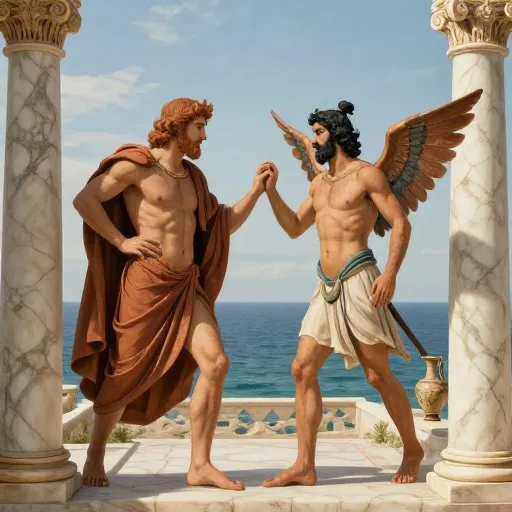
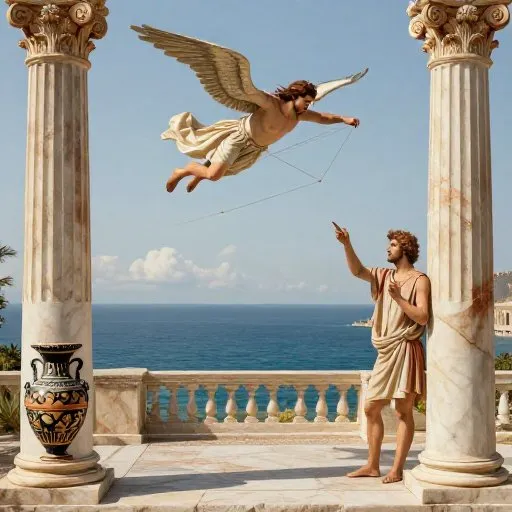
The Greek myth of Daedalus and Icarus. He warned his son about flying too high. His son didn't listen. The full story, told properly.
Mythwink
The greatest inventor in the world built his son a pair of wings. He only asked one thing.
Daedalus could build anything.
That is not a boast. That is a record. He was an Athenian craftsman, and the Greeks, who did not give credit carelessly, credited him with inventing the axe, the saw, the drill, the plumb line, and the mast with sails. He built statues so lifelike they were said to move on their own, so realistic that people chained them down at night so they wouldn't wander off. The Greek word for any skillfully made figure, daidalos, came from his name. He was not a craftsman who was famous. He was so famous that craftsmanship was named after him.
He had a nephew named Perdix, the son of his sister. When Perdix was about twelve, Daedalus started teaching him. The boy was immediately extraordinary. He picked up everything in days that had taken Daedalus years to learn. He watched a fish spine and invented the saw. He watched a compass describe a circle and invented the compass for architecture. The sources don't agree on all the details, but they agree on this: the child was going to surpass his teacher, and Daedalus knew it.
So Daedalus threw him off the Acropolis.
The boy would have died but Athena, who protects inventors and craftspeople, caught him and turned him into a bird. A partridge. If you are wondering whether the Greeks found it darkly appropriate that the man who would later lose a son to the sky first tried to throw a child out of it, you are reading the myth correctly. They put this detail in for a reason.
Daedalus fled to Crete. King Minos received him, because you don't turn away the greatest craftsman in the world. You put him to work.
The work came. Poseidon's white bull had already become a problem. Minos's wife Pasiphae had already developed her obsession. Minos came to Daedalus and Daedalus built the wooden cow and Daedalus did not ask questions about why the queen of Crete needed a hollow wooden cow lined with authentic hide. He built what he was asked to build. He was a craftsman. That was his life.
Nine months after the wooden cow, the Minotaur was born. And Minos came back to Daedalus and said: build me somewhere to put this.
So Daedalus built the Labyrinth. The structure that even its architect could only barely navigate. He designed the confusion directly into the walls. He made a machine for getting lost and he made it work and he handed it over.
Every piece of the problem that Minos had, Daedalus had solved. And every solution created a new problem. And eventually, Minos looked at everything Daedalus knew and arrived at a conclusion.
Daedalus knew too much. He could not be allowed to leave.
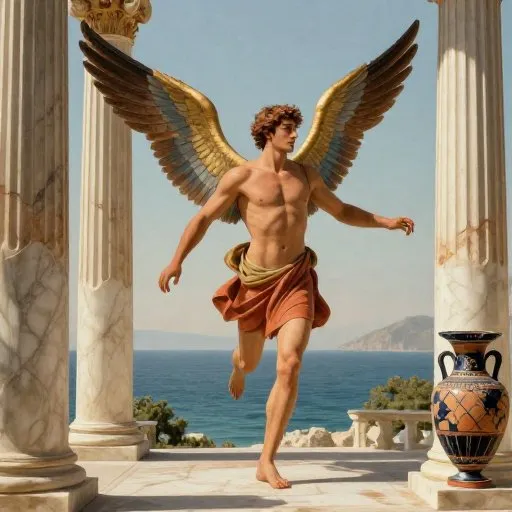
Minos imprisoned them both. Daedalus and his son Icarus, locked in a tower or in the Labyrinth itself, depending on the source. The method varied. The outcome was the same: the greatest craftsman in the world was in a cage and the cage was an island.
Think about what Minos was trying to prevent. The Labyrinth was a secret. Literally its only function depended on nobody knowing how to navigate it. If Daedalus left and someone asked him about the Labyrinth's layout, he would tell them. He had built it. He knew every turn. The Minotaur's prison only worked if the people sent into it were genuinely lost. Minos had built the most sophisticated trap in the ancient world and the trap's weakness was the man who had designed it.
Minos controlled the sea. His fleet was the largest in the region. He controlled the ports, the shipping lanes, the boats. You could not leave Crete without his permission, and he had specifically rescinded the permission of his most valuable prisoner.
But Minos controlled the sea and the land. Not the sky.
Daedalus was in a cell with time and materials and a mind that had invented the saw from watching a fish spine. He looked at the birds. The birds came to his window, or came near him wherever he was kept, and he watched them. He collected feathers. Small ones from the floor, larger ones from wherever he could reach. He had wax. He had thread.
He built two pairs of wings.
Ovid, in the Metamorphoses, describes the construction in detail. The smallest feathers in the center, the largest at the edges. Bound at the middle with thread, fixed at the base with wax. He shaped them to curve like bird wings, not flat like paddles. He tested the lift. He made adjustments. He made two pairs because there was himself, and there was Icarus. They were leaving together.
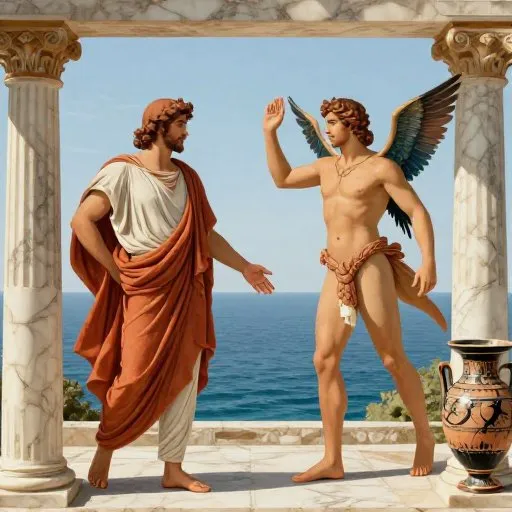
Then he called his son over and he explained the physics.
Icarus was a boy. The sources don't give him an age, but he is always young in every version, young enough that his father had to explain things to him, young enough that explaining them was not enough.
Daedalus laid it out simply. Two dangers. Two rules.
First: not too low. If they flew close to the sea, the spray would wet the feathers. Wet feathers lost lift. They would fall into the water and drown.
Second: not too high. If they flew close to the sun, the wax would soften. Soft wax lost its grip. The feathers would separate from each other and the wing would come apart. They would fall from the sky and die.
The correct altitude was the middle. High enough to clear the sea's moisture, low enough to stay in cooler air where the wax held. Fly straight. Follow behind him. Don't deviate.
He said this. He said it clearly. Ovid gives him a speech and the speech is a father's speech, practical and frightened at the same time, the kind of thing you say to a child when the stakes are real and you need them to understand what real means.
While he was explaining, Icarus was playing with the feathers. Picking them up. Pressing his thumb into the wax. Testing the flex of the wing frame. The way children do with things that are not yet understood as tools, not yet understood as serious.
Daedalus noticed. He kept talking.
There is something in this moment that the myth gives you and then moves past. A man who had built things his entire life, who had built things with devastating consequences, who had thrown a child off a cliff because the child threatened his position, had built something for the first time that was purely about love. No king had commissioned these wings. No catastrophe required them. He had spent his imprisonment building a way for his son to be free, and now he was watching his son press his thumb into the wax of the wing that was supposed to save his life, and he said: follow the middle path. Don't fly too high.
He fastened the wings to the boy's shoulders. He checked the fit. He checked it again. Then he put on his own wings, and they launched from the tower, or from the cliff, or from the edge of the prison, and they flew.
They were over the Aegean.
Below them: the island of Samos to the left, Delos, Lebynthos, Calymne. Real islands. The geography in Ovid is specific. The shepherds on the rocks below looked up and saw them. The fishermen in the boats looked up. A plowman in a field stopped and watched. Two men flying over the Aegean Sea on feathered wings. The shepherds thought they were gods. In that moment, with that sight, it was not an unreasonable conclusion.
Daedalus was ahead. He was flying the middle altitude. He had told Icarus to follow behind him, to match his height, to stay in the corridor of safety between the sea and the sun. He was setting the example and watching for the islands he was navigating toward. He could not watch his son and navigate at the same time.
Icarus went up.
Not all at once. Not a single dramatic plunge skyward. It starts gradually in every version. The exhilaration of the thing. You are a boy who has spent however long in a prison on an island, and now you are in the open sky, and the sky is vast and cold and completely unlike anything a person has ever experienced, and the wings are working, and the wind is there, and above you the sky gets darker blue and you are rising and it is magnificent.
The wax warmed.
Daedalus turned and Icarus was not behind him. He looked up.
The feathers were separating. They fell first, scattered into the air above him, small dark shapes floating downward. Then Icarus. He was calling out. His father's name. Some versions say that. He called and Daedalus heard him and could do nothing. The wings were already gone. The boy was falling.
The Aegean received him. Daedalus circled. He found the body. He brought it to the nearest shore, an island that still carries Icarus's name. Icaria. It is a real island. You can find it on a map between Samos and Mykonos. It has been called that since before history began writing down the names of things, which means the story is older than the documents.
He buried his son on the shore of that island.
Daedalus flew on to Sicily.
This is the part that doesn't get told very often, and it should. He didn't stop. He couldn't stop. He had wings and his son was dead and staying at the beach would not change either of those facts. He flew to Sicily, to the court of King Cocalus, who welcomed him and put him back to work because that is what kings did with Daedalus.
He built a steam bath. He built a reservoir. He built a honeycomb of pure gold for the goddess Aphrodite's temple. The list of things he made in Sicily is shorter than the Athenian list, and the things on it are smaller. A steam bath. A reservoir. Functional things. Useful things. Nothing that moved under its own power. Nothing lifelike. Nothing that anyone would chain down for fear it would walk away.
Minos tracked him down, because Minos tracked everyone down and because the riddle of the spiral shell gave Daedalus away. Minos had been traveling the Mediterranean with a spiral shell and a challenge: if anyone could thread the shell, he would know Daedalus was nearby, because only Daedalus could figure out how. Cocalus brought the puzzle to Daedalus. Daedalus tied a thread to an ant and drove the ant through with a hole at the tip of the shell and honey. The shell came back threaded. Minos knew.
He demanded Daedalus back. Cocalus agreed to hand him over, or appeared to. The night before the transfer, Cocalus's daughters killed Minos. The method in most versions is scalding water pumped through the pipes of Minos's bath. The bath Daedalus had built. The daughters had hidden Daedalus and did not want to lose him.
Daedalus survived Crete. He survived Minos. He survived his own most catastrophic invention, the Labyrinth that ate children in the dark. He survived throwing a child off the Acropolis. He survived building the thing that led to the Minotaur's existence and the thing that allowed the tribute to be paid.
He did not build anything joyful again.
That is not in the ancient texts. The texts don't say this. But the list of things he made after Icarus is shorter and quieter and made for kings who needed practical solutions. A steam bath. A reservoir. Things that worked without aspiration. The man who had built moving statues and a hollow cow and a maze that unmapped itself built a steam bath. Maybe the joy went with the feathers, scattered over the Aegean, floating down to the surface of a sea that was already named for someone else's grief.
The wings that killed Icarus were the only thing Daedalus ever made for love. He didn't make that kind of thing again.