← All Stories

The Irish myth of Cu Chulainn: a boy who killed a massive guard dog at age seven, renamed himself after it, and went on to be Ireland's greatest warrior. The full story.

Cu Chulainn and the Hound

Mythwink

Cu Chulainn and the Hound

He killed the guard dog with his bare hands. Then he offered to be the guard dog. That's basically the whole story.

1The Boy at the Gate

Chapter 1: The Boy at the Gate

His name was Setanta. He was seven years old. And he walked to Culann the smith's fortress alone, at night, because he had been invited to a feast and got delayed playing hurling and decided this was fine.

You should know a few things about Culann before we continue. He was the greatest smith in Ireland. Not a figure of speech. The greatest. He made weapons for kings. He made weapons for heroes. He made the kind of objects that end up with names. And like any man who makes things powerful people want, he had a guard dog.

The Irish sources are careful about this dog. The Book of the Dun Cow, compiled in the twelfth century from much older oral traditions, says it took three chains to hold it. Three men to each chain. That's nine men to control one dog. They let it loose at night. Nothing got past it.

Setanta came through the gates at night.

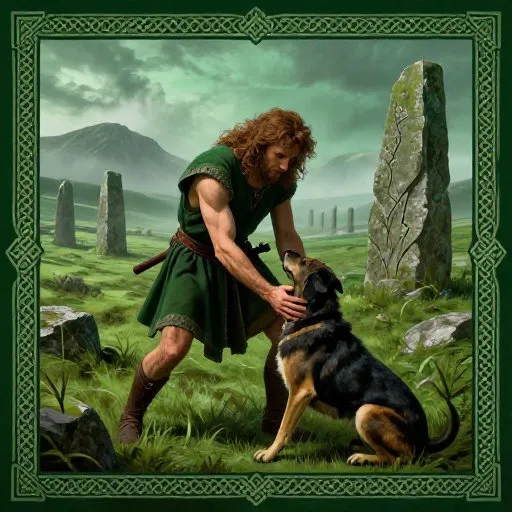
He had a hurling ball and a stick, because he'd been playing. The dog came at him. And Setanta, who was seven, threw the hurling ball so hard down the dog's throat that it killed the animal instantly. Then, because the ball had gone in, he grabbed the dog by the legs and beat it against a stone until it was dead.

Think about that. He was seven. He had a ball and a stick. A dog that nine grown men could barely restrain came running at him in the dark, and his response was to throw a ball into its face and then use the corpse as a weapon.

Culann found him standing over the body. He wasn't angry exactly. He was just ruined. That dog was the only thing standing between his entire household and whatever came out of the dark at night. And now it was gone, because a child had a game to get to.

Setanta looked at the dead dog. He looked at Culann. He said: I will be your hound until a new dog is raised and trained.

From that moment, he was Cu Chulainn. Culann's Hound.

2The Woman Who Taught Everything

Chapter 2: The Woman Who Taught Everything

The druids looked at Cu Chulainn when he was young and saw something alarming. Not his strength. That was obvious. What alarmed them was what they saw in his future. A life that burned hot and short and left nothing behind but the fire.

He was going to be the greatest warrior Ireland had ever produced. He was also going to die young. The prophecy on this was apparently quite specific. Whether he died young or lived long, he had to choose. He chose glory. He chose it without hesitation, which should tell you something about who he was.

His training happened in Scotland, because that's where you went if you wanted to learn real fighting. Specifically, he went to Scathach. Her name means "The Shadowy One." She ran a warrior school on the Isle of Skye. She was the best. She did not take students who hadn't already demonstrated they were worth her time. Cu Chulainn got to her school by crossing the Plain of Ill Luck, which had ground that turned into a swamp under anyone who didn't know the trick, and the Bridge of the Cliff, which flipped over when you were halfway across and threw you off the edge.

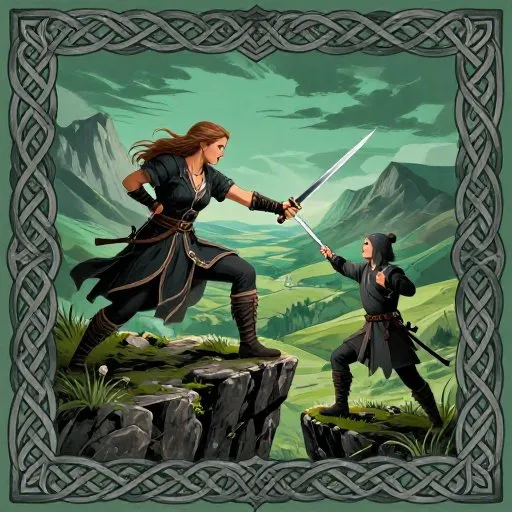
He got across. He pressed the point of his sword against Scathach's heart and demanded to be trained. She agreed. This was, in the logic of warrior schools, the correct thing to do. You don't argue with a man who got over the bridge.

Scathach taught him everything. Combat forms. Battle strategy. The gae bolga, a spear that entered as one point and opened into barbs inside the body, leaving no way to remove it that wasn't worse than the wound. She taught him how to fight on water, in darkness, against opponents twice his size. She taught him the things you can't survive without knowing.

She also warned him about the riastrad.

The warp spasm. The battle frenzy. The thing that came over him when he fought and turned him into something that wasn't entirely a person anymore. The Irish sources describe it in detail that reads like someone trying hard to be accurate. His body rotated inside his skin. One eye sank into his skull, the other bulged out. His hair stood straight up and the tips glowed. His heart beat so loud his enemies could hear it.

He could not control it. He could barely aim it. When it came, everyone in range was a target. Friend and enemy and anyone who happened to be standing nearby.

Scathach trained him to use it anyway. Because a weapon you can't control is still a weapon, if you're careful about where you point it before it fires.

3What the Curse Looked Like

Chapter 3: What the Curse Looked Like

The Tain Bo Cuailnge. The Cattle Raid of Cooley. The longest and oldest Irish epic, and the story that proves the prophecy right on every count.

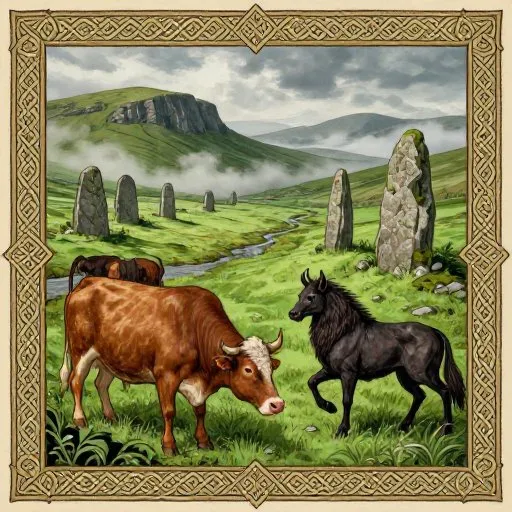
Queen Medb of Connacht wanted a bull. Specifically, the Donn Cuailnge, the Brown Bull of Ulster. This was not a metaphor. She wanted the actual bull. She and her husband had been comparing their wealth and she was one bull short, and she could not live with that, so she gathered an army of every warrior in Ireland and marched on Ulster.

Here's the problem. Ulster had a curse.

The warrior Macha had been forced to race horses while pregnant, which is exactly as grim as it sounds. She won. She cursed the men of Ulster with it: when Ulster needed them most, they would be struck by labor pains and be unable to fight. Every warrior in the province, incapacitated, for days or weeks at a stretch. Medb knew this. The timing of her raid was not an accident.

The curse didn't work on Cu Chulainn. Nobody is entirely sure why. He was young enough that it didn't take hold. Or the curse had an exemption for men who were part divine, since his father was Lugh, one of the Tuatha De Danann. The sources don't agree. What they agree on is this: when the armies of Connacht crossed into Ulster and every warrior in the province collapsed, Cu Chulainn was the only one standing.

One man. Against every army Medb could find.

He fought them using single combat, a custom that said the champion of one side fights the champion of the other instead of the whole armies clashing. Medb accepted the terms and sent her best fighters at him one by one. He killed them. She sent better fighters. He killed those too. He held the ford of a river and killed the best warriors of Ireland in sequence, day after day, while Ulster recovered.

He was not undamaged. He was wounded constantly. He fought injured, exhausted, with whatever he had. The Lugh sent healing to him at night, because a father can do that if he's a god. He survived on that edge for the entire campaign.

The riastrad came in the middle of it. More than once. When it did, Medb's armies stopped advancing. They had seen it before. They had heard about it. Seeing it in person was something else.
4Ferdia

Chapter 4: Ferdia

Here is where the story turns.

Among the warriors Medb sent against him was Ferdia mac Daman. Cu Chulainn's closest friend. His foster brother. They had trained together under Scathach. They had learned the same things from the same teacher. Every technique Cu Chulainn knew, Ferdia knew. Every trick, every weakness. They knew each other the way you can only know someone you've fought beside and against for years.

Medb didn't have enough gold to buy Ferdia's loyalty. She used something better. Shame. She had poets begin composing satires about his cowardice, the one thing an Irish warrior could not survive. If Ferdia didn't fight Cu Chulainn, the songs would start. He would be the man who refused. He went to the ford.

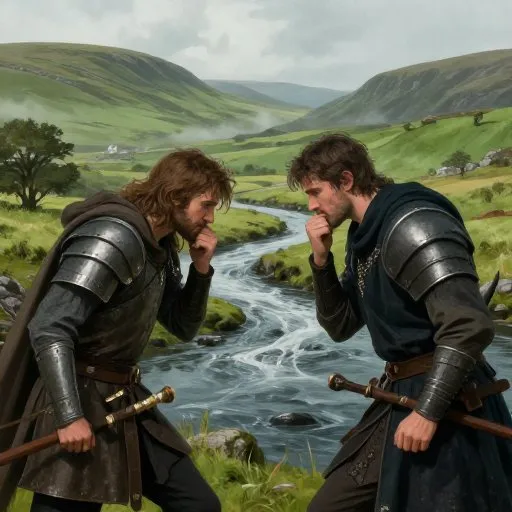
Three days they fought. Three days on the same stretch of water, one trying to kill the other. They were so evenly matched that the fights ran from morning until dark with neither gaining enough advantage. At the end of each day they stopped. The sources say they shared food. They sent medicine to each other's wounds through their charioteers. They called each other by name. They had not stopped being what they were to each other. They were just also trying to kill each other, because that was what the situation required.

On the fourth day Cu Chulainn used the gae bolga. The weapon Scathach had taught him. The one with no good answer.

He killed Ferdia. He held him while he died.

The lament in the Tain is one of the oldest pieces of Irish poetry still intact. It is not heroic. It does not celebrate the victory. It is just grief. Cu Chulainn holding his dead friend and saying, over and over, that everything since Ferdia died is just noise. The whole war. All of it. Noise.

He won. Ulster's warriors recovered from the curse and finished the fight. The Brown Bull went back. The raid was defeated. Cu Chulainn was the hero of the whole province.

He sat down next to Ferdia and wept, and that is in the text, exactly like that.

5The Pillar Stone

Chapter 5: The Pillar Stone

He died on his feet.

The end came through a series of geasa, sacred prohibitions that governed his life. A geis was a magical prohibition: eat this, never eat that, do this before battle, never do the other thing. Cu Chulainn had accumulated several, and they were carefully constructed to contradict each other. His enemies engineered situations where following one geis meant breaking another. He didn't dodge the trap because he couldn't. Breaking a geis was worse than death for a man of his honor. So he broke them, one by one, and felt his strength leave him with each one.

His enemies wounded him. His horse wept, the sources say, because horses knew. He was dying and he knew it.

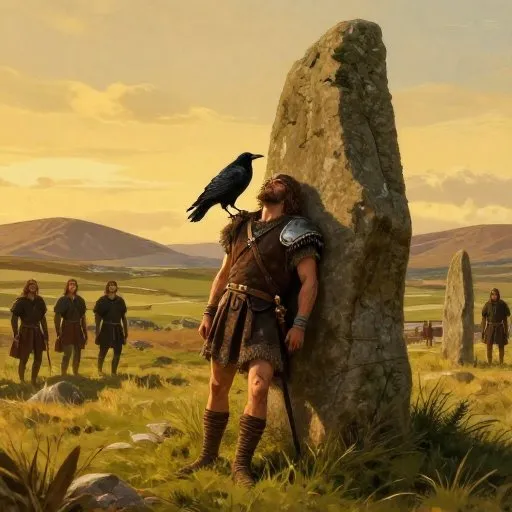
He found a pillar stone by a lake. He used his belt to tie himself to it so that he would die standing rather than lying down. His enemies were close. They had beaten him. They knew it. But nobody wanted to be the first to approach. The reputation alone kept them at distance.

Then a raven landed on his shoulder.

Ravens in Irish mythology are associated with the Morrigan, the goddess who had followed Cu Chulainn his entire life. She had tried to seduce him. He had refused her. She had tried to warn him and protect him. He had ignored her. She had watched him fight and kill and love and mourn for his entire life. And at the end she came, or sent her bird, and stood on his shoulder and said nothing.

When the raven landed, the enemies knew. They came forward. Cu Chulainn, tied to a pillar stone and dead, was still facing them.

He was seventeen years old. Some sources say twenty-seven. The lifespan doesn't matter. What matters is he chose it. A druid offered him long life or a life that burned, and he looked at the choices and picked the one that hurt, because he thought the other kind wasn't worth having.

The Tain Bo Cuailnge is the great Irish epic. Cu Chulainn is its center. And the center is not a triumphant hero. It's a man who chose to be consumed by what he was, and was, and did not flinch from any of it.

Ireland has been telling this story for over two thousand years. They keep telling it because they haven't figured out yet whether he was right.

Mythology Notes