The Shoshone and Paiute tale of how Coyote stole fire: a trickster, an animal relay, a frog, and why fire still hides inside wood.
Mythwink
Coyote Steals Fire
He couldn't do it alone. Neither could the animals. That's the whole point.
The Shoshone and Paiute tale of how Coyote stole fire: a trickster, an animal relay, a frog, and why fire still hides inside wood.
Mythwink
He couldn't do it alone. Neither could the animals. That's the whole point.
This is the Shoshone and Paiute story of how Coyote stole fire, and here is how Coyote steals fire in one line before the chase begins: Coyote takes fire from the Fire Beings on their mountain, and a relay of animals carries the burning brand hand to hand down the slope, staying just ahead of the pursuit until Frog hides the fire inside wood, where it lives to this day.
Now let's be clear about the situation. The world existed. People were in it. And they were cold.
Not a little cold. Genuinely, teeth-chattering, dying-every-winter cold. No fire. Raw meat. Sleeping in animal skins that didn't help much when the wind came down from the mountains. The people had everything except the one thing that separated surviving from not surviving. And the reason they didn't have it was that somebody else had all of it and was keeping it that way on purpose.
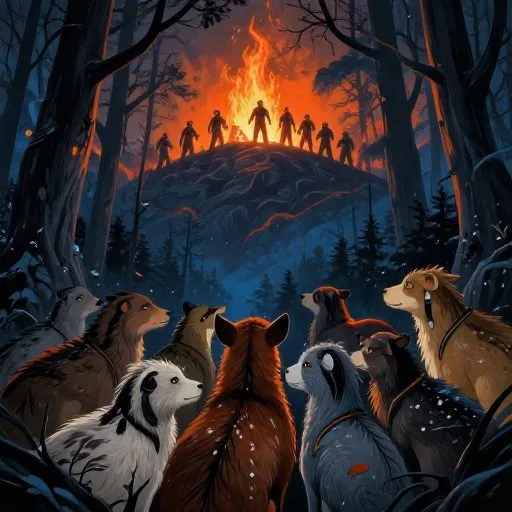
The Fire Beings lived on a mountain. Different Shoshone and Paiute tellers place the mountain differently. Some stories set it above the dry basin country east of the Sierra Nevada, others somewhere in the high desert. The geography shifts. What doesn't shift is the Fire Beings themselves. They had fire, they knew the people needed it, and they kept it anyway. Piled it up on their mountaintop and guarded it.
You can read that as simple greed. But there's something older in it. Fire is power in the most literal sense. Warmth, light, cooked food, protection from animals, the ability to harden a spear point. Whoever controls fire controls the difference between life and death for everyone who doesn't have it. The Fire Beings understood exactly what they were sitting on.
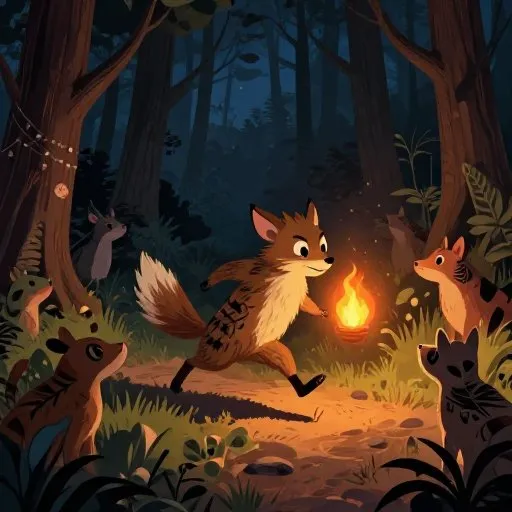
And Coyote had been watching.
Coyote is not a hero. Get that out of your head right now. He is not brave, not noble, not especially concerned about the welfare of others except when it happens to line up with something he wants. He is the trickster. He is the one who causes problems and also solves them, sometimes the same problem, sometimes on the same afternoon. The Shoshone and Paiute peoples, along with dozens of other nations across the West, have been telling stories about Coyote for thousands of years. He does good things for bad reasons. He does bad things that turn out well. He is the chaos principle with legs and a tail and an interest in getting his own way.
He looked at the Fire Beings hoarding warmth while people shivered, and he decided to do something about it. Not because he was noble. Because the situation was interesting. Because he thought he could. Because Coyote, above all else, cannot resist a problem that looks impossible.
He called a meeting.
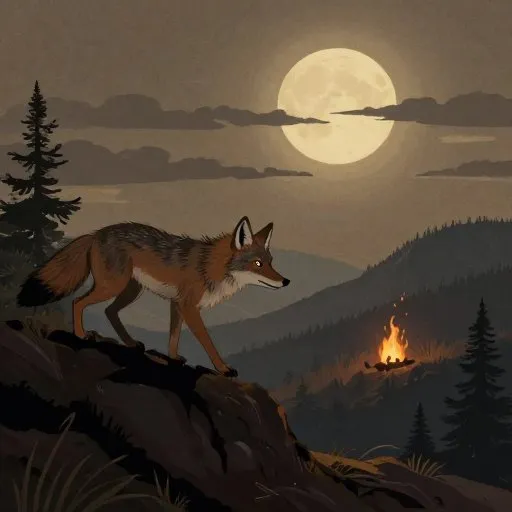
Here is Coyote's great insight: he could not do it alone.
This deserves more credit than it usually gets. Coyote is many things, but humble is not on the list. For him to look at a situation and say I need help means the situation is genuinely hard. The Fire Beings had sentries. They had the high ground. They had fire, which, if you need reminding, was the entire thing they were protecting. Running straight up a mountain and grabbing a burning brand and running back down was a plan that ended one way.
So he organized a relay.
He went to the animals. He explained the situation. He laid out the route from the mountain back to the people. He stationed them at intervals through the forest and the scrub and the dry grass hills below. Each animal at a post. Each one knowing where the next one waited. If Coyote came running with fire and passed it along before he dropped it, the chain would continue. Every animal adding its best speed to the distance. The Fire Beings could chase one runner. They could not chase all of them.
Think about the logistics. This is coordination. This is planning. This is Coyote doing something neither simple nor stupid, which catches people off guard every time, because Coyote has a reputation for running on instinct and chaos. And he does, usually. But he is also clever in ways that don't get the attention they deserve.
He placed the fastest animals nearest the mountain, where their speed would matter most, in the first stretch when the Fire Beings would still be close. He placed the slower animals further down the line, where the gap between runners would have widened and the pursuit would have thinned. And he put Frog near the very end, down where the water and the wood waited. We'll get to why.
Then he climbed the mountain. Alone.
He went up at night.
The Fire Beings had their fire burning on the peak, as they always did. Light that could probably be seen for miles across the desert. Coyote would have shown up against it. So he moved carefully, staying in the dark edges, approaching from the side where the glow didn't quite reach.
What he was looking for was a moment of distraction. The Fire Beings had to sleep, or at least rest. They had to look away sometime. They had guarded fire for so long they had probably gotten comfortable. Comfortable means careless, eventually. Comfortable means the gap between one lookout and the next stretches a little longer, because nothing has ever come to steal the fire and there's no particular reason tonight should be different.
And then there was a moment. The stories don't all agree on what caused it. In some tellings Coyote simply waited for the right instant. In others he made a distraction. Either way, there was a gap. And Coyote moved.
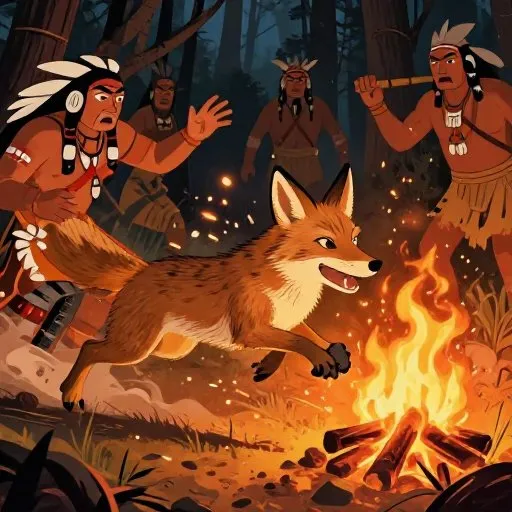
He grabbed a burning branch from the fire and ran.
The shout went up immediately. The Fire Beings came after him.
Here is what the Paiute and Shoshone tellings understand about a foot race that a lot of tidy hero stories miss: running with fire is not the same as running without it. You are holding something that is trying to burn you. You are holding something that needs air to survive, which means you cannot cradle it close, you have to hold it out and away, and that throws your balance off. You are holding something that marks you perfectly visible to anything chasing you. There is no version of this that is clean.
Coyote ran. The Fire Beings ran after him. He got down off the mountain and into the trees with them close behind, and at the first post he shoved the burning branch into the next animal's grip and that animal ran.
The relay had begun.
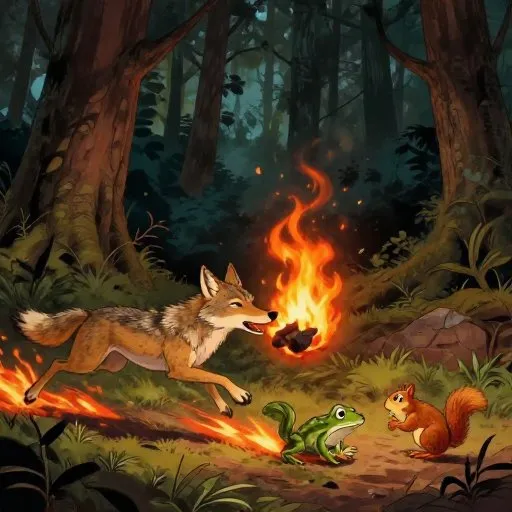
Each animal took the fire as far as it could go.
The stories name different animals in different tellings. The Shoshone and Paiute versions are not a single fixed text, they're an oral tradition, alive and varying by community and storyteller. But across the versions the shape holds: fast animals near the mountain, slower animals further along, each one doing its part.
When one animal tired, another took the fire. When one was about to be caught, the next was already running. The Fire Beings could not gain ground on the whole relay. They would close on one runner and that runner would hand off and drop back, and a fresh animal would be ahead of them again. Chase it long enough and the situation doesn't improve. It gets worse. Because with every handoff the fire gets further from the mountain, and the Fire Beings get further from home.
But the chain almost broke.
Near the end of the relay, Frog caught the fire. In some versions this is where it gets desperate. Frog is not fast. Frog is not built for a mountain foot race across the high desert. The Fire Beings caught up. They grabbed Frog by the tail to stop him.
Frog did the only thing he could think of. He swallowed the fire.
The Fire Beings pulled so hard on his tail that it came off in their hands. This is why, various Paiute and Shoshone tellers have explained over the generations, frogs have no tails. The tail stayed with the Fire Beings. Frog got away. And the fire went with him, inside him, safe.
When Frog was clear of them, he spit the fire out.
He spit it into Wood.
Not a particular piece of wood. Into wood. Into the material itself. This is the part of the story that explains something real about the physical world. The fire went into wood and stayed there, hidden inside it, and that is why, if you rub two dry sticks together long enough, the fire comes back. It was always in there. Frog put it there. You're just reminding it.
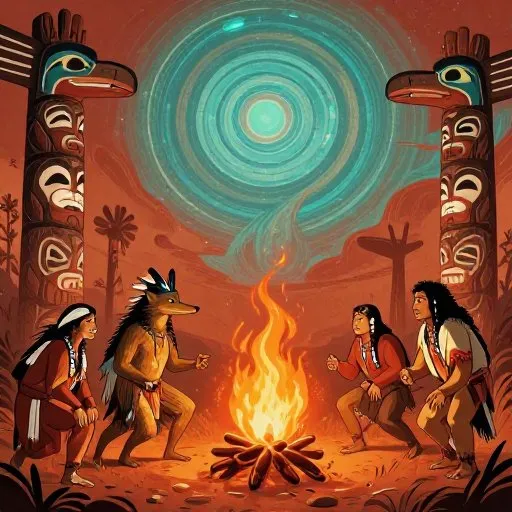
The people got fire.
The Fire Beings went back to their mountain. The monopoly was broken and there was nothing to be done about that now. Fire was everywhere, inside the wood, inside the world, available to anyone who knew how to call it back out. You cannot un-teach a thing that's been learned. You cannot re-hoard what's already been handed out.
The people were warm. They cooked meat. They lived through winters that would have killed them before.
And Coyote got no particular credit for it. That's the other thing the stories understand. Coyote did not want a monument. He probably wasn't thinking about monuments when he ran up that mountain. He was thinking about the problem, and the solution, and whether it would work. When it worked, he moved on to the next thing. Coyote always moves on to the next thing.
But here is what the story really is, underneath the chase and the theft and the animal relay. It's a story about what happens when one group of beings has something everyone else needs. The Fire Beings aren't demons. They're just hoarding. And the answer isn't a hero. There's no single champion who rides in and defeats them. The answer is a trickster who admitted he couldn't do it alone, and a crowd of animals who each agreed to do their small part, and the plain fact that if enough different creatures run far enough in the same direction, you can move fire from a mountain to everywhere.
Nobody got the credit. Nobody needed to. The fire was in the wood now.
Rub two sticks together sometime. Think about Frog.
Once you know this story, you start seeing it everywhere.
The theft of fire is one of the oldest ideas human beings tell each other. Someone powerful keeps the fire. Someone clever takes it and gives it to the rest of us, usually at a cost. Across the ocean and across the centuries, the Greeks told it about Prometheus, who stole fire from the gods in a hollow fennel stalk and paid for it with thirty thousand years chained to a rock. Same motif, different world: the guarded flame, the daring thief, the gift that changes everything for the people below. Both traditions share the stolen-fire motif, and you can read our companion telling, <a href="https://mythwink.com/stories/prometheus-steals-fire">Prometheus Steals Fire</a>, and watch the same shape appear in a completely unrelated tradition.
The Shoshone and Paiute version does one thing the Greek version doesn't, and it's worth sitting with. Prometheus acts alone. He is the lone genius, the single sufferer, the one name we remember. Coyote's fire gets stolen by a committee. A trickster who admits he needs help, and then Frog, and a line of animals whose names shift from teller to teller, each carrying the flame a little further. The Greek story is about a hero. This story is about a relay. Neither is wrong. They're just answering the same question with different values.
If you want more of this tradition, the wider world of Coyote and the other Great Basin and Plateau stories lives in our <a href="https://mythwink.com/categories/native-american">Native American mythology</a> collection. Coyote is emphatically not one character. The Shoshone Coyote, the Nez Perce Coyote, the Navajo Coyote share a name and a profile and almost nothing else, and the best way in is always the telling recorded with the specific nation whose story you're reading.
The fire-theft motif is a good thread to pull. Pull it far enough and you find that people who never met, on continents that never touched, all decided the story of how we got warm was worth telling the same way. Someone had it. Someone took it. Now it belongs to all of us.

The story ends with fire hidden inside wood. That is not only a good line. It is an accurate description of how Great Basin peoples actually made fire, and the tale is a set of instructions dressed as a chase.
The method is friction. You take a dry spindle, a straight stick of the right wood, and you spin its tip against a dry fireboard until the two surfaces grind out fine, dark dust. Keep spinning and the dust heats past the point where it can stay cold. It gathers in a notch cut in the board, it starts to smoke, and if you have done everything right a single glowing coal forms, no bigger than a grain. That coal is the fire coming back out of the wood. Frog put it there. You are reminding it.
Two tools do this work. The hand drill is the simpler one: the spindle spun between flat palms, pressed down and rolled fast, the hands walking down the shaft and starting again at the top. It is hard, and it wants dry weather and dry wood. The bow drill adds a small curved bow with a loose cord looped once around the spindle, so a back-and-forth saw of the bow spins the spindle far faster than palms can manage. Faster spin, more heat, a coal in less time.
Then comes the part the drill cannot finish. You tip the coal into a loose bundle of the driest tinder you have, shredded bark or fine dry grass, and you breathe. Slow at first, then steady, feeding it air the way the burning brand needed air on the mountainside. The smoke thickens, the bundle browns, and then it catches all at once into open flame.
This is why the story survived. An oral tradition is a way of storing knowledge without writing it down, and a people who lived through Great Basin winters could not afford to lose the knowledge of fire. Wrap the technique in a chase with a trickster and a frog and a lost tail, and a child hears it once and keeps it for life. The myth is memorable on purpose. The survival technology rides inside the story, exactly the way the fire rides inside the wood.
Get on the list before the myths do.
New retellings from world mythology, gods behaving badly included. This list is just starting, so nothing has gone out yet, only a place in line.
Nothing has been sent from this list yet. You'll be among the first to hear once new myths start going out, and you can leave anytime.