← All Stories

The Chinese myth of Hou Yi the archer and Chang'e who flew to the moon. A love story, a theft, and the origin of the Mid-Autumn Festival. Chinese myth, told properly.

Chang'e and the Moon

Mythwink

Chang'e and the Moon

He shot nine suns out of the sky. She drank his reward. They never saw each other again.

1Ten Suns

Chapter 1: Ten Suns

In the beginning, there were ten suns.

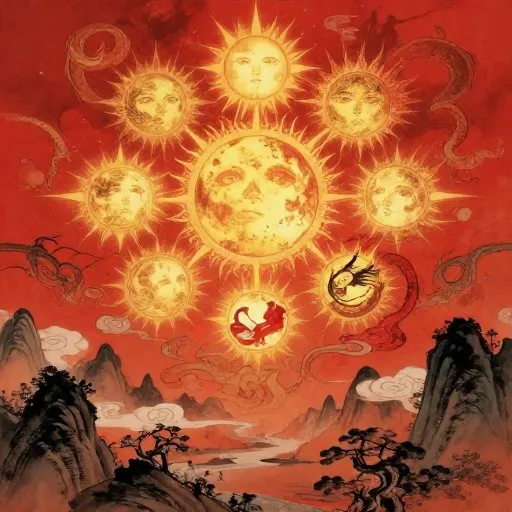
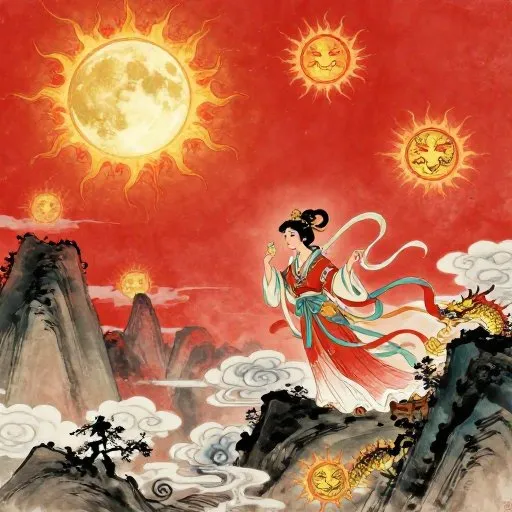
This is not a metaphor. The Chinese cosmological tradition, as recorded in the Huainanzi and the Shan Hai Jing, held that there were ten suns, each one a divine bird, a three-legged golden crow called a juncrow, living in a mulberry tree in the eastern sea. Each morning, one of them would ride a carriage driven by their mother, the goddess Xihe, across the sky. One sun per day, rotating through the ten, so the earth was never without light but also never overwhelmed.

This system worked fine for a long time.

Then all ten decided to rise at once.

The texts don't explain why. Maybe they got bored. Maybe they argued about the schedule. Maybe the rotation system broke down through divine carelessness. The Huainanzi, written in the second century BCE, simply states that all ten suns appeared in the sky together and does not linger on the reason, the way a historian sometimes doesn't linger on the reason a disaster started because the disaster itself is what matters.

The effect was immediate and total. Crops died. Rivers boiled away. Forests caught fire. The mountains scorched. People could not go outside. The Emperor Yao, the legendary sage-king, watched his kingdom become uninhabitable and did what any ruler in a myth does when something supernatural is happening: he asked a specialist.

He summoned Hou Yi.

Hou Yi was a divine archer. Not metaphorically divine. He was a god, serving in heaven, sent down to assist humanity because the situation had moved beyond the human capacity to address. He came with a red bow, white arrows, and instructions from the Jade Emperor to scare the suns back into line.

Scare. That was the instruction. Not shoot. Scare.

2The Nine Birds

Chapter 2: The Nine Birds

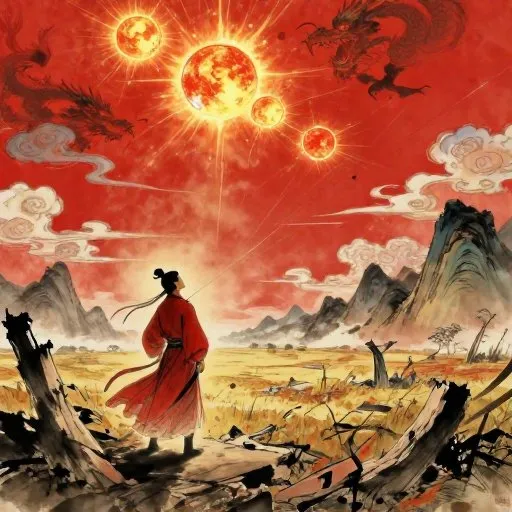
Hou Yi stood in the ruined fields of the earth, looked up at ten suns blazing in the sky, and shot one of them.

It fell. The divine golden crow inside it fell with it. The Shan Hai Jing describes a three-legged golden bird, a juncrow, the creature that IS the sun, that became simply a bird falling from the sky while the light went out. Nine suns left. He shot another.

Eight.

Seven.

He was very good at this. The Huainanzi doesn't describe him hesitating or adjusting his aim or having any difficulty whatsoever. One arrow. One sun. A man working through a list.

The Emperor Yao, watching this from below, suddenly realized something: if all the suns died, there would be no light at all. He needed exactly one sun left. He slipped away and quietly removed one arrow from Hou Yi's quiver without telling him.

Hou Yi reached for his tenth arrow. It wasn't there. He had nine dead suns, nine fallen birds, nine celestial fires burning on the ground, and no more arrows. One sun remained in the sky. Which was, it turned out, the correct number.

The sources are not unanimous on whether Hou Yi noticed the missing arrow or simply stopped at nine. Some versions suggest he counted wrong. Most suggest Yao's intervention was the reason. Either way: one sun, burning normally, doing the job the way it had always been meant to do.

The earth recovered. Slowly. The rivers filled back up. The forests, the ones that had any trees left, began to grow. The people came back outside.

Hou Yi had saved humanity by destroying nine divine birds, the children of a goddess, on the orders of a Jade Emperor who hadn't told him to go quite that far.

Heaven noticed. This was not a comfortable situation for anyone.
3The Elixir

Chapter 3: The Elixir

The reward for saving humanity was exile.

The Jade Emperor, whose own divine children Hou Yi had shot out of the sky, banished him. Him and his wife, Chang'e, both stripped of their immortality and sent to live as mortals on the earth. Among the people Hou Yi had just saved, who would age, and get sick, and die. As Hou Yi and Chang'e would now also do.

The different sources give different versions of what happened between the exile and what comes next. The Huainanzi, the oldest source, is sparse. Later texts add detail. The outline is consistent: Hou Yi heard that the Queen Mother of the West, Xi Wangmu, who lived on the mythical Kunlun Mountain in the west, had an elixir of immortality. Not enough to make two people immortal. Enough for one person to return to heaven, or enough for two people to remain human but live forever. There was no version where both of them went home.

He made the journey. This is not a small thing. Kunlun Mountain in the mythological tradition was not a real mountain you could find on a map. It was the axis mundi, the pillar connecting earth to heaven, the most distant possible place. He went, and he came back, and he had the elixir.

He hid it. He needed to think.

The Huainanzi doesn't tell us what he was thinking about for those days or weeks. But a man who had been a god, who had saved the world, who was now living out a mortal span because of it, holding a bottle with exactly enough medicine for one person to escape that fate: he had a choice to make and it was not an easy one.

He hid it under the rafters. He didn't drink it. He didn't give it to Chang'e. He put it where he could think about it.

4The Moon

Chapter 4: The Moon

This is where the sources disagree most sharply, and the disagreement matters.

Version one: a man named Feng Meng, a student of Hou Yi's, knew about the elixir. One day when Hou Yi was out hunting, Feng Meng came to the house with a sword and threatened Chang'e. Drink it or he would take it by force. She drank it rather than let it fall to someone like him.

Version two: Chang'e was simply curious. She found the elixir, opened it, and drank it. An impulse. A moment of weakness. A choice she made.

Version three: she drank it knowing what it would do, wanting immortality, and left.

The earliest texts lean toward the first version. The later ones are more complicated. The question of why she drank it has been argued by Chinese scholars for two thousand years, and there is no settled answer, which is probably the point. A story where her motivation is clear is a story about a theft or a rescue or a sin. A story where her motivation is ambiguous is a story about people, and what they do when they're frightened or desperate or tempted, and how you can love someone and still not be able to explain what they did.

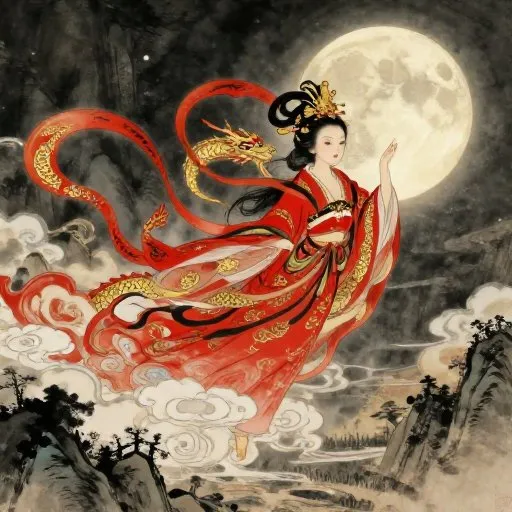
She drank the elixir. She rose from the ground. She rose through the roof, through the air, up through the sky. She had taken enough for one person to ascend to heaven, but she had taken it as a mortal woman and not a goddess, and her body carried her to the moon rather than back to the celestial court.

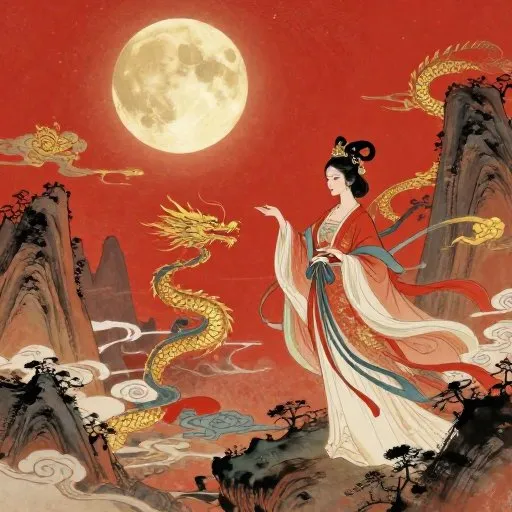
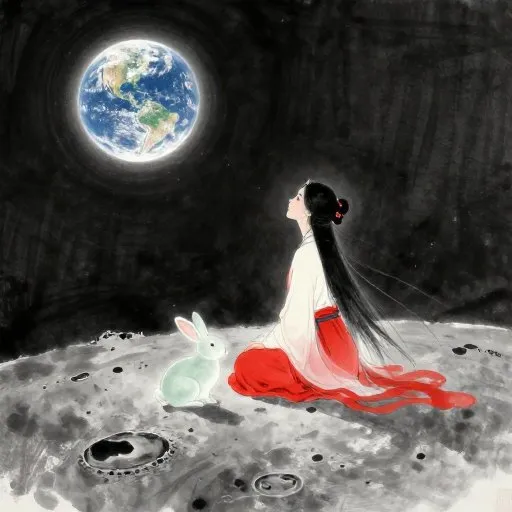
She arrived at a cold, white place. She was alone. She had the company of a jade rabbit, which the myths place on the moon as a companion, grinding the herbs for the elixir of immortality with a mortar and pestle for eternity, which is either a comfort or a punishment depending on how you look at it.

Hou Yi came home to an empty house. He looked up. He saw the moon, which was brighter than usual. He understood.

5The Festival

Chapter 5: The Festival

He didn't stop loving her. That's the part the story insists on.

He set out an altar with her favorite foods. Honey cakes. Melons. He made offerings to the moon. He stood outside at night and looked up.

The tradition says he could sometimes see her there, a shadow in the light. Whether that was real or grief is a question the myth doesn't answer. The Chinese tradition does not always distinguish between the two.

Hou Yi returned to work. He shot the giant boar Feng Xi that was ravaging the lands. He killed the great serpent Zao He in the great marsh. He shot the man-eating beast Zaochi. He kept going. He was a divine archer living as a mortal, and the world was full of things that needed shooting. The stories kept piling up around him: hero, monster-slayer, the man who once saved the sun. His name was everywhere.

He died eventually. Mortals do. The story doesn't dwell on it.

Chang'e is still on the moon. That's not a metaphor either: the Chinese space exploration program, begun in the early 2000s, named its lunar missions the Chang'e program. The first Chang'e spacecraft reached the moon in 2007. As of this writing, Chang'e 5 brought back lunar soil samples in 2020, and Chang'e 6 followed in 2024. A country that has been telling her story for two thousand years went to find her.

The Mid-Autumn Festival, celebrated on the fifteenth day of the eighth lunar month when the moon is fullest and brightest, has honored her for centuries. Families gather. They eat mooncakes: round, dense, filled with lotus paste or red bean or salted egg yolk. They look at the moon together. The modern holiday has layers, agricultural traditions and harvest celebrations folded in over the centuries, but the oldest thread is Chang'e, alone in the cold light, and the people on the ground who still remember her.

The mooncake is round because the moon is round because longing needs a shape you can hold in your hands.

Mythology Notes