← All Stories

The Ashanti myth of Anansi and Onini the python: how a spider tricked the world's most dangerous snake into proving its own length, and why all stories belong to the spider.

Anansi and the Python

Mythwink

Anansi and the Python

He convinced a python to tie itself up. Using the python's own ego. It worked.

1The Price of All Stories

Chapter 1: The Price of All Stories

The stories of the world were not free.

Before Anansi, the Ashanti tradition holds that the stories belonged to Nyame, the sky god. Not freely given. Owned. Kept. If you wanted to tell a story, a real story, the kind that teaches and illuminates and carries the weight of truth from one generation to the next, you were borrowing from Nyame's collection. The stories had a price on them.

Anansi the Spider wanted to buy them.

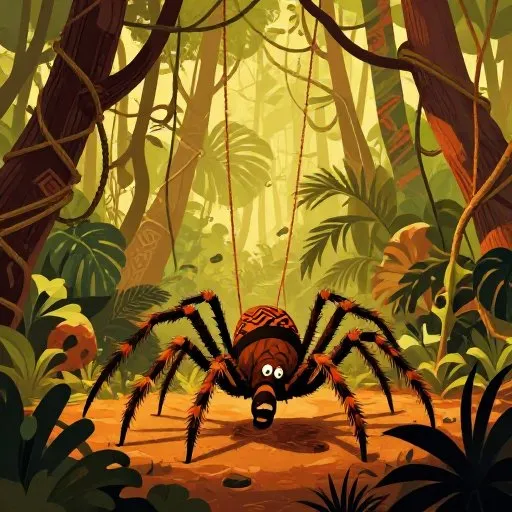
Think about this for a moment. A spider wanted to purchase the rights to all stories in existence from the god who owned them. Not a warrior. Not a king. Not someone with armies or wealth or divine lineage. A spider. Small, many-legged, living in the corners of things.

Nyame named his price. He made it impossible on purpose. This was not unusual. When gods name prices in West African mythology, they tend to name the thing that seems most clearly uncatchable. In this case, the price was four specific things: Onini the great python, Osebo the leopard, the Mboro hornets, and the Mmoboro forest fairy. Live, presumably, since dead things are easier. All four had to be brought to Nyame.

Bring me the python. Bring me the leopard. Bring me the hornets and the fairy. Do that, and the stories are yours.

Anansi went home and consulted his wife Aso.

This is important. Anansi is brilliant, but the plans in these stories often begin with Aso. He comes home, describes the problem, and she tells him what to do. She is the strategist. He is the executor. A lot of mythology gives the clever spider all the credit, but the Ashanti sources are honest: Anansi and his wife figured this out together.

She told him how to catch the python.
2The Argument About Length

Chapter 2: The Argument About Length

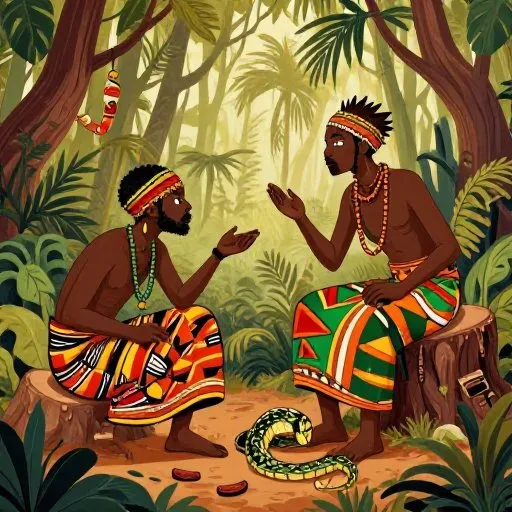
The plan required Anansi to go to Onini and pretend to be in the middle of a domestic disagreement.

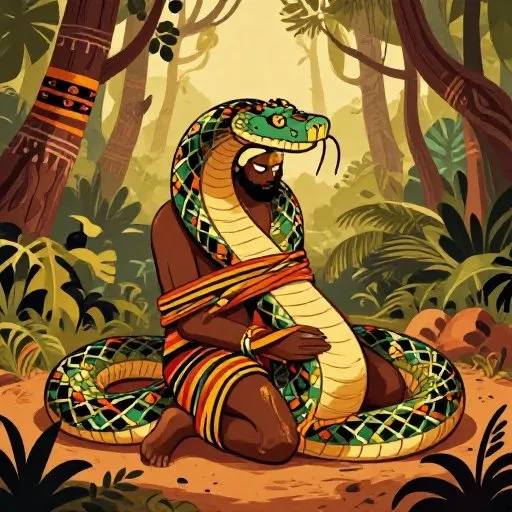
Here are the facts about Onini. He was the largest python in the world. Not the largest python in the forest. The largest python in existence. The Ashanti sources don't mess around with this. Onini was the serpent against which all other serpents were measured, and the measurement always came out in his favor. He was ancient, massive, and he knew it.

This is the tool Anansi needed.

He cut a long palm branch. He went to the forest where Onini lived, and he began talking to himself out loud, in the way of someone carrying on a dispute that had started somewhere else. He muttered: she's wrong. She's completely wrong. I told her but she won't listen.

Onini, as anticipated, noticed. The python raised his head and asked what the problem was.

Anansi explained. His wife Aso had said that Onini was shorter than this palm branch. He, Anansi, had argued otherwise. He had said Onini was certainly longer. But Aso refused to believe him. He had come to measure so he could prove her wrong.

Onini looked at the palm branch.

You want to understand what Anansi just did. He took the biggest, most powerful, most dangerous creature in the forest, a python whose vanity about its own size was proportional to its actual size, and he handed it a reason to cooperate. Not a threat. Not a bribe. A problem. A problem that Onini could solve by doing exactly what Anansi needed him to do.

The python stretched out alongside the palm branch. He laid himself flat to be measured.

3The Rope

Chapter 3: The Rope

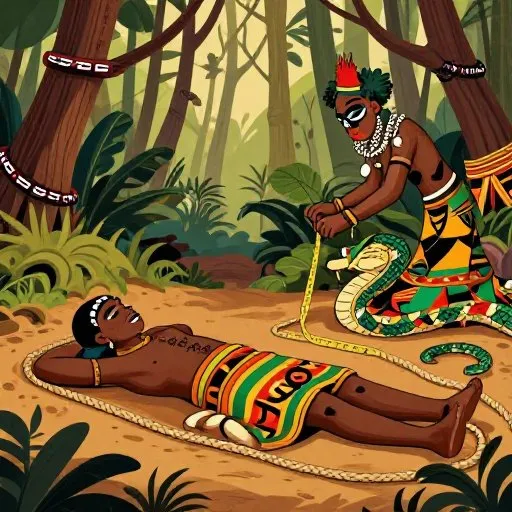
While Onini was stretched out being helpful, Anansi measured.

He made a show of it. He looked along the length. He frowned in a considering way. He walked from one end to the other. The branch is a little short here, he said. Could you stretch just a bit more? Onini stretched. Could you straighten your head? Onini straightened.

And while Onini was fully extended, fully cooperative, fully committed to the project of proving his own length, Anansi tied the rope.

One end of the palm branch to one end of Onini. Then the next length. Then the next. He worked from the tail toward the head, binding as he went, and Onini was so occupied with the business of lying straight and being measured that by the time he understood what was happening, it was already done.

The sources describe Anansi tying quickly. You can imagine why. The moment of maximum danger was the moment Onini understood. Until that moment, Onini was cooperating. After that moment, Onini would stop cooperating, and an untied Onini understanding he had been tricked was not a situation with good outcomes for a spider.

Anansi finished the binding before the moment arrived. Onini was secured to the palm branch. His own pride had been the mechanism. The argument about his wife had been invented for exactly this purpose. The entire encounter had been designed not to overpower Onini but to give Onini a reason to put himself in the position where he could be secured.

That's the thing about Anansi. He never fights what he can redirect. Never opposes what he can aim at itself. The python's strength was never the obstacle. The python's vanity was the tool.

Anansi brought Onini to Nyame.

4One of Four

Chapter 4: One of Four

Nyame looked at the python. He acknowledged the task was done. One of four.

Three more to go.

The hornets went next. Anansi used a calabash and an argument about rain: he pretended to shelter the hornets from a sudden downpour by holding the calabash over their nest and suggesting they move inside for their own comfort. When they did, he stopped the opening. Osebo the leopard was caught in a pit trap. The forest fairy was caught through a tar doll, the kind of trap where the victim gets more stuck the more they struggle, which is also a story you may recognize from other traditions, because it turns up everywhere a clever trickster needs to catch something proud.

Each time, the method was the same. Find what the target wants or fears or believes about itself. Give it a reason to do the thing you need it to do. Stand aside while it does it.

Anansi brought all four to Nyame. The sky god received them. The python. The leopard. The hornets. The fairy. All alive. All caught by a spider using nothing but wit and the willingness to ask his wife for advice before going out.

Nyame gave Anansi the stories.

The Ashanti tradition is explicit about this moment and what it means. Before Anansi bought the stories from Nyame, they were called the stories of Nyame. After, they were called Anansesem: Anansi's stories. And they have been called that ever since. Every story, every folktale, every tale told at night by firelight to children who need to know how the world works, belongs to a spider who bought them from a god with cleverness and a palm branch.

5Why the Spider Owns Everything

Chapter 5: Why the Spider Owns Everything

There's a reason the stories belong to Anansi and not to a hero or a king.

Kings have armies. Heroes have strength. A spider has nothing except the ability to understand how other creatures think, and the patience to let that understanding do the work. Anansi does not win by being stronger than the python. He wins by knowing exactly what the python cares about and giving it a way to care about it at exactly the wrong moment.

This is a specific kind of intelligence that gets recognized differently across different cultures. Some traditions celebrate the warrior. Some celebrate the prophet. The Ashanti tradition, in making Anansi the master of all stories, is saying something about what kind of intelligence is worth the most. Not the kind that breaks things. The kind that redirects them.

Anansi stories spread far from West Africa. They traveled to the Caribbean with the people taken from the Gold Coast during the transatlantic slave trade. In Jamaica, in Trinidad, in Barbados, in South Carolina and Georgia, the spider story survived. He became Anansi, Anancy, Nancy, Aunt Nancy. He showed up in every place that needed to know that cleverness survives what strength can't, that the small thing can win against the large thing if it's smarter, that you can buy everything with nothing if you understand the buyer.

The Nigerian author and scholar Chinua Achebe wrote about this tradition. The Guyanese author Wilson Harris wrote about it. Neil Gaiman wrote a novel in which Anansi is explicitly the god of stories and his sons are trying to recover what belongs to him. The spider is in everything. The spider was always in everything.

He bought those rights fair and square. He brought the python and the leopard and the hornets and the fairy. The price was paid.

The stories are his.

Mythology Notes