Mythwink
Anansi and the Box of Stories
The sky god owned every story ever told. Anansi was a small spider with a very good plan.
West African (Ashanti) Mythology
Mythwink
The sky god owned every story ever told. Anansi was a small spider with a very good plan.
West African (Ashanti) Mythology
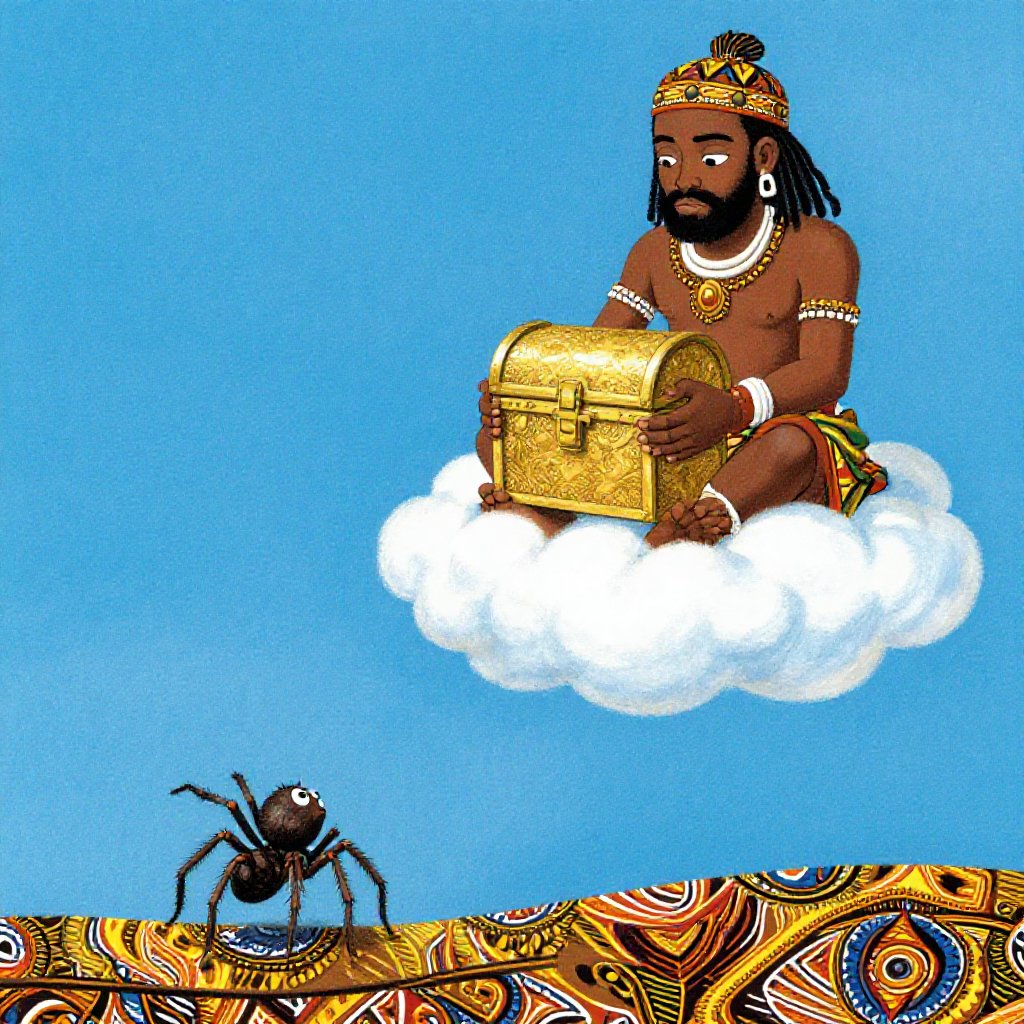
In the beginning, stories did not belong to people. They belonged to Nyame, the sky god, who kept them in a carved wooden box high above the clouds. Every tale ever told, every riddle ever spoken, every story of how the world came to be: all of it sat in that box, and Nyame owned it the way a chief owns his land. When people sat around fires at night and opened their mouths to speak, they had nothing. Silence, mostly. A few observations about the weather.
Anansi the spider had been watching this arrangement for a long time and found it unreasonable. He was not a large creature. He was not a wealthy creature. His eight legs were thin and his body was small and most of the bigger animals did not take him seriously at meals. But he had a mind that moved the way water moves: around every obstacle, through every gap, always finding the low path. And he had decided he wanted the stories.
He spun a thread up through the clouds. He climbed it, which took most of a morning. When he reached Nyame's sky palace and asked to buy the box of stories, the sky god did not laugh. He had seen Anansi before. He named a price he was absolutely certain could not be paid: Onini the python, who could crush a man's ribs without waking from his nap. Mmoboro the hornets, who traveled in a cloud that hummed like a funeral drum. Osebo the leopard, fastest and most arrogant of all the forest cats. And Mmoatia the fairy, who was invisible and whose moods were violent. "Bring me all four," said Nyame, "and the stories are yours."
Nyame was very confident about this price. He had set prices before. This was his best one.
Anansi went home and told his wife Aso what Nyame had said. Aso thought for a moment, then told him exactly what to do. Anansi listened carefully, because a smart man always listens to a smarter person, and then went to cut a long branch from a palm tree.
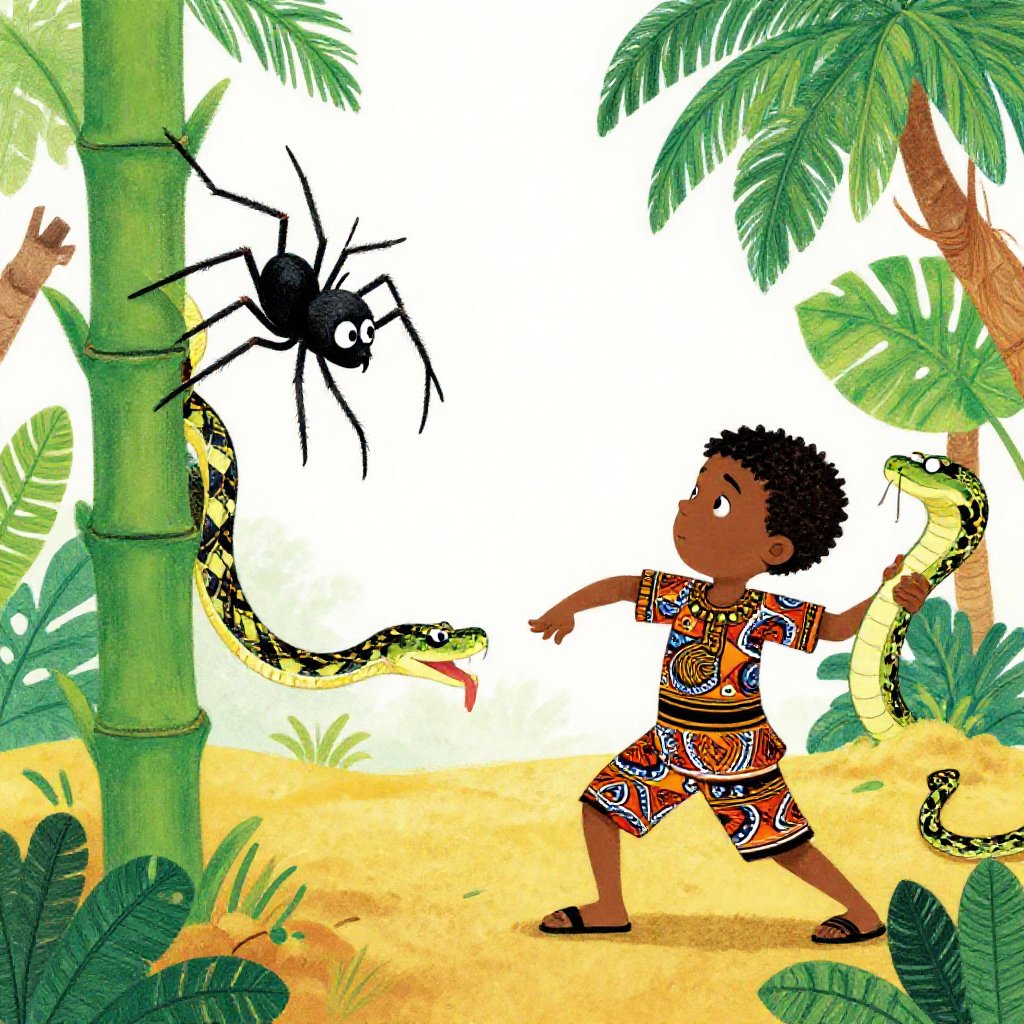
He found Onini the python sunning on a rock beside the river, which is where Onini always was, being too large and confident to bother with hiding. Anansi sat down near him and began talking to himself, loudly, the way a person does when they want to be overheard. He was wondering, he said, whether Onini was really as long as people claimed. His wife said yes, certainly. He himself wasn't so sure. The branch he was carrying was quite long. Probably longer. He dragged it past the python with a look of studied indifference.
Onini, who had strong opinions about his own length, lifted his massive head. Anansi suggested they settle it by measuring. Onini stretched himself alongside the branch. One end, Anansi tied. Then the middle, for reference. Then the other end, to keep things accurate. By the time Onini realized he had been trussed up like a parcel for the market, Anansi was already tightening the last knot. "You see," said Anansi pleasantly, "you are exactly as long as this branch." He carried Onini to the sky.
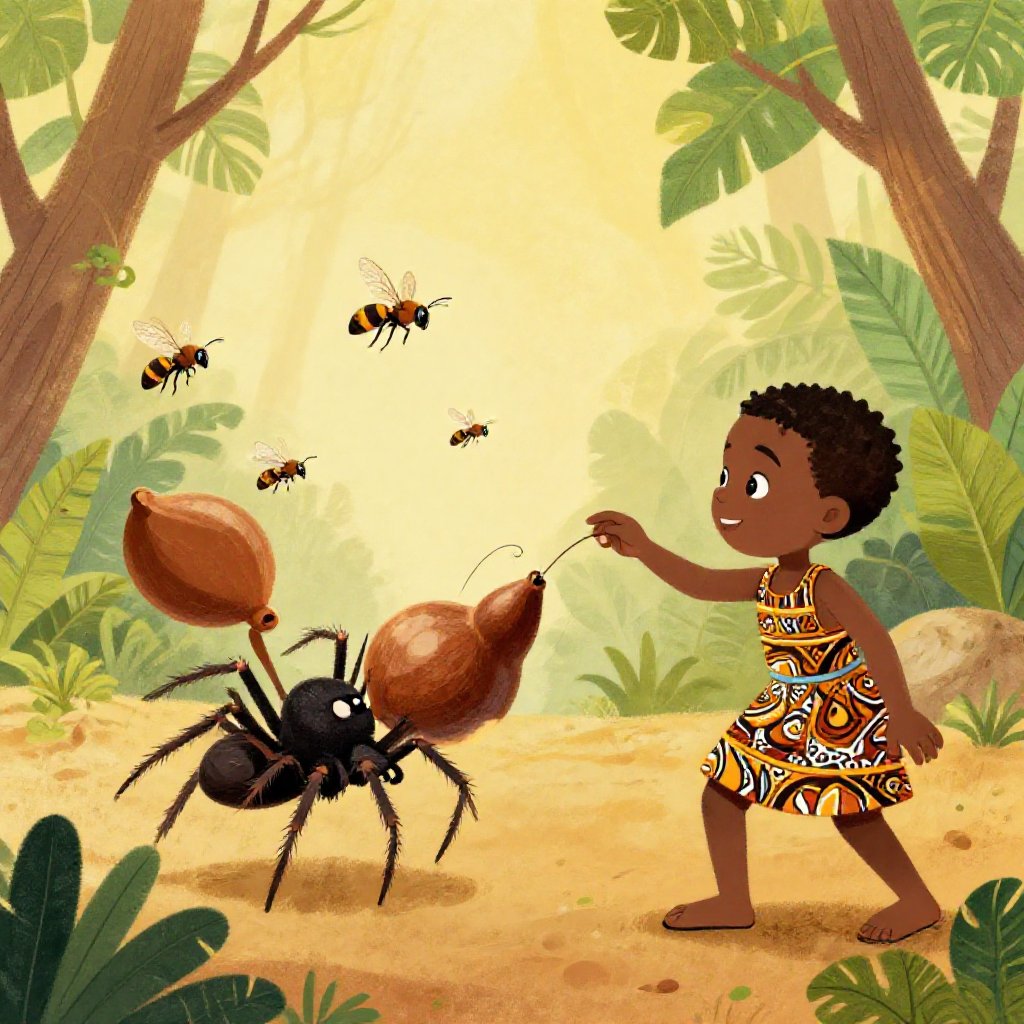
The hornets were next. Mmoboro's swarm lived in a tree at the edge of the forest and had a collective personality best described as looking for a reason. Anansi climbed the tree before dawn with a calabash gourd full of water. When the hornets woke, he was already there, pouring water over himself, over the branch, over the opening of their nest.
He shook his head with the manner of a man who had just understood something unfortunate. "Rain is coming," he announced to no one in particular. The hornets, who feared rain getting into their nest, stirred with alarm. Anansi, still shaking his head, helpfully suggested they wait out the storm inside the calabash he happened to be carrying. It was dry inside. Very roomy. He had done this before himself. The hornets deliberated for approximately the length of time it takes to decide you have no better option, then flew inside.
Anansi plugged the opening with a wad of leaves and kept walking. The buzzing from inside the gourd was loud enough that a passing monkey stared. Anansi gave him a polite nod. He was a man on his way to return a calabash of hornets to the sky god.
This was a perfectly normal morning.
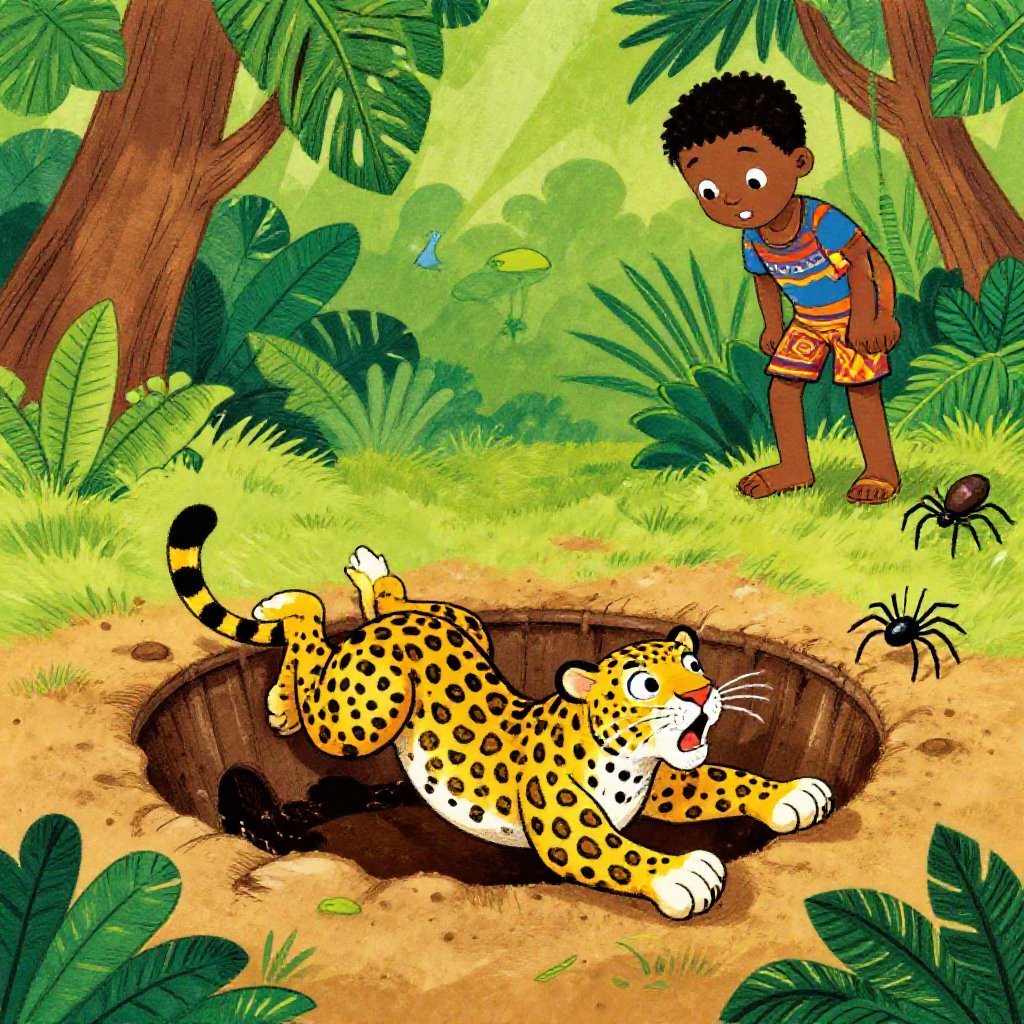
Osebo the leopard required a different approach, because Osebo was neither vain like the python nor credulous like the hornets. Osebo was simply very fast and very good at being a predator. Anansi dug a pit in the middle of one of Osebo's favorite paths and covered it with thin branches and leaves. He went home and slept.
By morning, Osebo had fallen in. The leopard was furious in the way that only an apex predator can be furious: entirely convinced it was someone else's fault. Anansi climbed down, made sympathetic sounds, and offered to help him out with a rope of bent saplings. He bent two young trees down into the pit. Osebo grabbed them. Anansi tied him to them and let the trees spring up. Osebo rose into the air, dangling, inverted, completely unable to scratch anything. Anansi carried him up the thread to the sky, gripping the rope and ignoring the snarling.
Mmoatia was the hardest, because you cannot catch what you cannot see. Anansi carved a wooden doll and smeared it with sticky tree gum, then set it near the roots of the odum tree where Mmoatia was known to dance. He put a bowl of yam beside the doll as an offering. Mmoatia appeared from nowhere, ate the yam, and then struck the doll for not saying thank you. Her hand stuck. She hit it with the other hand. Both hands stuck. She kicked it. Both feet stuck. By the time she finished being outraged, she was completely attached to a doll, which Anansi picked up and carried to Nyame with the leopard under one arm, the hornets rattling in their gourd, and the python draped over both shoulders.
Nyame looked at what Anansi had brought him. He looked for a long time. The greatest chiefs of heaven and earth had come to him with gold and cattle and promises, asking for that box, and he had named this price precisely because it was not payable. And yet.
He gave Anansi the box. And then, because Nyame was a god and not a bureaucrat, he did something more: he announced to all the sky and earth that the stories no longer belonged to him. They belonged to Anansi. He said it in the voice that echoes off mountains: all the stories of the world were henceforth to be called Spider Stories. Anansi sat with the box in his lap and felt the weight of everything ever told pressing up through the wood against his palms.
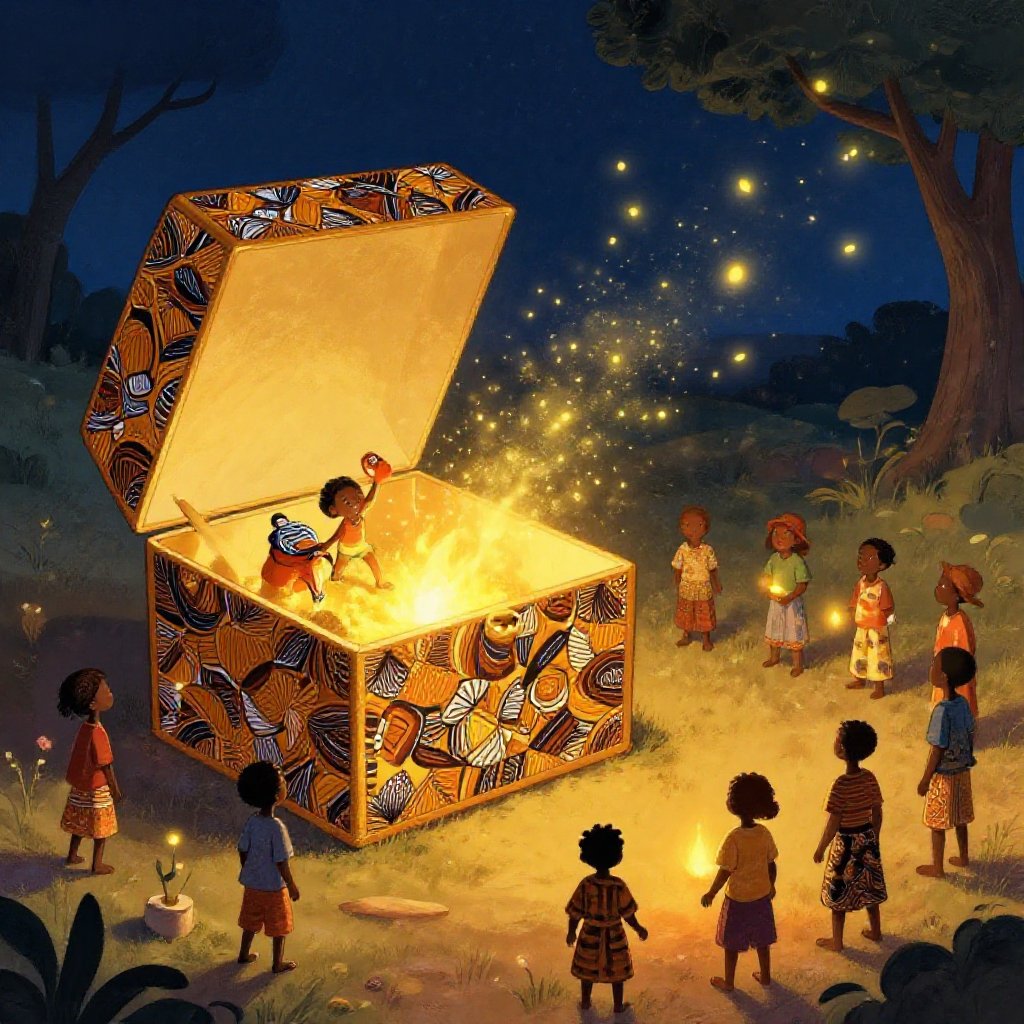
He brought the box down to earth and opened it. The stories came out in every direction. They went into the trees, into the rivers, into the wind, into the mouths of grandmothers sitting by fires at night. They went into the earth and the sky and the bodies of sleeping children. They scattered everywhere and have never been gathered back up, which is why stories are everywhere now, and why the best ones always belong to those clever enough to find them.
This is, naturally, an Anansi story. He would want you to know that.