← All Stories

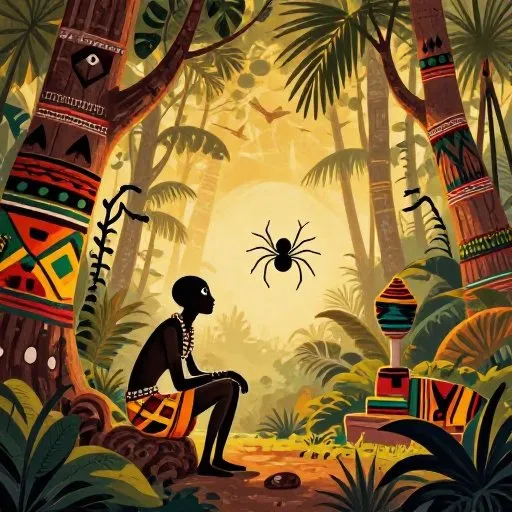
The Ashanti myth of Anansi the spider, who bought all the stories in the world from Nyame the sky god. The price was impossible. He paid it anyway.

Anansi and the Box of Stories

Mythwink

Anansi and the Box of Stories

The sky god owned every story ever told. Anansi was a small spider with a very big plan and a wife who was smarter than both of them.

1The Price

Chapter 1: The Price

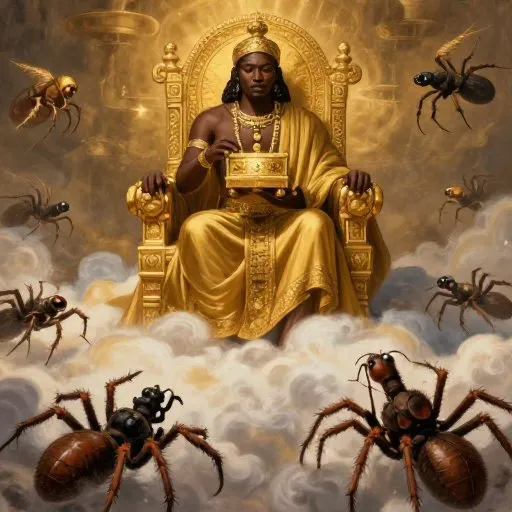
In the beginning, stories did not belong to people. They belonged to Nyame, the sky god of the Ashanti people of present-day Ghana, who kept every story ever told in a carved wooden box high above the clouds. Creation myths, trickster tales, riddles, histories: all of it, sealed in a box, owned by a god who had decided ownership was the point.

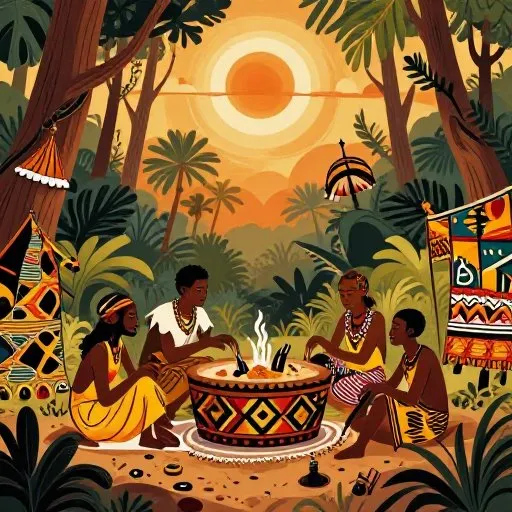
When people sat around fires at night and opened their mouths, they had nothing. Observations about the weather. A few facts about yams. Nothing worth repeating.

Anansi the spider had been watching this arrangement for a long time and found it unreasonable.

He was not large. He was not powerful. His eight legs were thin and his body was small, and the larger animals of the forest did not take him particularly seriously at most occasions. But he had a mind that moved the way water moves: around obstacles, through gaps, always finding the low path while everything else was arguing about the high road. And he had decided he wanted the stories.

He spun a silk thread up through the clouds, which took most of a morning, and climbed it to Nyame's sky palace. He announced he wanted to buy the box of stories.

Nyame did not laugh. He had seen Anansi before. He named a price.

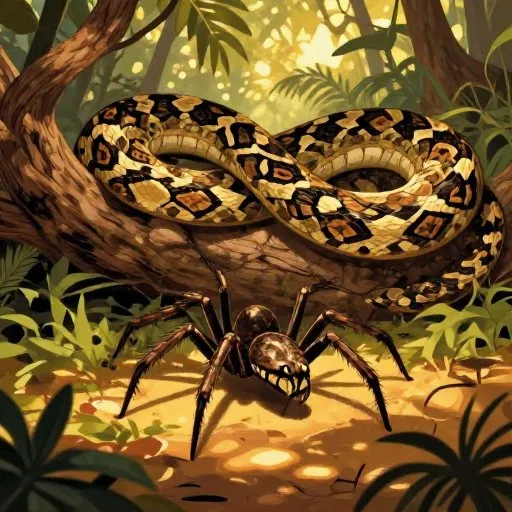
The price was: Onini the python, who could crush a man's ribs without waking from his nap. Mmoboro the hornets, who traveled in a swarm that hummed like a funeral drum and whose sting left grown men unable to think clearly for a day. Osebo the leopard, fastest of all the forest cats and aware of it. And Mmoatia the fairy, who was invisible, unpredictable, and violent about perceived slights.

"Bring me all four," said Nyame, "and the stories are yours."

Nyame had set impossible prices before. This was his best one. He was quite confident about it.
2The Python

Chapter 2: The Python

Anansi went home and told his wife Aso what the price was.

Aso thought for a moment. Then she told him exactly how to catch the python. Anansi listened, because a smart person always listens to a smarter person, and then he went and cut a long branch from a palm tree.

He found Onini sunning on a flat rock by the river, which is where Onini always was. Onini was very long and very confident about it. He had strong opinions about his own length, which Anansi had noticed. Anansi sat down nearby and began talking to himself, loudly, the kind of talking to yourself that is designed to be overheard. He was wondering, he said, whether Onini was really as long as everyone claimed. His wife said yes, obviously. He himself wasn't certain. The branch he was carrying looked longer to him, possibly.

He dragged the branch past the python with an expression of studied indifference.

Onini lifted his massive head. He had opinions about this. Anansi suggested, reasonably, that they settle it by measuring. Onini stretched himself alongside the branch. Anansi tied one end of Onini to the branch. Then the middle, for accuracy. Then the other end, so the comparison would be fair. By the time Onini understood that he had been trussed up like goods for the market, Anansi was tightening the last knot. "You are," said Anansi, with genuine satisfaction, "exactly as long as this branch."

He carried Onini up the silk thread to the sky and delivered him to Nyame.

One.

3The Hornets and What Rain Is For

Chapter 3: The Hornets and What Rain Is For

The hornets were next.

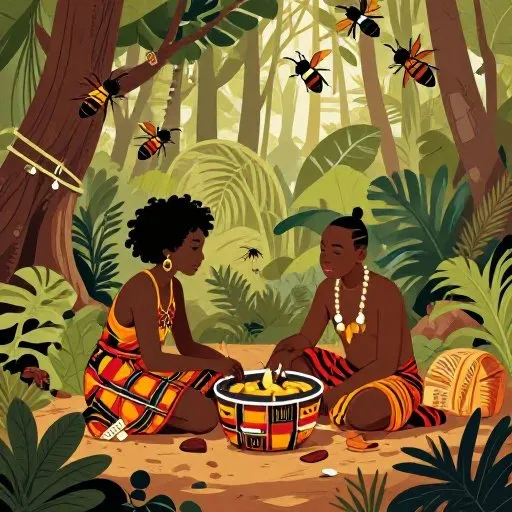
Mmoboro's swarm lived in a tree at the forest's edge and had what you would have to call a collective chip on their shoulder. They were looking, at all times, for a reason. Anansi climbed the tree before dawn with a calabash gourd full of water.

When the hornets woke, he was sitting in the tree above their nest, pouring water over himself, over the branch, over the nest's opening. He shook his head slowly. He sighed. He had the expression of a man who has just understood bad news.

"Rain is coming," he said to no one in particular. "Serious rain."

The hornets stirred. Rain getting into the nest was a problem they had opinions about. Anansi, still shaking his head at the unfortunate weather situation, helpfully pointed out that the calabash he happened to be carrying was dry inside and quite roomy. He had sheltered in one himself during a storm only last week. Excellent option, he said. The hornets deliberated for approximately the length of time it takes to decide you have no better idea, and flew inside.

Anansi plugged the opening with a wad of leaves.

He came down from the tree carrying a calabash full of furious hornets, gave a polite nod to a monkey who was watching him with great interest, and climbed back up the silk thread to the sky.

Two.

4The Leopard and the Fairy

Chapter 4: The Leopard and the Fairy

Osebo required a different approach. The python had vanity. The hornets had fear. Osebo had neither. Osebo was simply a predator, very fast, with no reason to be curious about a spider.

Anansi dug a pit in the middle of one of Osebo's known paths. He covered it with thin branches and leaves. He went home and slept. By morning, Osebo had fallen in. The leopard was furious in the way that only an apex predator who has been outsmarted by a hole can be furious: loud, committed, and entirely convinced it was someone else's fault.

Anansi appeared at the edge of the pit looking concerned. He made sympathetic sounds. He offered to help. He bent two young trees down into the pit, and Osebo grabbed them with both paws. Anansi tied him to the bent trees and released them. The trees sprang up. Osebo rose into the air upside down, dangling, unable to claw anything. Anansi carried him up the thread, ignoring the snarling, which did not stop.

Three.

Mmoatia the fairy was the hardest, because you cannot grab what you cannot see, and you cannot trick what you cannot find. Anansi carved a small wooden doll, smeared it with sticky tree gum, and set it near the base of an odum tree where Mmoatia was known to dance at certain hours. He put a bowl of yam beside the doll as an offering.

Mmoatia appeared from nowhere, ate the yam, and said thank you to the doll. The doll said nothing, because it was a doll. This offended Mmoatia, who had manners and expected reciprocity. She struck the doll for its rudeness. Her hand stuck. She struck it with the other hand. Both hands stuck. She kicked it. Both feet stuck. By the time she had finished expressing her opinion of the doll's behavior, she was completely attached to it and Anansi was picking her up.

He climbed back to the sky with the python over his shoulders, the leopard snarling upside down, the hornets rattling in the gourd, and the fairy doll-stuck and arguing with everyone.

5The Box Opens

Chapter 5: The Box Opens

Nyame looked at what Anansi had laid at his feet.

He looked for a long time. The greatest kings and divine beings had come to him across the centuries with gold, with prayers, with tribute of every kind, asking for that box. He had named this price for those who were most insistent, because the price was not meant to be paid. It was meant to be the answer that ended the conversation.

He had not, apparently, met Anansi before. Not really.

Nyame gave Anansi the box. And then he did something more, something larger: he called out to all the sky and the earth and announced that the stories of the world no longer belonged to him. They belonged to Anansi the spider. He said it in the voice that carries across every level of existence. All the stories of the world were henceforth to be called anansesem: spider stories. Whether Anansi was present or not. Whether the story was about a spider or not. They were his.

Anansi climbed back down the silk thread to earth with the box in his hands. He sat down and opened it.

The stories came out in every direction. They went into the trees and into the rivers and into the wind. They went into the grass and the animals and the mouths of grandmothers sitting beside fires at night. They went into sleeping children and into the earth itself. They scattered so completely that they have never been gathered back up, which is why stories are everywhere now, and why they cannot be owned anymore by anyone, except in the sense that any story belongs to the person telling it at that moment.

This is an Anansi story. He would want you to know that.

The Ashanti people have told it for centuries. It traveled with them, carried across the Atlantic against their will during the slave trade, and it took root in the Caribbean, in Brazil, in the southern United States. Anansi became Aunt Nancy in the American South. He became part of Brer Rabbit. He became a hundred other tricksters. The stories kept scattering, the way they scattered when the box opened.

That is, when you think about it, exactly the point of the story. The stories cannot be locked back in. Not by anyone. Not even by the sky.

Mythology Notes