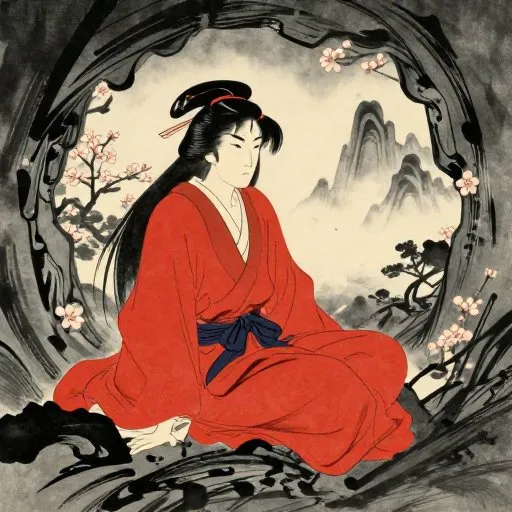
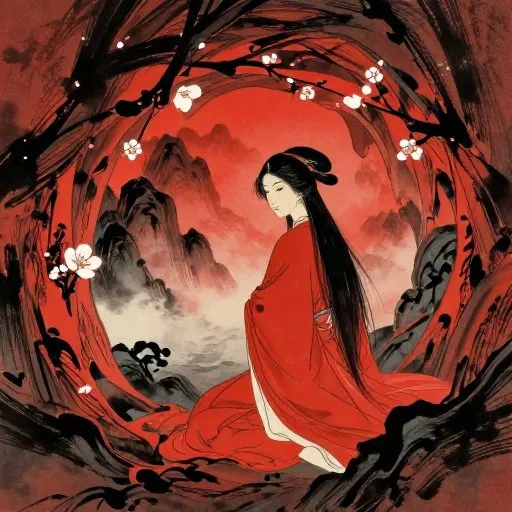
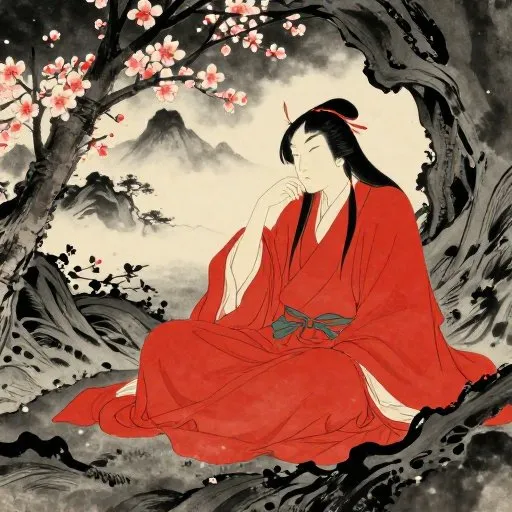
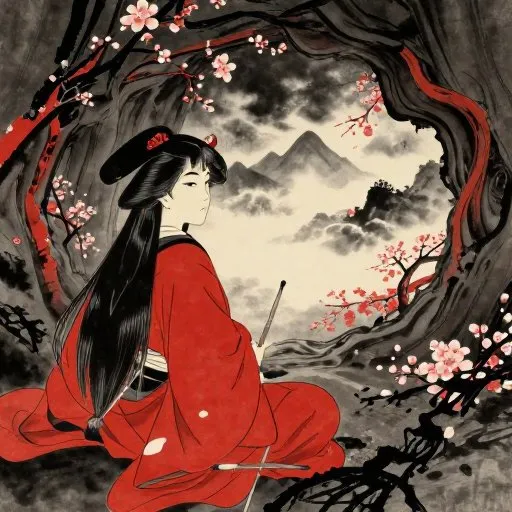
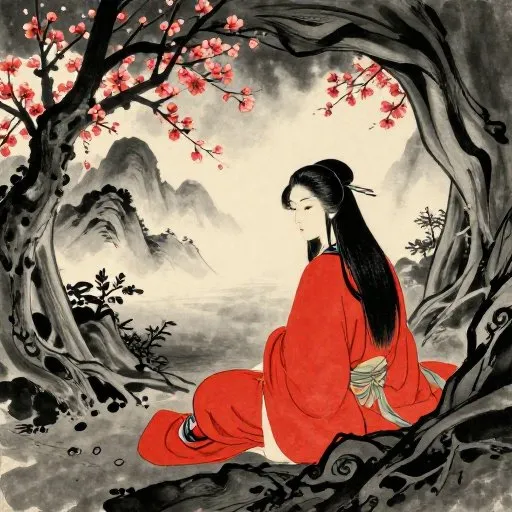
The Japanese myth of Amaterasu: how her brother's rampage drove the sun into a cave, plunging the world into darkness, and what it took to coax her back out again.
Mythwink
The sun god hid in a cave. Eight hundred gods threw a party to get her back out.
Susanoo was angry before he even arrived.
He was the god of storms. Younger brother of Amaterasu, the sun goddess, who ruled the High Plain of Heaven and everything that grew under her light. Their father Izanagi had assigned them their domains after the death of their mother, and by most accounts the division was fair. Amaterasu got the heavens. Susanoo got the seas.
Susanoo did not want the seas.
He wanted to go to the underworld, the land of Yomi, where his dead mother was. He wept and howled and raged to such a degree that mountains shook and seas churned and crops withered and the world was in chaos. Izanagi, in considerable frustration, finally banished him entirely. If you will not rule the seas, you will rule nothing. Go.
Susanoo decided, on his way into exile, to stop by and say goodbye to his sister.
Amaterasu was suspicious from the moment she heard he was coming. She had watched his tantrum from above and she knew what a Susanoo in a mood looked like. She met him armed, in full divine armor, ready for a confrontation. Susanoo swore he had only come to say farewell. He meant no harm.
Whether he meant harm or not is a matter of interpretation. What he did next was not subtle.
He destroyed her rice paddies. The flooding was his doing, or his presence, or simply what happened when a storm god who had been crying for years moved through a farming landscape. Ridges between paddies collapsed. Irrigation ditches filled with debris. He claimed it was an accident. He also filled in the ditches of her weaving hall and broke down its walls and then, in the act that ended whatever tolerance Amaterasu still had, he threw a flayed horse through the roof.
A flayed horse. Through the roof of the weaving hall. Where her attendants were sitting at their looms.
One of the weavers died from the shock of it. The sources are slightly inconsistent about exactly how, but the death was real enough in the telling that it mattered. The weaving hall, the sacred space where the cloth of the gods was made, had been violated. The attendant was dead. And Susanoo was standing in the middle of all of it claiming, probably, that it had not been his intention.
Amaterasu had heard enough.
She went into the cave.
The cave is called Ama-no-Iwato, the Rock Cave of Heaven. It is a real place. There is a shrine at Takachiho in Miyazaki Prefecture, Japan, that marks the location the tradition claims. Ama-no-Iwato Shrine. Visitors go there today. The cave across the river from it is the cave. The place where the sun goddess hid.
She rolled a boulder across the entrance. She went inside. She stayed.
The immediate effect was total. The light left the world. Not gradually, not the slow greying of a cloudy day, but completely. Amaterasu was the sun and she had hidden herself and so there was no sun and therefore there was no light.
The Kojiki, compiled in 712 CE, and the Nihon Shoki, compiled in 720 CE, are the two oldest surviving records of Japanese mythology. Both describe what followed the darkness in essentially the same terms: catastrophe. Crops died. The forests filled with demons who had been waiting for exactly this opportunity. Evil spirits made noise and caused destruction everywhere. The entire cosmic order had been disrupted because the sun goddess was upset and not coming out.
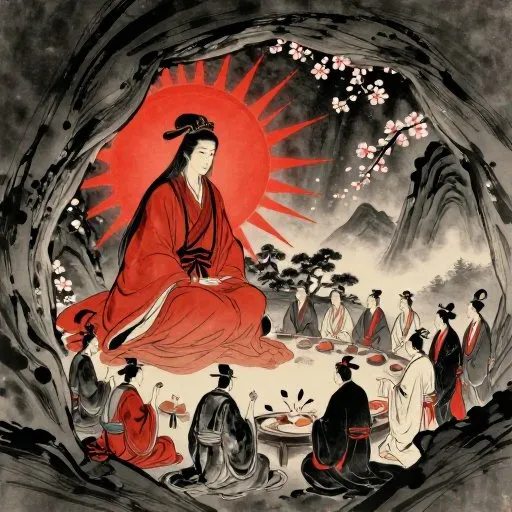
Eight hundred gods gathered outside the cave.
Eight hundred.
They did not gather quietly. This was not a solemn assembly of divine authorities deliberating in hushed tones. This was a crisis meeting with eight hundred attendees, all of whom understood that the situation was urgent and that standard approaches were probably not going to work on a sun goddess who had just watched a horse get thrown through a roof.
They needed a new approach.
The god Omoikane, whose domain was wisdom and thought, came up with the plan.
It was not, you have to admit, the plan anyone would have expected. The world was dark. Demons were running wild. Eight hundred gods were gathered in panic outside a cave. And the Wisest God looked at the situation and said: throw a party.
Not a small party. A party loud enough to make a goddess who had decided she was never coming out curious about what she was missing. They would need roosters to crow, which would normally signal dawn, and which would add to the confusion. They would need lights, torches and fires, because the darkness was complete and they could not see each other. They would need music. And they would need Ame-no-Uzume.
Ame-no-Uzume was the goddess of revelry and the dawn. Her name means something close to "Great Goddess Uzume" and she had a reputation for performing dances that were not precisely solemn. The Kojiki describes what she did in terms that the later texts sometimes soften but the original does not. She overturned a wooden tub and stood on it. She let her clothing fall open. She danced.
The eight hundred gods laughed.
Not politely. Not diplomatically. They laughed with the full genuine volume of eight hundred divine beings who were watching something unexpected happen in the middle of the worst crisis they had experienced in their entire immortal lives. The laughter echoed. The party roared. The sound reached inside the cave.
Amaterasu had been sitting in the dark with her grievance, and outside she could hear eight hundred gods having what sounded like a very good time without her.
She moved the boulder a crack. She looked out.
They had prepared for this moment.
The god Ama-no-Mahitotsu had forged a mirror. The Yata no Kagami. It was large, polished bronze or copper, and it had been hung in a tree facing the entrance of the cave for exactly this reason. When Amaterasu moved the boulder and looked out, the first thing she saw was the mirror.
She saw herself.
She had never seen her reflection before. She was the sun. She was the light. She had no surface to reflect from. She looked at the brightness in the mirror and she was dazzled by it and she leaned further out to see what it was, this shining thing that was apparently outside while she was inside.
And the moment she leaned out, the god Ame-no-Tajikarao, who had been hiding beside the entrance specifically for this purpose, grabbed her hand and pulled her out.
That's it. That is the mechanism. Eight hundred gods built a party around a mirror and a hidden strong man and waited for the sun goddess to get curious enough to lean out, and it worked. She was out. Another god immediately stretched a rope across the entrance of the cave behind her to prevent her from going back in. She was committed now, whether she liked it or not.
The light returned to the world. The demons fled. The crops could grow again.
The mirror that had caught her eye became one of the three Imperial Treasures of Japan. The Yata no Kagami. It is kept today at the Ise Grand Shrine in Mie Prefecture, which is the most sacred Shinto shrine in Japan, dedicated to Amaterasu herself. It is not displayed publicly. It is not photographed. It has not been publicly seen in modern times. The Japanese imperial family regards it as a direct link to the divine ancestor of the dynasty.
There is a sacred mirror in a shrine in Japan because of a plan involving eight hundred gods, a party, and a goddess who could not resist looking at a shining thing in a tree.
He was expelled from heaven.
This was, if you are keeping track, the second major expulsion in the story. He had been expelled from his sea domain by his father. Now the assembled gods expelled him from the heavens entirely. They tore out his beard and his fingernails as punishment, which was a meaningful act in the symbolic vocabulary of Japanese mythology, removing the tokens of his divine power. They sent him down to earth.
He landed in the Izumo region of Japan, which is where his next story takes place. He was not finished being important. He was, in fact, about to become the hero of a different myth entirely, killing an eight-headed serpent and finding a legendary sword in its body. The same character who had been the villain of one myth walked into another one and distinguished himself.
This is a thing worth noticing about Japanese mythology. It is not tidy. The characters are not fixed in their moral categories. Susanoo was wrong to do what he did to his sister. He was expelled for it. And he was also, separately, the hero of the Yamata no Orochi story. Both things are true. The Japanese mythological tradition did not require its figures to be consistent in the way that later narrative traditions might.
The Ama-no-Iwato myth is recorded in both the Kojiki and the Nihon Shoki, compiled in the early 8th century CE under imperial patronage. They were the first written records of Japanese oral tradition, created in part to establish the divine lineage of the imperial family. Amaterasu, as the ancestor of the imperial line, sits at the center of that political theology. The cave story is not incidental. It is the moment when the most important divine being was at her most vulnerable and the world nearly ended, and the fact that it was resolved through cleverness and joy rather than warfare or divine fiat says something real about what the tradition valued.
The mirror is in Ise. Amaterasu is still there, in some sense, behind the inner sanctum where no one who is not the emperor or the chief priests can go. The sun still rises over Japan every morning.
The story says this was not guaranteed. Somebody had to throw a good enough party to make it happen.